Build trust with a professional site showcasing your services, certifications, and customer reviews.
Tell us what you do and our AI writes and builds your auto repair shop site around it.
Build My Auto Repair Shop Site - Free
15,000+businesses trust us
4.7
from 1,200+ reviews
No credit card required
Free plan: 3 template sites · AI building from $20/mo · Cancel anytime
gearhartautomotive.com
Drive more customers to your shop.
What pages does an auto repair shop website need?
Short answer: An auto repair shop website needs a home page with hours and a request-service button, service pages for brakes and diagnostics, a makes-we-service page, an appointment or estimate request form, warranty and policy details, and technician bios. We.Inc's AI builds all of these from a short description of the shop.
Key facts
We.Inc's Starter plan for AI-built auto repair shop sites starts at $20 a month with 250 credits.
The free plan allows up to 3 template sites on a we.inc address with no AI.
In a 2026 measurement of 28 auto repair shop websites, 46 percent had no tap-to-call link.
Monthly US Google searches for auto repair shop website terms are 320 for the base term, per DataForSEO, September 2026.
The service request form emails vehicle year, make, model, mileage and symptoms to the shop instead of syncing to a live bay schedule.
Summary checked against this page on September 25, 2026.
An auto repair shop website should list the services you do (brakes, diagnostics, alignments, state inspections), the makes you work on, your hours and location, and a simple way to request an appointment or estimate. Drivers usually find you on their phone when a warning light comes on, so tap-to-call and directions matter most. we.inc can build all of that from a short description of your shop.
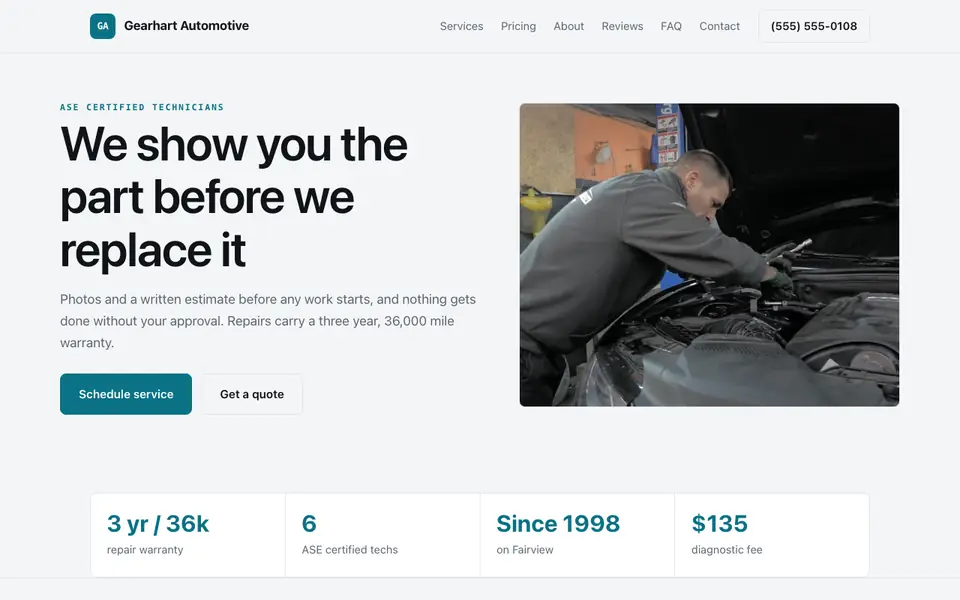
Gearhart Automotive: an example site for auto repair shops, made with We.Inc.
Build trust with a professional site showcasing your services, certifications, and customer reviews.
Pages every auto repair shop website needs
Home: Hours, address, phone and a request-service button in the first screen, because most visitors are mid-problem.
Services: Separate entries for brakes, oil changes, check-engine diagnostics, suspension, AC and inspections match how drivers search.
Makes we service: Owners of European, diesel or hybrid vehicles want to know you have the tools before they tow the car over.
Appointment / estimate request: A form asking year, make, model, mileage and symptoms lets you call back prepared.
Warranty and policies: Explain your parts-and-labour warranty, diagnostic fee, and whether customers can supply their own parts.
About / technicians: Mentioning certifications your techs actually hold, such as ASE, builds trust. List only what is true.
Try this prompt
A website for Kowalski Garage, an independent auto repair shop in Milwaukee. Services: brakes, check-engine diagnostics, alignments, AC recharge, Wisconsin emissions-related repairs. We specialise in Subaru and Toyota. Show hours Monday to Saturday, a click-to-call button, a map, our 12-month parts and labour warranty, and a service request form with year, make, model, mileage and a description of the noise or warning light.
How do I show that my shop can be trusted with a car?
Show the people and the paperwork. A photo of each technician with any certifications they hold, a picture of the actual bays and a clear warranty statement on parts and labour all reassure a nervous driver. Explain how you handle estimates: that you call before doing any work beyond what was agreed. That single promise answers the worry most people bring to a new shop.
Should I write about common repairs on my site?
Yes, a short page for each job you do often works well. Drivers search for symptoms like "grinding when I brake" or "car shakes at highway speed", so explain what usually causes the noise, how you diagnose it and roughly how long the car will be with you. Keep it practical and skip scare tactics. These pages also give you something useful to link from your Google Business Profile.
Three designs that suit an auto repair shop website.
Navy Auto Repair Shop
Orange Sports Car Dealer Hero
Dark Premium Auto Detailing
About auto repair shop website design on we.inc
Auto Repair Shop website design without the agency retainer. Describe the business in plain English and the AI writes and builds the pages around it: your services, your prices, your words.
Features designed for your industry
Services: Display your repair and maintenance services.
Certifications: Showcase ASE certifications and warranties.
Appointments: Let customers book service appointments online.
Who this auto repair shop website design suits
General repair
Specialty repair
Tire shops
Oil change
Brake specialists
What makes an auto repair shop website work
Symptom-first wording
Customers describe grinding, pulling or a flashing light, not part names. Service pages that start with the symptom ("squealing when you brake") meet them where they are.
Request, not live booking
The AI builds a service request form that emails you the vehicle details. It does not sync to a bay schedule; if you use shop management software with online booking, link its booking page instead.
Be clear about diagnostic fees
State whether the diagnostic charge is applied to the repair. It heads off the most common billing dispute before the car arrives.
Towing and after-hours drop-off
If you accept key-drop or partner with a tow company, say so with instructions. It captures breakdown traffic other shops miss.
What it costs
You can publish a garage template free on a we.inc address, but having the AI write your service pages and adding your shop's own domain means a paid plan from $20 a month, with the domain itself usually $10 to $20 per year.
Free for 3 template sites, without AI; AI building from $20 a month. Compare plans
Frequently asked questions
Can customers book a specific time slot?
The site collects appointment requests and emails them to you to confirm. There is no live calendar sync; if your shop software offers online booking, the AI can add a button to it.
Should I list prices?
Many shops post starting prices for fixed jobs like oil changes or inspections and quote everything else after diagnosis. You control what appears.
Can I show which vehicles I work on?
Yes. Ask for a makes-we-service section; it helps owners of less common vehicles decide to call.
Can customers pay online?
You can add payment links through your own Stripe account, for example for deposits. The site does not replace your shop's point-of-sale system.
Will the site show up for “mechanic near me”?
Clear service pages, your address and a complete Google Business Profile help. No builder can guarantee rankings.
In our 2026 measurement of 28 auto repair shops websites, 14% had no search description, 36% had no structured data and 46% had no tap-to-call link. See the full study.