Website Care Plans: Turn One-Off Builds Into Monthly Revenue
A website care plan bundles hosting, updates, backups, security and edits for a monthly fee. What to include, how to price it, and the real revenue math.
A website care plan is a monthly service that keeps a client's site hosted, updated, backed up, secure and improving after launch. For an agency selling $2,000 to $10,000 projects, it turns every launch into income that repeats each month instead of ending at handoff. Published plans run from under $100 to about $600 a month, and most agency plans reviewed by The Admin Bar sat between $100 and $150.
TL;DR: Offer three tiers (around $99, $199 and $399 a month), pitch the plan in the proposal rather than after launch, and cap the time each tier includes. At a 50% attach rate, an agency doing 24 projects a year grows revenue about 20% in year two. Doubling needs a higher attach rate and price, and it shows up as a run rate entering year three, not in year two.
Why do web design agencies add care plans?
Project income resets to zero every month. Care plan income stacks. The Admin Bar's State of the WordPress Agency 2026 survey of 622 WordPress agency owners and freelancers found that agencies with no recurring revenue were rarely or never profitable 58.3% of the time. Among agencies earning 25% to 49% of revenue from recurring work such as care plans, hosting and retainers, that fell to 9.7%.
The same report adds a fair caveat about retainer agencies: stronger agencies tend to gravitate toward retainers, so the model reflects a healthy business as much as it creates one. Still, the direction is clear. A care plan is the simplest way to smooth out lumpy months.
What goes in a website care plan?
A good care plan covers the work that keeps a site safe and useful, and makes that work visible to the client:
- Hosting and SSL. Fast hosting, a valid certificate, and uptime monitoring that alerts you, not the client.
- Updates. Software, theme and plugin updates, checked after they run. On a hosted website builder, the platform handles much of this, which frees your time for edits.
- Backups. Automatic daily backups kept for at least 30 days, and a restore you have actually tested.
- Security. Malware scanning, login protection and a plan for cleanup if something gets through.
- Edits. A fixed amount of time for content changes: new staff, updated prices, holiday hours, a new service page.
- Reporting. A short monthly report on uptime, work done, form leads and top pages. Clients cancel what they cannot see.
- SEO. Basic on-page checks, Google Business Profile updates and a monthly ranking snapshot, on higher tiers only.
Be careful with SEO. Kyle Van Deusen of The Admin Bar keeps SEO out of his care plans because clients may cancel the whole plan, backups included, when rankings disappoint. If you include it, sell named tasks ("update 2 service pages a month") rather than results.
How to package a care plan in three tiers
Three tiers let clients pick their own level and give you a natural upgrade path. Here is a structure that works for most small business sites:
| Essential | Growth | Partner | |
|---|---|---|---|
| Monthly price | $99 | $199 | $399 |
| Hosting, SSL, backups, monitoring | Yes | Yes | Yes |
| Updates and security checks | Yes | Yes | Yes |
| Edit time included | None (billed hourly) | 1 hour a month | 3 hours a month |
| Reporting | Monthly email summary | Monthly report | Monthly report and quarterly call |
| SEO | No | Local listing check | Named monthly SEO tasks |
| Response time | 2 business days | 1 business day | Same business day |
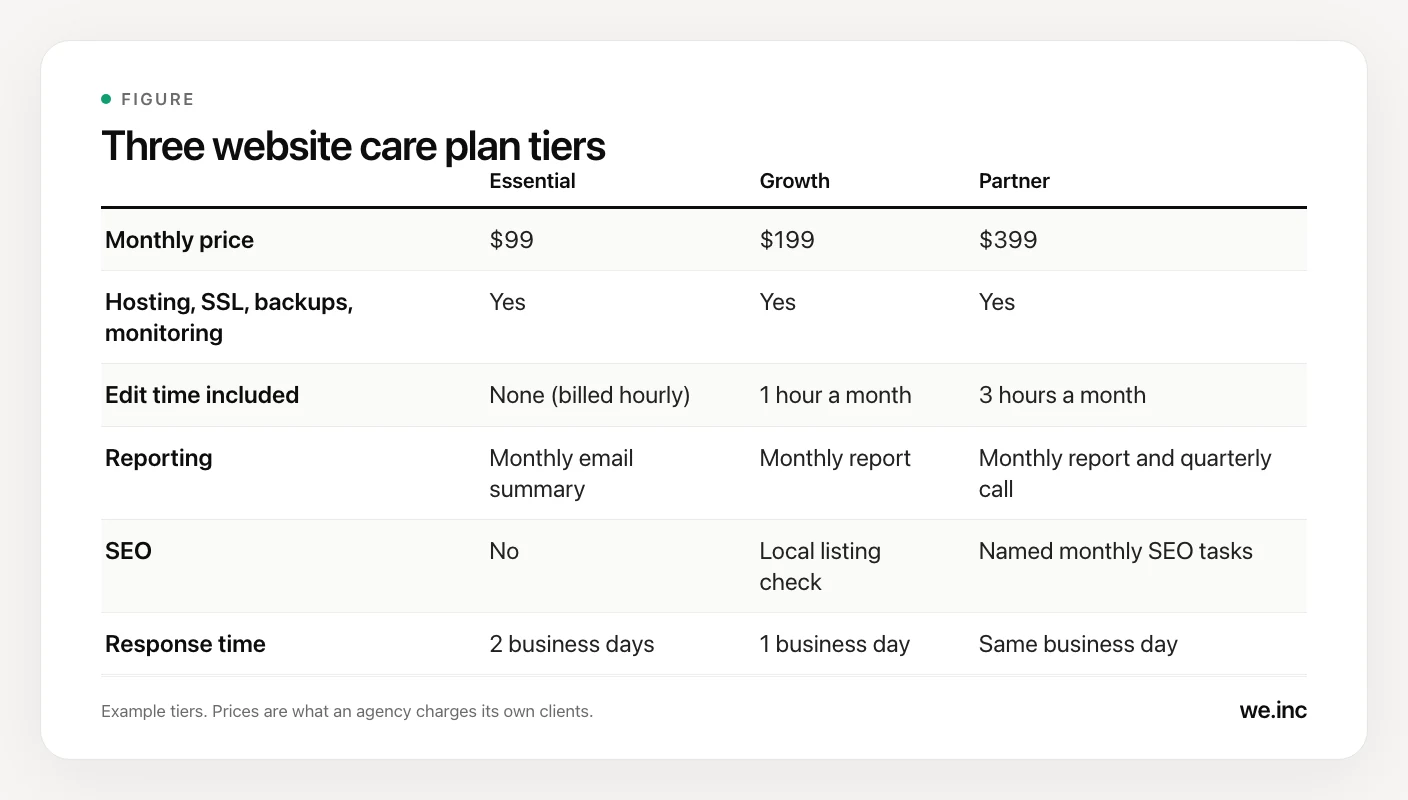
Put the tier you want most clients on in the middle. Say in the agreement that unused edit time does not roll over.
How much should you charge for a website care plan?
Start with the market, then check it against your costs. Here is what published care plans cost, as of September 2026:
| Provider | Entry plan | Highest listed plan | What changes between tiers |
|---|---|---|---|
| WP Buffs | $89/month (Maintain) | $359/month (Custom) | Unlimited small edits from the $179 Protect plan, then speed work and custom code monitoring |
| FatLab Web Support | $99/month (Starter) | $599/month (Enterprise) | Developer hours: 0, 1, 3 or 8 a month, with extra hours at $150 |
| GoWP | $39/site/month (Pro), plus a free tier | $99/site/month (Business) | AI edits (15 or 50 a month) and 5 human edits of about 30 minutes on Business |
These are retail prices listed for site owners, and GoWP also lists a $49 monthly white-label option for agencies. Agency pricing sits in a similar band. Van Deusen reviewed more than 100 agency care plan pages in 2025 and found few under $75, most between $100 and $150, and a top end around $250 for plans that did not bundle the website, SEO or other services.
To set your own price:
- Add up hard costs per client: hosting or platform share, backup and security tools, reporting software.
- Estimate monthly hours per tier and multiply by your hourly rate.
- Add margin so the plan still pays when a client uses every included minute.
- Build in a yearly increase, written into the agreement. Van Deusen names skipping regular price increases as a mistake he wishes he had avoided.
How to sell a care plan at project handoff
The best time to sell a care plan is before the project starts. By handoff, the client should already expect it.
- Put it in the proposal. List the care plan as a line item under the project, with the Growth tier pre-selected.
- Explain what happens without it. Missed updates, a lapsed domain, a broken form nobody notices for a month. A car service analogy works for most owners.
- Give them the choice. Van Deusen found clients more receptive when he explained the work and offered to handle it, instead of making the plan mandatory.
- Start billing at launch. The first charge lands the week the site goes live, when the client is happiest with you.
- Hand over a one-page "what we do each month" sheet at the launch meeting, so the value is in writing.
How do you convert existing clients to a care plan?
Past clients are the fastest care plan sales, because the trust already exists. A simple campaign:
- List every site you launched in the last 3 years that is still live.
- Run a free site check on each: speed, broken links, forms, SSL and outdated content.
- Send each client their results with one fix done free and an offer to handle the rest on a plan.
- Offer a founding price locked for 12 months if they sign within 30 days.
The math: if 30 past clients get the offer and 1 in 5 take the Growth plan, that is 6 × $199 = $1,194 a month, or $14,328 a year.
Churn: why clients cancel care plans and how to stop it
Clients rarely cancel only on price. They cancel because they cannot see the work, their card fails, or their business changes. Fixes for each:
- Make the work visible. A monthly report, plus a short note whenever you fix something they never knew was broken.
- Recover failed payments automatically. Stripe Billing can retry failed subscription payments to reduce involuntary churn, and its recommended Smart Retries default is 8 tries within 2 weeks.
- Offer a downgrade before a cancel. A client leaving Partner may happily stay on Essential.
- Talk to Partner clients every quarter. Upgrades and early warnings both come from these calls.
- Offer annual prepay with a small discount for clients who prefer one invoice a year.
- Sell tasks, not promises, especially for SEO.
A client portal under your own brand also helps, because clients log in to your product rather than a vendor's. See how a white-label client dashboard keeps your name in front of every client.
Can a care plan double your agency's revenue?
Sometimes, but not in year two. Here is the math for an agency doing 24 projects a year at $5,000 each ($120,000 a year), adding care plans at three attach rates.
Assumptions you can check:
- Clients join evenly through the year, so a new care client pays for 6 months on average in the year they sign.
- About 1 in 10 care clients cancels in year two, halfway through the year, rounded to whole clients.
- Project revenue stays flat at $120,000 in both years.
| Low | Base | High | |
|---|---|---|---|
| Care plan attach rate | 25% | 50% | 75% |
| Blended care plan price | $99/month | $199/month | $299/month |
| New care clients per year | 6 | 12 | 18 |
| Cancellations in year two | 1 | 1 | 2 |
| Year 1 revenue | $123,564 | $134,328 | $152,292 |
| Year 2 revenue | $130,098 | $161,790 | $213,288 |
| Year 2 vs year 1 | +5% | +20% | +40% |
| Care plan run rate entering year 3 | $13,068/year | $54,924/year | $121,992/year |
Walk through the Base column:
- Year 1: 12 clients × $199 × 6 months = $14,328 of care revenue. Add $120,000 of projects for $134,328.
- Year 2: 11 continuing clients × $199 × 12 = $26,268, plus 1 cancelled client × $199 × 6 = $1,194, plus 12 new clients × $199 × 6 = $14,328. That is $41,790 of care revenue, so year two totals $161,790.
- Entering year 3: 23 clients × $199 × 12 = $54,924 a year.
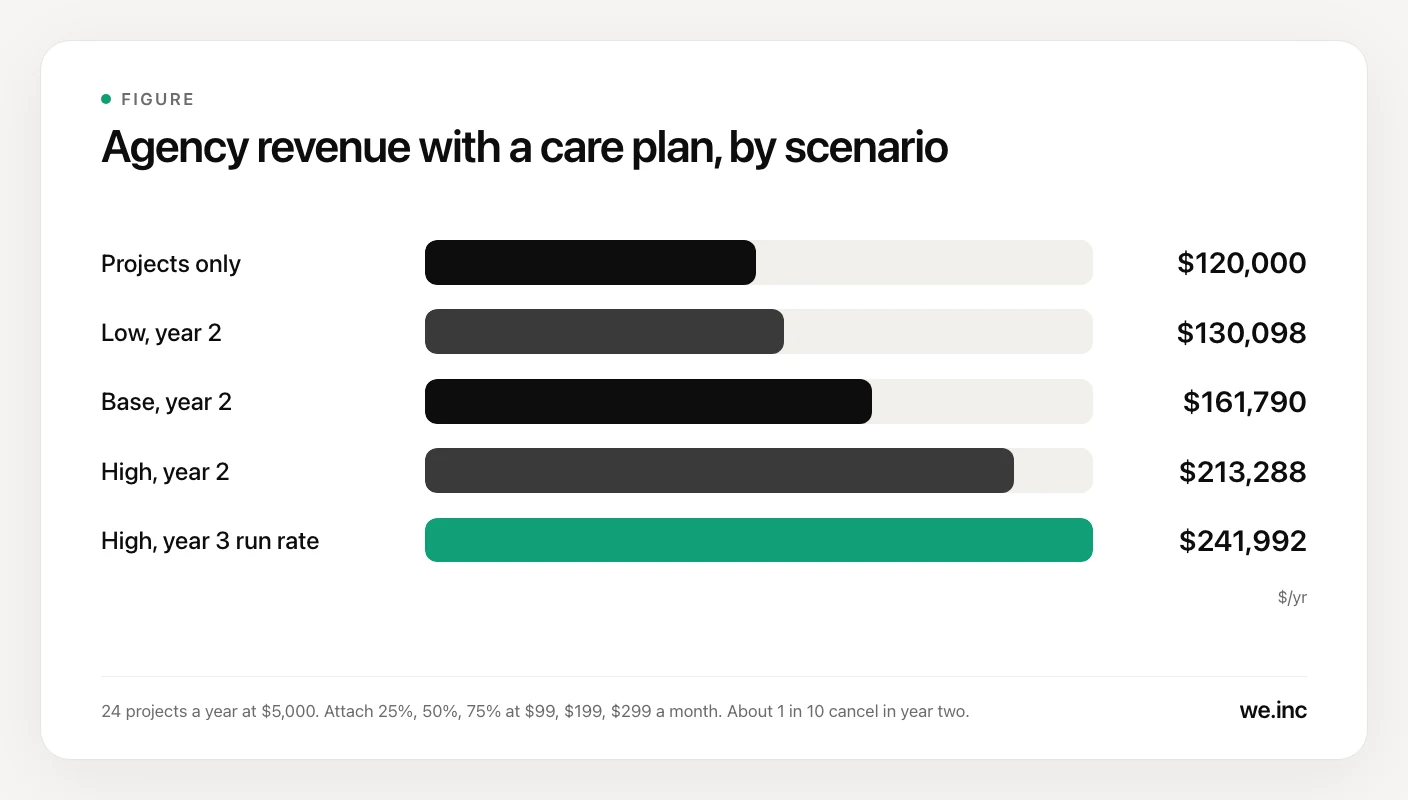
In the High case, care plans alone run at $121,992 a year entering year three, more than the $120,000 from projects. Together that is a $241,992 run rate, about double the project-only agency. That is what "double your revenue" really looks like: two years of high attach rates and fuller plans. In the Base case, with 12 new clients a year and 1 in 10 cancelling, reaching the 51 clients needed ($10,000 a month ÷ $199) takes roughly 5 to 6 years. Model your own mix with the reseller margin calculator.
What do care plans cost you in time?
Recurring revenue is not passive income. Take the Base case entering year three: 23 care clients, split 10 Essential, 8 Growth and 5 Partner. That mix earns 10 × $99 + 8 × $199 + 5 × $399 = $4,577 a month, the same $199 average used above.
Say Essential clients take 30 minutes a month (checks and the report), Growth clients 1.5 hours (edits plus the report) and Partner clients 4 hours (edits, the report and call prep). That is 5 + 12 + 20 = 37 hours a month, or about $124 of revenue per hour before hosting and tools.
The hidden costs are real too:
- Interruptions. A site down at night is now your problem.
- Scope creep. Quick edits grow into redesigns unless you log time.
- Tool costs. They feel expensive at 5 clients and cheap at 50. Van Deusen reports paying only a few dollars a month in hard costs, excluding hosting, for the tools that automate most care tasks across more than 70 clients.
- Capacity. At some client count, one person cannot run new projects and care work alone. Decide in advance when you will hire or outsource.
If per-site platform fees are part of your cost, check how they scale before you commit. Our Duda white-label review walks through that pricing model.
Where We.Inc fits
Care plans are easier to deliver when every client site lives on one platform under your name. We.Inc's white-label platform lets agencies run an AI website builder on their own web address, with their own name, logo and colours on the login, dashboard and builder screens, and emails to clients carry the agency's brand. You bill care plans through your own Stripe account, so clients pay you. Edits happen visually or in code, and sites publish to custom domains with SSL. The platform is one flat monthly fee with no per-site charge, shared on a 30-minute demo call. If you are starting from zero, read how to start a website reseller business and the complete white-label website builder guide.
Sources
- The Admin Bar: State of the WordPress Agency 2026, checked September 2026
- The Admin Bar: What is a Website Care Plan and What's Included?, checked September 2026
- WP Buffs care plans, checked September 2026
- FatLab Web Support pricing, checked September 2026
- GoWP pricing, checked September 2026
- Stripe Docs: Automate payment retries, checked September 2026
More in Blog
- Top Website Design Trends for 2026
- 25 Website Footer Design Examples That Work
- How to Design Website Forms That People Actually Complete
- Website Hosting Explained: A Beginner's Guide
- Website Maintenance Checklist: Keep Your Site Healthy
- Website Navigation Best Practices for Better UX
- Website Popup Strategies That Work (Without Annoying Visitors)
- Website Redesign Checklist: Everything You Need
We.Inc is an AI-powered website builder you can resell under your own brand. Launch a branded client dashboard, bill on Stripe Connect, and deliver AI-generated websites in minutes. White-label plans are custom priced, with no per-site fees.
Product
- AI Website Builder: Describe a site in plain English; it's live in minutes
- White Label Platform: Your brand, your domain, your margin
- Enterprise: SSO, custom SLAs, and dedicated support
- Developer API: Embed site generation into your SaaS
Who It's For
- For Agencies: Resell under your brand
- For Freelancers: Your own branded builder
- For Hosting Providers: Add a builder to your stack
- For SaaS Platforms: Embed site creation via API
- For Startups
- For Financial Services
- For Healthcare
Features
- Drag & Drop Editor
- Built-in SEO Tools
- Custom Branding
- Client Dashboard
- Reseller Billing (Stripe Connect)