Plastic surgery web design that earns the consultation
Describe your practice and the AI builds a plastic surgeon website with procedure pages, surgeon credentials, and a consultation request form. Edit it by chat, visually, or in code.
Tell us what you do and our AI writes and builds your plastic surgery site around it.
Build My Plastic Surgery Site - Free
15,000+businesses trust us
4.7
from 1,200+ reviews
No credit card required
Free plan: 3 template sites · AI building from $20/mo · Cancel anytime
Plastic surgery web design that earns the consultation
Good plastic surgery web design puts the surgeon's credentials first, gives every procedure its own page with candidacy, recovery and a price range, shows before-and-after photos with consent, and makes a consultation request easy. On we.inc you can start from a free template or describe your practice to the AI (from $20/month) and it builds those pages for you.
Describe your practice and the AI builds a plastic surgeon website with procedure pages, surgeon credentials, and a consultation request form. Edit it by chat, visually, or in code.
Pages every plastic surgery website needs
Home: Surgeon name, board certification, location and a consultation button in the first screen.
Procedures: One page per procedure (breast, body, face, non-surgical) so each can be found by the exact search a patient types.
Before and After: Consented photos grouped by procedure, with a short case note. Patients spend more time here than anywhere else.
About the Surgeon: Training, board certification, hospital privileges and memberships, written plainly.
Pricing and Financing: Price ranges or what a quote includes, plus any financing partner you work with.
Consultation: A request form with procedure of interest, preferred contact method and the best time to call.
Try this prompt
A website for a board-certified plastic surgeon in Scottsdale, with procedure pages for breast augmentation, tummy tuck, rhinoplasty and facelift, a before-and-after gallery by procedure, a surgeon biography with training and certifications, and a consultation request form.
How should recovery time be explained on a procedure page?
As a plain week-by-week outline, with a note that every patient heals differently. For example: when most people return to desk work, when bruising usually fades and when exercise can resume. Patients plan time off around this, so vague phrases like "minimal downtime" cause more phone calls than they save. Have the surgeon review each outline before it goes live.
Can I show before-and-after photos of real patients?
Only with each patient's written consent for web use, and with identifying details such as tattoos or jewellery removed or cropped where they ask. Show the same angle and lighting in both shots, label the procedure and say how long after surgery the second photo was taken. Professional bodies and state boards have their own advertising rules, so check yours before publishing.
Should the surgeon's training be on every page?
No, one strong profile page is enough, linked from each procedure. On it, list medical school, residency, fellowship and board certification by their full names, and say which hospitals grant privileges. Patients researching a surgeon often check these against public records, so accuracy matters more than length.
Start from this design
Three designs that suit a plastic surgery website.
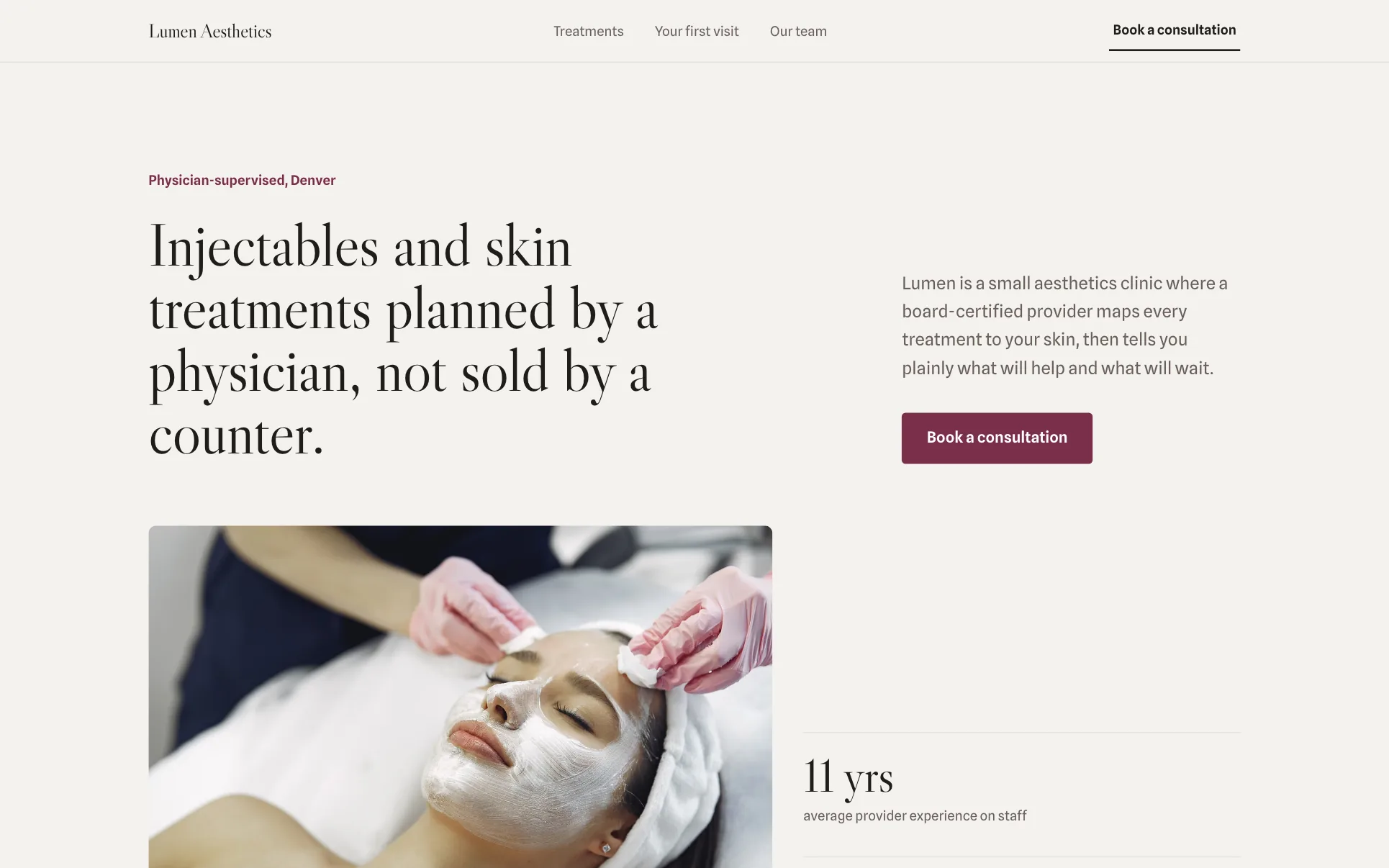
Physician-Led Med Spa
Misty Mental Wellness Device
Illustrated Mindfulness App
About plastic surgery website design on we.inc
Skip the plastic surgery web design brief and the six week wait. Tell the AI about the business in a sentence and it builds the whole site, ready to edit.
Features designed for your industry
Credentials up front: Board certification, training and hospital privileges where patients look first.
A page per procedure: Candidacy, recovery, risks and a price range for each procedure you offer.
Consultation requests: A form that asks the procedure of interest and preferred contact, and emails your coordinator.
Who this plastic surgery website design suits
A board-certified plastic surgeon in solo practice
A cosmetic surgery group with several surgeons and a med spa
A facial plastic surgeon focused on rhinoplasty and facelifts
A dermatology practice adding cosmetic procedures
What makes a plastic surgery website work
Credentials are the conversion
Patients choosing surgery check board certification before anything else. Name the certifying board, your training and your hospital privileges on the home page and the About page, not only in a footer.
Write the recovery page you would want to read
Each procedure page should cover who is a good candidate, how long the procedure takes, what recovery looks like week by week, and the main risks. Honest detail builds trust and pre-qualifies consultations.
Handle photos and reviews with care
Only publish before-and-after photos with written patient consent, and check your state and board advertising rules. Do not add testimonials or results you cannot document.
Keep medical records off the website
The site's consultation form should collect only contact details and the procedure of interest. Detailed medical history belongs in your practice's HIPAA-compliant intake system, linked from the site if you use one.
What it costs
Templates are free to publish on a we.inc address, up to three sites. Having the AI build and edit your procedure pages and galleries starts at $20/month on Starter.
Free for 3 template sites, without AI; AI building from $20 a month. Compare plans
Frequently asked questions
What makes good plastic surgery web design?
Credentials in the first screen, a separate page for each procedure, a consented before-and-after gallery, clear price ranges or quote guidance, and a short consultation form. Fast loading on phones matters because most patients research on mobile.
Can I add a med spa section to my plastic surgery site?
Yes. Many practices run injectables and skin treatments alongside surgery. Add a med spa menu as its own section so those visitors find prices fast. Our med spa website design guide and med spa examples show how that section can look.
Does this work for dermatology web design too?
Yes. A dermatology practice uses the same structure: condition and treatment pages, provider credentials and an appointment request form, with cosmetic services listed separately from medical ones.
Is the consultation form HIPAA compliant?
Treat it as a contact form only: name, phone, email and procedure of interest. Collect medical history in your practice's own HIPAA-compliant system, not through the website form.
What does a plastic surgeon website cost on we.inc?
Up to three template sites are free on a we.inc address, with no AI credits and no custom domain. AI building and editing starts on Starter at $20 a month, and a custom domain needs a paid plan plus about $10 to $20 a year for the name.