How Are White-Label Website Builder Licences Priced for Agencies? The Five Models and What 50 Sites Really Cost | How-to Guide
White-label website builders charge agencies through five models: a platform fee with sites included, per-site fees, seats, usage credits, or a negotiated contract. Here is how each works, how to cost 50 client sites, and the clauses that change the bill.
Most white-label website builders charge an agency in one of five ways: a monthly platform fee that includes a few sites, a fee for every extra site, a fee per team seat, a pool of usage credits (common with AI builders), or a negotiated contract once you pass a volume threshold. Real bills are almost always a mix: a platform fee to unlock the white-label features, then a per-site charge on top. For an agency running 50 client sites, the per-site line usually dwarfs the platform fee, so the number to compare between vendors is the cost of site 50, not the headline price. The rest of this guide shows how to model that, with one worked example from a public price list.
Why the headline price misleads
Vendor pricing pages are written to make the entry plan look cheap. For an agency, three things are usually hidden behind that first number:
- The white-label switch sits on a higher tier. Lower plans often let you build client sites but show the vendor's name in the editor, the login page or the emails your clients receive.
- Included sites run out quickly. A plan that includes a handful of sites is a sample, not a portfolio. Every site after that is billed separately.
- Extras are metered. Seats, ecommerce, extra storage, AI generation and premium support can each have their own line.
So before comparing anyone, write down your own numbers: how many sites today, how many in 12 months, how many staff log in, and which clients need a store or member area. Those four inputs decide which model is cheapest for you.
The five pricing models
| Model | How you are billed | Good for | Watch out for |
|---|---|---|---|
| 1. Platform fee with included sites | A flat monthly or annual fee unlocks the agency features and includes a small number of sites | Agencies starting out with fewer sites than the included count | The fee usually stays even when you have zero clients; the white-label tier is often the expensive one |
| 2. Per-site fee | A charge for each published site, monthly or yearly, sometimes cheaper when paid annually | Agencies that bill clients per site and want cost to track revenue | Does an unpublished draft count? Are staging copies billed? Is the annual price locked for the term? |
| 3. Seats | A charge per team member who can log in | Small teams with many sites | Whether clients who edit their own sites count as seats |
| 4. Usage credits | A pool of credits for AI generation, edits or builds, topped up as you go | AI-first builders where the vendor's own costs scale with use | What one credit buys, whether credits roll over, and who pays when a client edits heavily |
| 5. Negotiated contract | Annual agreement with volume tiers, minimums and sometimes a setup fee | Hosting companies, SaaS platforms and large agencies with predictable volume | Minimum commitments, auto-renewal, price rises at renewal, exit terms |
Many vendors also sell reseller margin features: you set your own price for each client and the platform collects it. That does not change what you pay the vendor, but it changes how much admin you do. We cover the client side of this on the reseller billing page.
A worked example from a public price list
Duda publishes its agency pricing, which makes it a useful example of model 1 plus model 2. On its pricing page, checked on 2026-10-25, the White Label plan is listed at $199 a month billed monthly or $149 a month billed annually, with 4 sites included. Additional sites on that plan are listed at $17 a month or $168 a year each. The Custom plan, also white-label, is priced through sales. (Lower Duda plans, Basic, Team and Agency, are cheaper but are not listed as white-label.)
Here is what that list price works out to as the site count grows, using the annual rates:
| Sites | Platform fee per year | Extra sites per year | Total per year | Per site per month |
|---|---|---|---|---|
| 4 | $1,788 | $0 | $1,788 | about $37 |
| 10 | $1,788 | 6 x $168 = $1,008 | $2,796 | about $23 |
| 25 | $1,788 | 21 x $168 = $3,528 | $5,316 | about $18 |
| 50 | $1,788 | 46 x $168 = $7,728 | $9,516 | about $16 |
Two lessons hold for almost any vendor using this model. First, by 50 sites the per-site line is about four fifths of the bill, so a small difference in the extra-site price matters more than the platform fee. Second, the cost per site keeps falling but never reaches the extra-site price, because the platform fee is spread across more sites. This is list pricing only; Duda's Custom plan and any vendor's negotiated deal can be different, so ask.
To be fair to Duda: a public, per-site price list is exactly what an agency needs to budget, and many white-label vendors do not publish one at all.
A cost model you can copy
Put every vendor you are considering into the same sheet. These are the rows that change the answer:
| Line | Question to answer | Vendor A | Vendor B |
|---|---|---|---|
| Platform fee | Which tier is the cheapest one where clients never see the vendor's name? | ||
| Included sites | How many, and do drafts count? | ||
| Extra site price | Monthly and annual; is it the same for a one-page site and a store? | ||
| Ecommerce | Per site add-on, transaction fee, or included? | ||
| Seats | Price per staff seat; do client editors count? | ||
| AI usage | What is metered, and what happens when the pool runs out mid-project? | ||
| Custom domains | Included for every site? For your own dashboard address too? | ||
| Support | Is priority or partner support a paid add-on? | ||
| Exit | Can you take every site's files with you, and is that free? | ||
| Total at today's count | |||
| Total at next year's count |
Fill in the last two rows for both your current portfolio and the one you expect in a year. The vendor that wins at 10 sites is often not the one that wins at 50.
The clauses that change the bill more than the price
What counts as a site
Ask for the definition in writing. Is a site billed when it is created, when it is published, or when a domain is connected? Are landing pages for the same client separate sites? An agency doing campaign pages can double its bill on this one definition.
Paused and cancelled clients
When a client stops paying you, can you unpublish their site and stop paying for it, while keeping the work in case they come back? Some platforms keep billing until the site is deleted.
Renewal price
Annual discounts are often only for the first term. Ask what renewal looks like and whether there is a cap on increases. In a negotiated contract, put the cap in the contract.
Minimums
Volume contracts often trade a lower per-site price for a minimum number of sites or a minimum annual spend. That is fine if your pipeline is real, and expensive if it is a forecast.
Data exit
Price is not only what you pay to stay; it is what you would pay to leave. If a platform cannot export a site's code or content, moving 50 sites later means rebuilding 50 sites. Our vendor exit plan guide has a checklist.
How to turn the platform cost into a client price
Once you know your cost per site at your real volume, add the parts the platform does not do: your time for edits, support, reporting and account management. Price each client on value, not on the platform's line item, and keep the platform cost per site below a fixed share of what each client pays you. Our blog post on web design agency pricing models walks through that margin math, and website maintenance packages shows how to package the recurring part.
What to look for beyond the price
A cheaper platform that makes your team slower is not cheaper. When you run a trial or a demo, check the things that eat staff hours on every client:
- Client set-up time. How long from "new client" to a branded login they can use?
- Per-client controls. Can you decide per client whether they can publish, connect a domain or see code?
- Approval. Can a client's change wait for your OK before it goes live?
- Billing. Can the platform charge clients for you, or will you invoice by hand?
- Exit. Can you download a site's code?
How We.Inc handles this
We.Inc's white-label offer is sold through a demo and a quote rather than a public price list, so this page does not list its prices. What we can show is how the agency side works. You manage every client from one list:
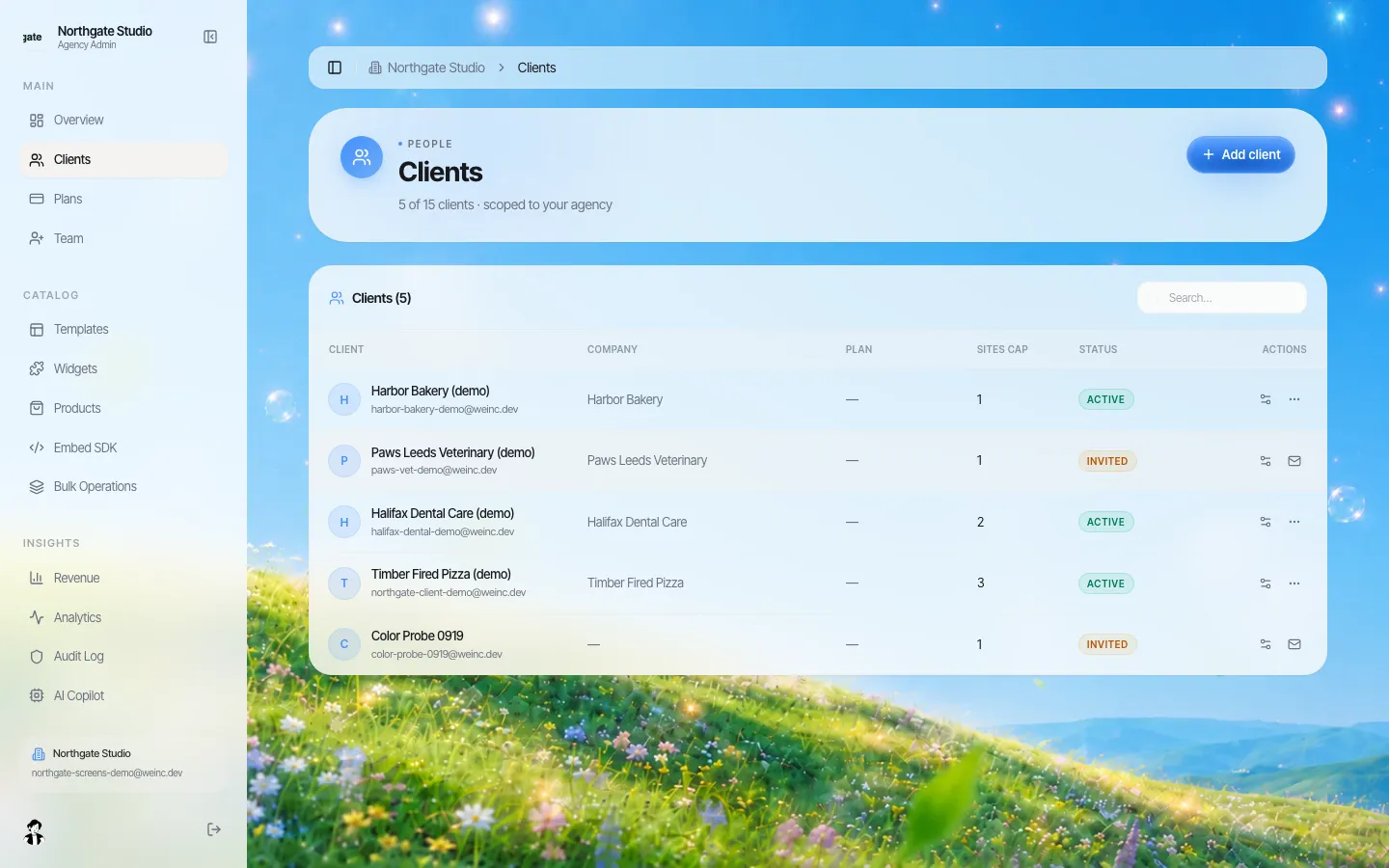
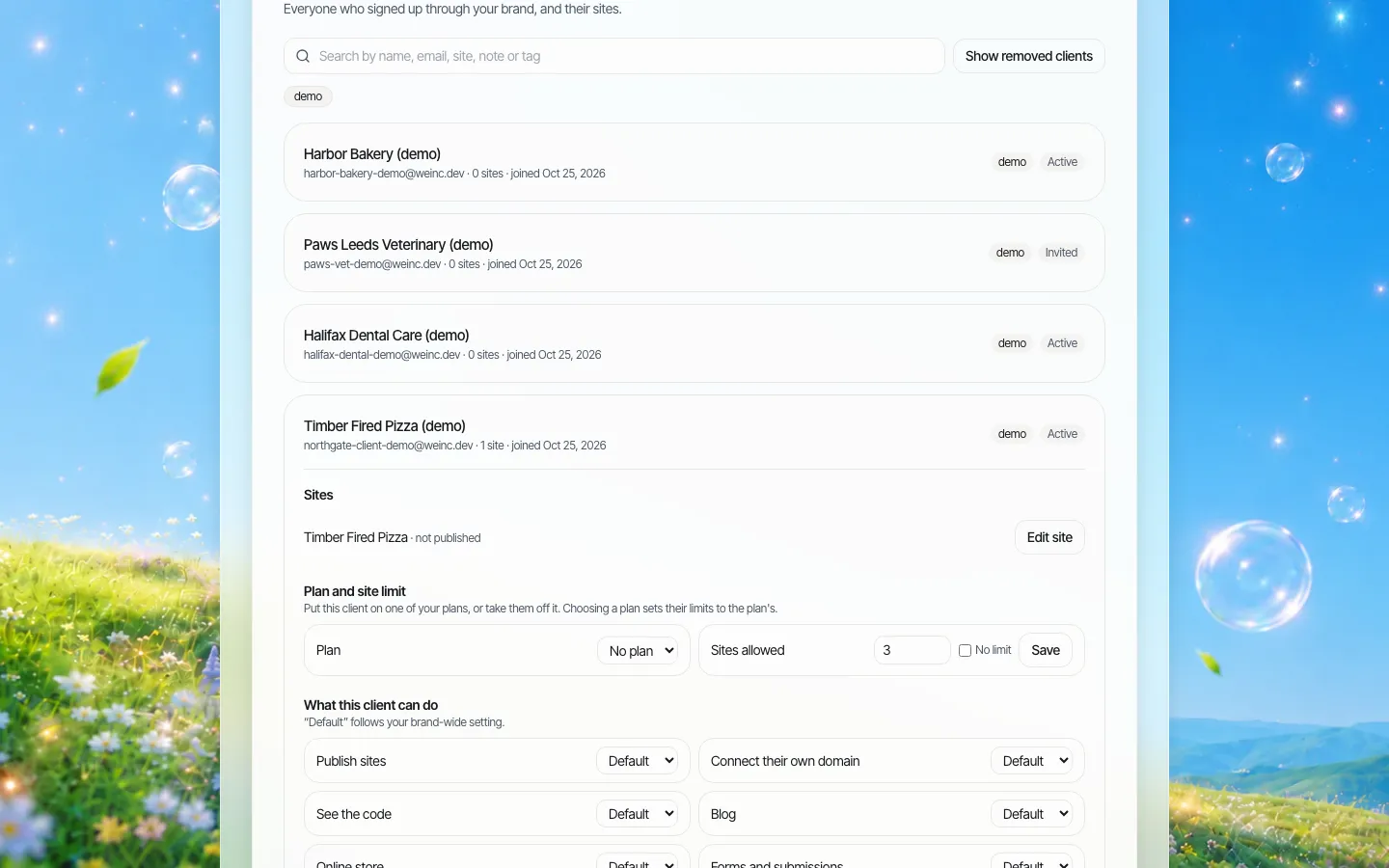
Each client has their own site limit and their own switches for publishing, connecting a domain, seeing the code, blog, store, forms and SEO settings, plus an optional single-step approval before a client's site goes live.
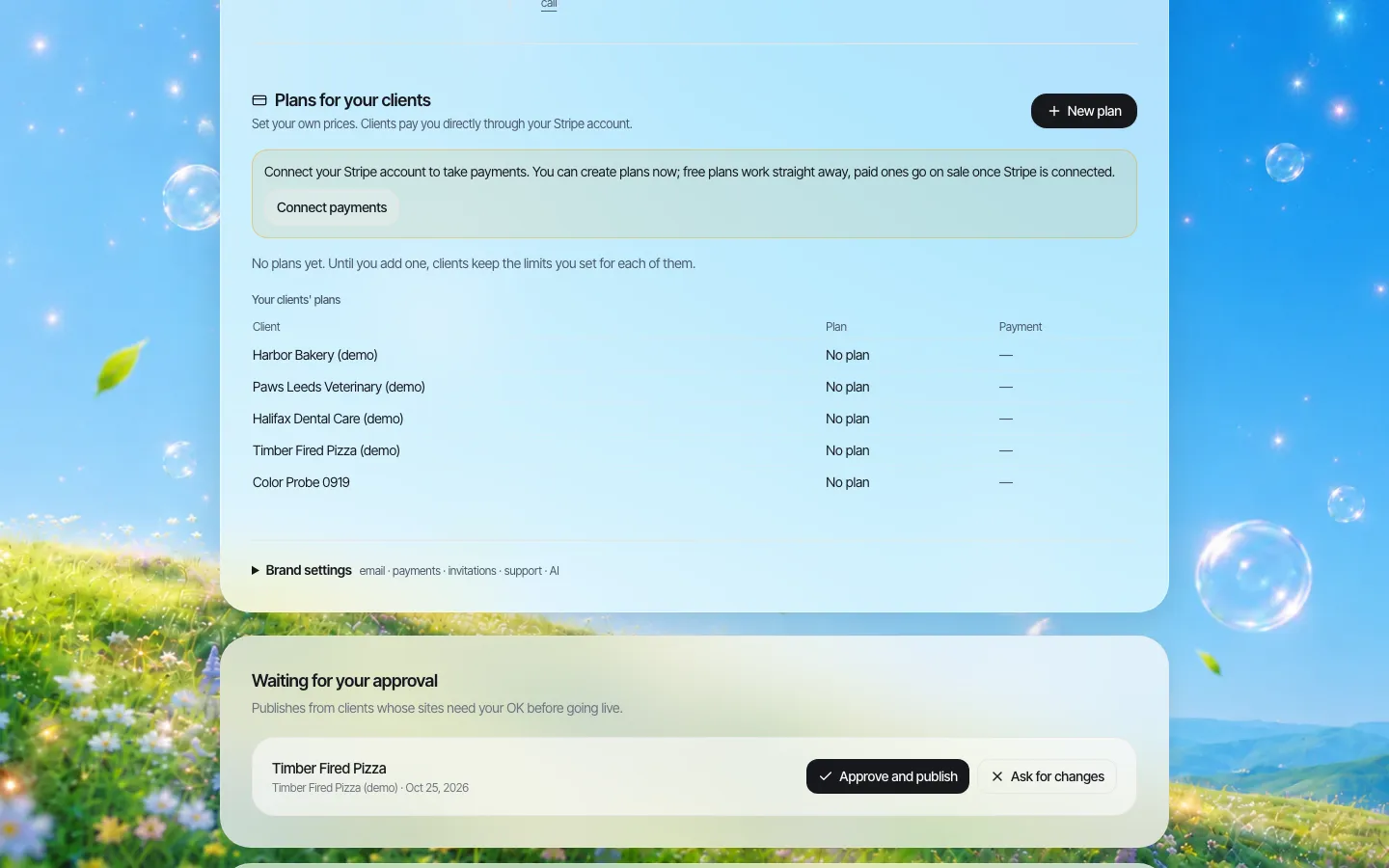
You can set your own plans and prices for clients and connect Stripe to collect them, so the client pays you and sees your brand.
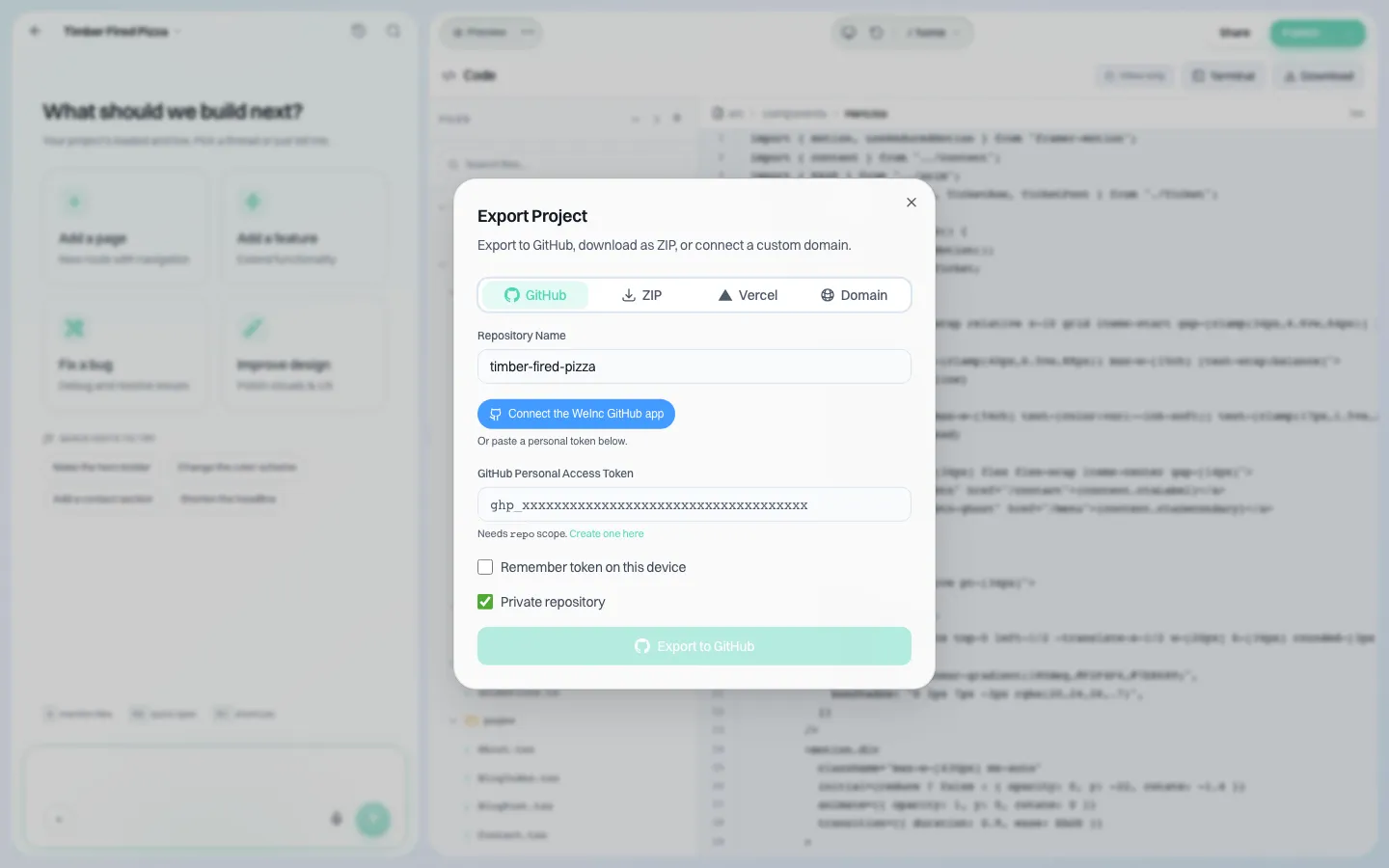
And every site's code can be downloaded as a ZIP or pushed to GitHub, so leaving never means rebuilding.
If you want a quote for your own site count, book a demo and bring the cost sheet above. We will fill in our column honestly.
Sources
Last checked 2026-10-25.
- Duda, Pricing (plan names, included sites, extra-site prices, which plans include white label).
Frequently asked questions
How are white-label website builder licences usually priced?
Through a platform fee that unlocks white-label features and includes a few sites, a fee for each extra site, sometimes seats or usage credits, and a negotiated contract at higher volumes. Most bills combine a platform fee with per-site charges.
What does it cost to run 50 client sites on a white-label builder?
It depends on the vendor's extra-site price more than its headline fee. On Duda's public list prices checked 2026-10-25, the White Label plan with 46 extra sites paid annually comes to about $9,516 a year, roughly $16 per site per month.
Is per-site or flat pricing better for an agency?
Per-site pricing tracks revenue if you bill clients per site. A flat fee is better if you have many small sites. Model both at today's site count and next year's before deciding.
What hidden costs should agencies ask about?
Which tier removes the vendor's name, what counts as a site, whether paused sites are billed, renewal price increases, minimum commitments, metered AI usage, ecommerce add-ons and whether exporting your sites costs anything.
Does We.Inc publish white-label prices?
No. We.Inc's white-label offer is quoted after a demo, based on your site count and needs.
More in Guides
- Who Owns a Client's Website When an Agency Builds It on a White-Label Platform? | How-to Guide
- Why Does My Website Say "Not Secure"?
- Why Is My Website Not Showing on Google? A Step-by-Step Diagnosis | How-to Guide
- WooCommerce vs Shopify: What You Actually Pay and Manage
- The Default WordPress .htaccess File, and Safe Things to Add
- WordPress robots.txt: Default Rules, Editing and Safe Examples
- www vs non-www: Pick One and Redirect the Other
- YAML Comments: How to Comment, and Comment Out, YAML
Related guides and tools
Start building
- how to make a website
- AI website builder
- free website builder
- website templates
- website builders by industry
We.Inc is an AI-powered website builder you can resell under your own brand. Launch a branded client dashboard, bill on Stripe Connect, and deliver AI-generated websites in minutes. White-label pricing is tailored to your volume and setup: book a 30-minute demo for a quote.
Product
- AI Website Builder: Describe a site in plain English; it's live in minutes
- White Label Platform: Your brand, your domain, your margin
- Enterprise: SSO, custom SLAs, and dedicated support
- Developer API: Embed site generation into your SaaS
Who It's For
- For Agencies: Resell under your brand
- For Freelancers: Your own branded builder
- For Hosting Providers: Add a builder to your stack
- For SaaS Platforms: Embed site creation via API
- For Startups
- For Financial Services
- For Healthcare
Features
- Drag & Drop Editor
- Built-in SEO Tools
- Custom Branding
- Client Dashboard
- Reseller Billing (Stripe Connect)
Resources
- Blog
- Help Center
- Free Business Tools
- Free UI Components
- Website Templates
- Template Collections
- Website Examples
- Guides
- Comparisons
- Alternatives
- Best Lists
- Reviews
- Pricing Guides
- Use Cases
- Glossary & Guides
- Integrations
- Developers
- Benchmark
- Windows App