Franchise Location Pages: How to Make Each One Worth Ranking | How-to Guide
A working guide to franchise location pages: the fields every page needs, a questionnaire to get real local detail from franchisees, a test for pages that are too alike, locator and URL structure, Business Profile and structured data alignment, reviews, and what to do when a location opens, moves or closes.
A franchise system with 40 locations usually has 40 location pages that were written in one afternoon. They share a template, a paragraph about the brand, and a sentence that says "proudly serving" a town. Search engines see the pattern, customers see a page that does not tell them whether the place is open on Sunday, and the franchisee sees no reason to keep it current. This guide is about fixing the pages themselves: what goes on them, how to get that material out of busy franchisees, how to tell whether two pages are too alike, and how to keep each page true as locations open, move and close.
If your question is the wider one of who controls what between corporate and franchisees, or which platform to run it on, start with our franchise website platform page, which sets out that split. This guide assumes the split is decided and gets into the page.
A location page has three readers
Every decision on a location page gets easier once you name who reads it:
- A customer who is about to go somewhere. They are often on a phone, often within a few miles, and want four facts: is it open, where exactly is it, can I call, and does this branch do the thing I need. Anything that pushes those facts below the fold is in the way.
- Search engines deciding which location to show. They compare the page with the location's Business Profile, the address in the page's structured data, and the links that point to it. Agreement between those sources matters more than clever copy.
- The franchisee. If the page is not useful to them (somewhere to post the new team member, the holiday hours, the charity run they sponsored), they will stop sending updates and the page goes stale within a season.
Brand copy written for none of these three ("a trusted name in quality service") is what makes 40 pages look like one.
The fields every location page should carry
Treat a location page as a record with fields, not a page of prose. Records can be checked; prose drifts. This is the field list we recommend, with who supplies each and how often someone should look at it:
| Field | Supplied by | Check | Why it earns its place |
|---|---|---|---|
| Location name as shown on signage | Corporate | On change | Must match the Business Profile and the sign customers look for. |
| Full street address, plus a one-line "how to find us" | Franchisee | Yearly | "Behind the pharmacy, entrance on Elm St" saves a phone call and is unique by nature. |
| Phone number that rings at this location | Franchisee | Quarterly | A shared call-centre number makes every page identical on the one fact people want. |
| Regular hours | Franchisee | Monthly | Wrong hours are the most common complaint about location pages. |
| Holiday and temporary hours, with dates | Franchisee | Before each holiday | Stops "open" showing on a day the doors are shut. |
| Services offered here, and not offered here | Franchisee, from corporate's list | Quarterly | The honest "this branch does not do X, the nearest one that does is Y" is genuinely local and genuinely useful. |
| Team: names, roles, photos (with consent) | Franchisee | On change | The strongest signal that a page is about a real place. |
| Photos of the actual premises | Franchisee | Yearly | Stock photos of a generic storefront help no one find the door. |
| Parking, transit, step-free access, languages spoken | Franchisee | Yearly | Practical detail customers search for and competitors rarely publish. |
| Service area, if staff travel to customers | Franchisee, approved by corporate | Yearly | Territory lines in the franchise agreement and the page should agree. |
| Local news, events, community work | Franchisee | When it happens | Gives the page a reason to change and a reason to be linked to locally. |
| Reviews or testimonials | Real customers of this location only | Ongoing | See the reviews section below: this is where legal risk sits. |
| Last reviewed date and reviewer | Whoever checked | Every check | Lets corporate see which pages nobody has touched in a year. |
Notice what is not on the list: a paragraph about the brand's history, the brand's mission statement, a list of every service the network offers. Those belong on brand pages that each location page links to once.
Getting the material: a questionnaire franchisees will actually answer
Franchisees do not refuse to supply content; they ignore requests that look like homework. Short questions with examples get answers. Copy this and send it at onboarding and once a year after:
- What is the exact name on your sign?
- How would you tell a first-time customer to find your entrance? (One or two sentences. Mention landmarks.)
- Where do customers park, and is it free?
- Is the entrance step-free? Is there anything a wheelchair user or a parent with a pushchair should know?
- Which languages can your team serve customers in?
- Which of the services on the attached list do you offer? Which do you not?
- Is there anything you offer that is not on the list?
- Who are the people customers will meet? First name, role, and whether they are happy to have a photo on the site.
- What are your regular hours? Which holidays are you closed this year?
- Which neighbourhoods or towns do most of your customers come from?
- What local teams, schools, charities or events have you supported in the last year?
- What do customers most often ask you on the phone that the website could answer?
- What do you do differently from other locations, if anything? (A longer-serving team, a bigger space, an evening slot.)
- Send three photos of the outside and inside taken in daylight, without customers in them.
- Who at your location should we ask when something on the page needs checking?
Question 12 is the most valuable. The answers become a short "common questions" block on the page that is local by definition, because it comes from the phone calls that location receives.
The "too alike" test
Google's spam policies treat pages built to rank for near-identical, place-by-place queries as doorway abuse, and mass-produced pages made mainly to rank as scaled content abuse. You do not need to guess where the line is if you test your own pages honestly. Three checks, in order of effort:
1. The swap test (two minutes)
Take any two location pages. Swap the town names. If both pages would still be accurate, they are not location pages yet; they are one page with a variable.
2. The shared-text measure (an hour for the whole network)
Paste the visible body text of each page, excluding header, footer and navigation, into a spreadsheet or a text comparison tool, and estimate what share of sentences appears on more than one location page. There is no published threshold, and we will not invent one. As a working rule of our own: if most of the sentences on a page also appear on other location pages, the page has not yet earned its own URL. Fix those pages first, or publish them short and accurate until the franchisee's answers arrive.
3. The customer test (ongoing)
Ask each franchisee what customers phoned about last week that the page could have answered. If the answer keeps being "our hours" or "whether you do X", the page is missing fields from the table above, whatever its word count.
Two habits make pages more alike over time and are worth banning in your brand guide: generated "about this area" paragraphs that describe the town rather than the location, and blocks of the same customer review shown on every page.
Locator and URL structure
A store locator that works only through a search box is invisible to anything that does not type. Build it so every location page can be reached through plain links as well:
- One URL per location, kept for life. A predictable pattern such as
/locations/springfield-main-st. Include a street or neighbourhood when two locations share a town, so the URL never needs renaming when a second one opens. - A plain index of all locations, grouped by state, province or region, with ordinary links to each page. The map and search box can sit on top of it.
- Region pages only when they have something to say. A region page that lists four locations and nothing else is fine as navigation; padding it with copy about the region recreates the doorway problem one level up.
- No location pages for places without a location. A page for a town you only serve from a neighbouring branch belongs in that branch's service-area field, not on its own URL.
- Every location page links up to the index and to the brand's service pages, and those service pages link to the locator rather than to forty individual branches.
Line the page up with the location's Business Profile
Google's Business Profile guidelines set rules that location pages should mirror:
- One profile per location. The guidelines say not to create more than one page for each location of a business, in one account or several.
- The same name across locations in a country, and one shared primary category for the same kind of business. If your location pages use a different naming pattern from your profiles, fix the pages.
- A real place customers can visit, or a service-area business that travels to customers. A rented mailing address does not qualify, and neither should it get a location page.
- Departments that operate as distinct public-facing units can have their own profiles under their own names. If a location has one (a service centre inside a showroom, say), give it a clearly labelled section on the location page.
Point each profile's website link at that location's page, not the brand home page, so the customer who taps "website" lands on the hours and the address they were looking at.
Structured data, per location
Google's LocalBusiness structured data documentation requires a name and an address, and recommends among others telephone, geo, openingHoursSpecification and a url for the specific location. Points that matter for franchises:
- Mark up each location as its own entity on its own page, using the most specific business type that fits.
- Holiday and seasonal hours can be expressed with
validFromandvalidThroughdates, which is a good reason to collect holiday hours as dated fields rather than free text. - Departments can be nested with the
departmentproperty, defining only what differs from the main location. - Google's documentation lists review and rating properties for sites that capture reviews about other local businesses. Do not add star-rating markup about your own locations on the expectation of stars in search.
Whatever produces the markup, check the published page with Google's Rich Results Test and confirm the address, phone and hours in the markup match the visible page. Markup that disagrees with the page is worse than none.
Reviews and testimonials: where the legal risk sits
In the United States the FTC's rule on consumer reviews and testimonials (16 CFR Part 465) took effect on October 21, 2024. Among other things it prohibits fake reviews and testimonials, buying reviews, undisclosed reviews by insiders, company-controlled review sites that pose as independent, and certain review suppression. For a franchise network that turns into practical rules:
- A testimonial on a location page must come from a real customer of that location. Never copy reviews between locations, even word-for-word real ones.
- Reviews written by franchisees, staff or their families must say so, or not appear.
- Do not offer discounts or gifts in exchange for positive reviews. Incentives tied to the sentiment of the review are the problem the rule targets.
- Do not show only five-star reviews while quietly hiding the rest and calling the selection representative.
Other countries have their own consumer protection rules on reviews. If you operate outside the US, check the rules where each location trades.
The location lifecycle
Most stale location pages are not neglected; they were never told that something changed. Put these events into the franchise operations calendar with a website action next to each:
| Event | Page action | Also update |
|---|---|---|
| Signed, not yet open | Publish only once there is a confirmed opening date and an address. Say "opening" with the date; no hours yet. | Locator, with an "opening soon" label |
| Opening week | Add hours, phone, team and photos. Remove the opening label. | Business Profile, structured data |
| Temporary closure (refit, flood, staffing) | Keep the page live. State the closure and the reopening date at the top, and name the nearest open location. | Profile marked temporarily closed |
| Relocation | Keep the same URL if the URL names the town; update the address and add "we have moved" for a few months. If the URL names the old street, redirect it permanently to the new page. | Profile address, directions text, photos |
| Change of franchisee | Keep the URL and the page history. Replace the team section and re-run the questionnaire. | Who has access to edit the page, the same day |
| Permanent closure | Redirect the URL to the nearest location or the locator. Do not leave a page that still lists hours. | Profile marked permanently closed, locator, sitemap |
How to tell if it is working
Judge location pages per location, not as a total. A network total hides the twenty pages that get nothing. Each quarter, look at the search impressions and clicks for each location URL, calls and direction requests from the matching Business Profile, and the "last reviewed" date. A location with impressions but few clicks usually has a weak title or wrong hours showing in results; one with no impressions after a few months usually has a page too close to its siblings, or a profile that links somewhere else.
Running location pages on We.Inc
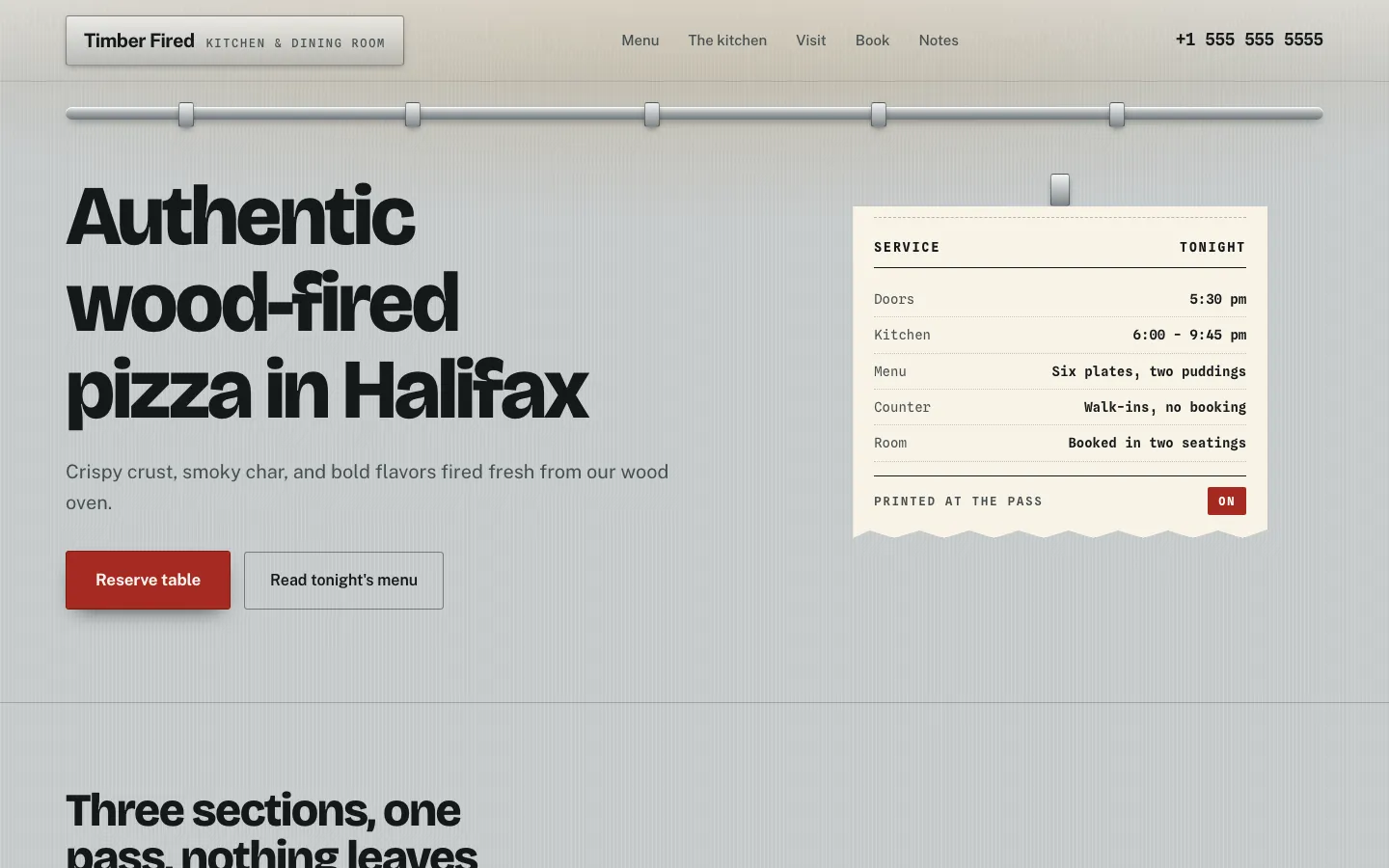
We.Inc is a white-label site platform: corporate runs the brand account and each location can have its own client account and site. Here is what that looks like today, shown on our demo brand "Northgate Studio" with a sample site.
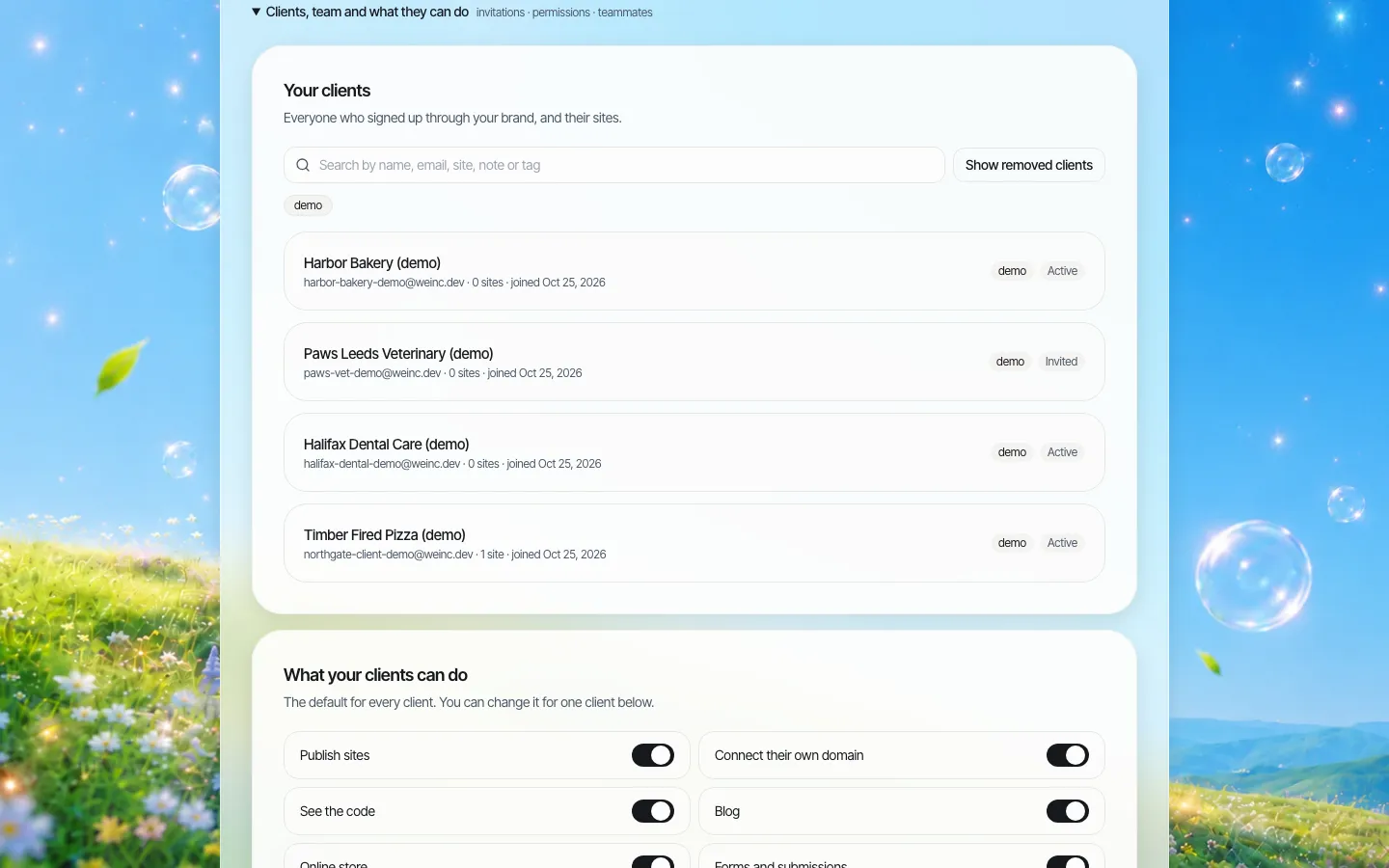
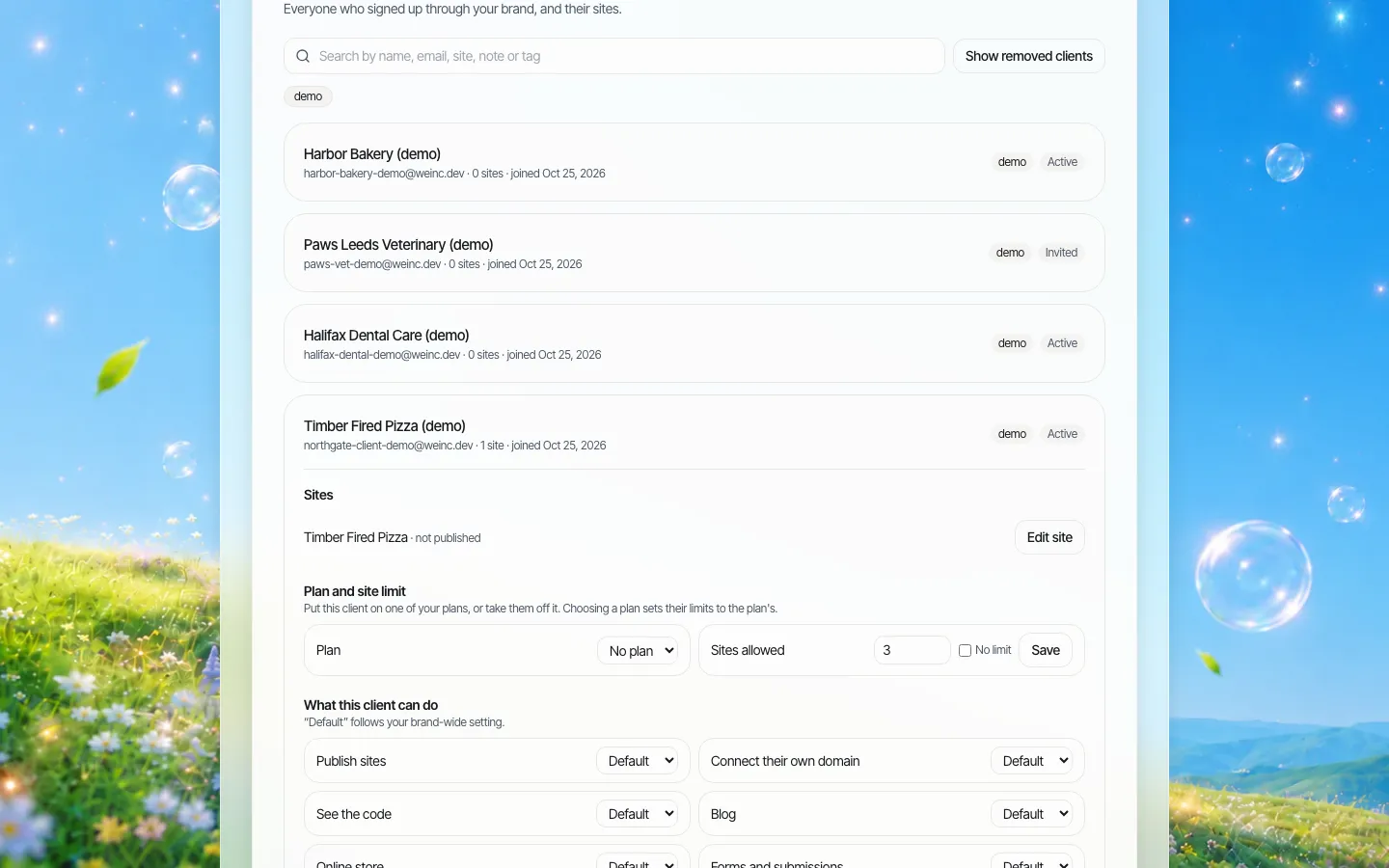
Per-location switches. For each location you decide whether it can publish on its own, connect its own domain, see the code, run a blog, an online store, forms and submissions, and change SEO settings. A brand-wide default applies unless you override it for one location.
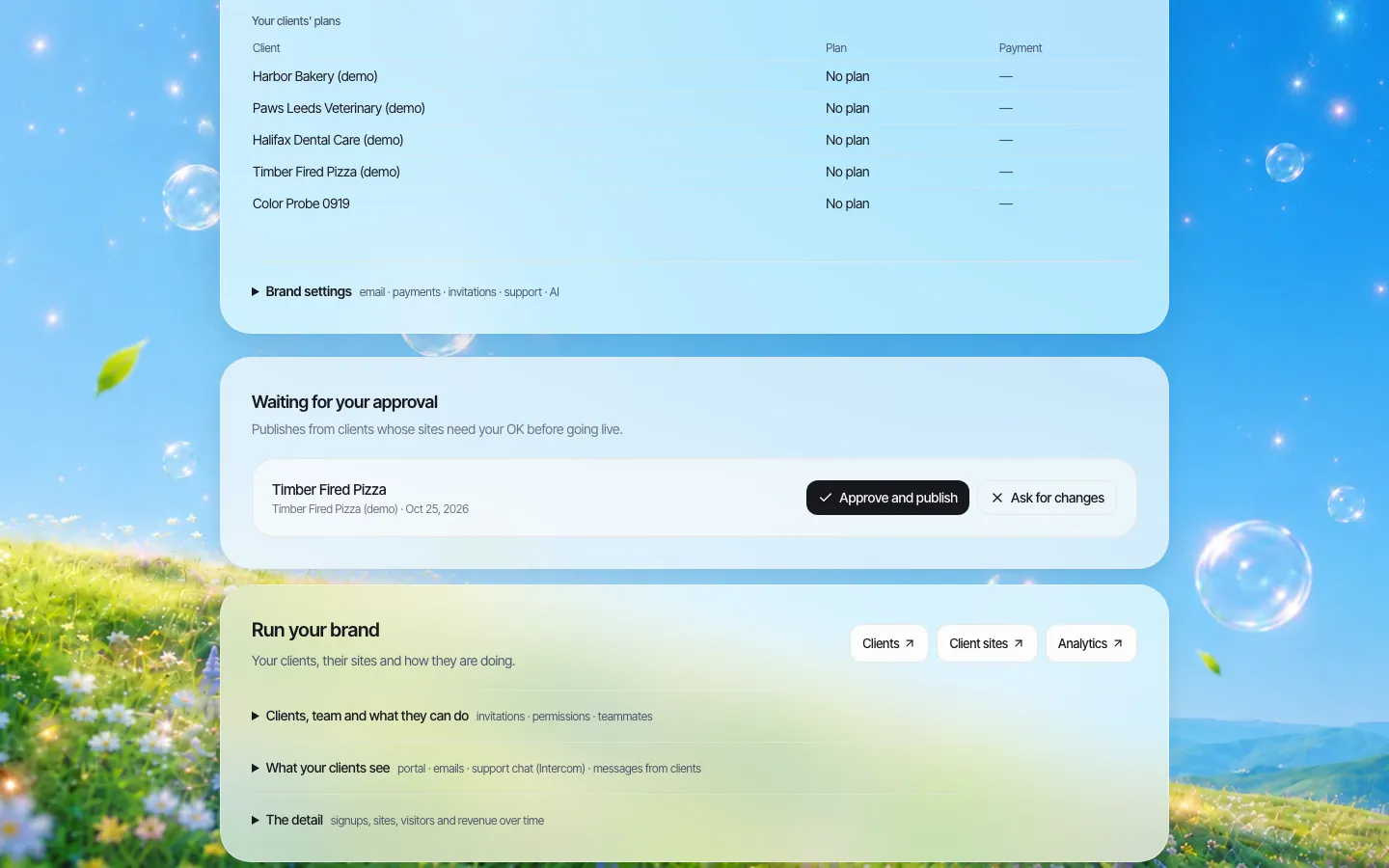
Approval before publishing. Set "publishing needs my approval" for all locations or for one, and changes wait in a queue until the brand owner approves them or asks for changes. It is a single approval step, not a multi-stage chain. That is the natural place to run the swap test and the review rules above before anything goes live.
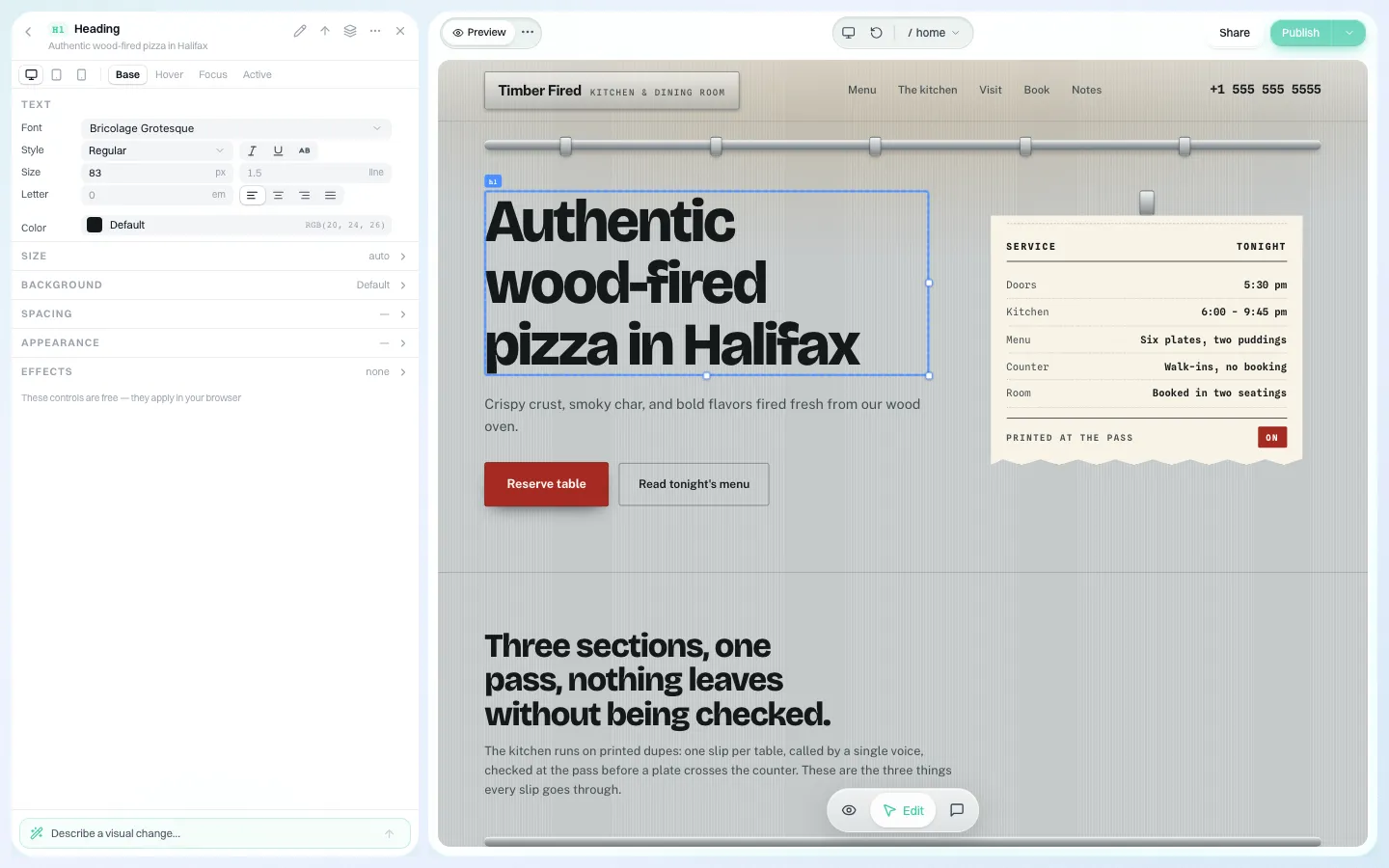
Plain-English editing. A franchisee can change hours or add a team photo by asking in plain words, or click on the page and edit text, sizes and colours directly. That speed is exactly why approval and the "last reviewed" habit matter.
A domain per location, if you choose. A location's site can be connected to a domain you own, or kept under the brand's domain structure. Who owns that domain when a franchisee leaves is a contract question, covered in our vendor exit plan guide.
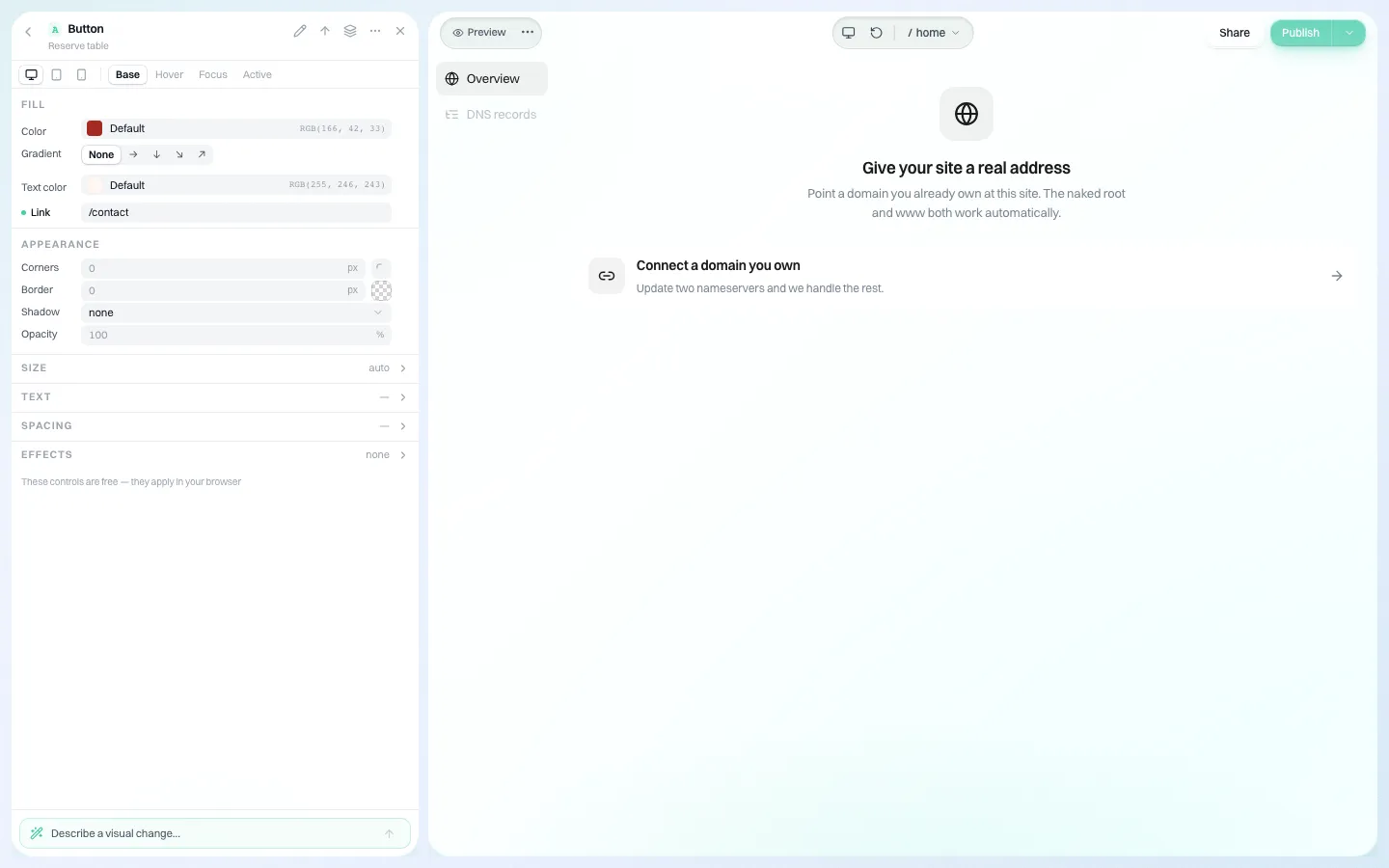
What it does not do. We.Inc does not run your store locator, sync Business Profiles, or lock individual fields on a page; control is per site and per feature, plus approval. Sites are generated and edited with AI, so check the structured data and the accessibility of each published page rather than assuming either. Each site's code can be downloaded or synced to GitHub, so the pages are not trapped with us.
Bring three real locations to a 30-minute demo (a new one, a long-standing one, and one with a quirk) and we will walk through how their pages, approvals and domains would be set up.
Sources
Last checked 2026-10-25.
- Google Search Central, Spam policies for Google web search (doorway abuse, scaled content abuse).
- Google Business Profile Help, Guidelines for representing your business on Google (one profile per location, naming, departments, eligibility).
- Google Search Central, Local business (LocalBusiness) structured data.
- Federal Trade Commission, 16 CFR Part 465, Rule on the Use of Consumer Reviews and Testimonials, and the Federal Register notice (effective October 21, 2024).
This guide is general information about search and consumer-protection rules, not legal advice. Check review and advertising rules with a qualified lawyer for the places your locations trade.
Frequently asked questions
How different does each franchise location page need to be?
Different enough that swapping the town names would make both pages wrong. Real hours, phone, team, photos of the premises, directions, which services that branch offers and the questions its customers actually ask make a page local. Pages that differ only by place name risk being treated as doorway pages.
Should a location page link to the location's Google Business Profile, or the other way round?
Both, but the important one is the profile's website link pointing to that location's own page rather than the brand home page, so people land on the address and hours they were looking at. Keep the name, address, phone and hours identical in both places.
Can we show the same customer reviews on every location page?
No. A testimonial should come from a real customer of that location. In the US the FTC rule on consumer reviews, in effect since October 21, 2024, prohibits fake reviews and undisclosed insider reviews, and copying a review onto locations the customer never visited misleads readers.
What should happen to a location page when the location closes?
Redirect its URL permanently to the nearest open location or to the store locator, mark the Business Profile permanently closed, and remove it from the locator and sitemap. A page that still lists hours for a closed location is the worst outcome.
More in Guides
- Can You Get a Free Domain Name? An Honest Breakdown | How-to Guide
- Free Next.js Templates, Checked for Licence and Upkeep
- React vs Vue vs Svelte vs Astro vs Next.js, with the Same App
- Git Cheat Sheet, Grouped by What You Want to Do
- Git Rebase: Rebase vs Merge, Interactive Rebase and Undo
- How to Rename a Git Branch (Local and Remote)
- Git Worktree: Several Branches Checked Out at Once
- GitHub Personal Access Tokens for Git
Website builders for the businesses in this article
Related guides and tools
Start building
We.Inc is an AI-powered website builder you can resell under your own brand. Launch a branded client dashboard, bill on Stripe Connect, and deliver AI-generated websites in minutes. White-label pricing is tailored to your volume and setup: book a 30-minute demo for a quote.
Product
- AI Website Builder: Describe a site in plain English; it's live in minutes
- White Label Platform: Your brand, your domain, your margin
- Enterprise: SSO, custom SLAs, and dedicated support
- Developer API: Embed site generation into your SaaS
Who It's For
- For Agencies: Resell under your brand
- For Freelancers: Your own branded builder
- For Hosting Providers: Add a builder to your stack
- For SaaS Platforms: Embed site creation via API
- For Startups
- For Financial Services
- For Healthcare
Features
- Drag & Drop Editor
- Built-in SEO Tools
- Custom Branding
- Client Dashboard
- Reseller Billing (Stripe Connect)
Resources
- Blog
- Help Center
- Free Business Tools
- Free UI Components
- Website Templates
- Template Collections
- Website Examples
- Guides
- Comparisons
- Alternatives
- Best Lists
- Reviews
- Pricing Guides
- Use Cases
- Glossary & Guides
- Integrations
- Developers
- Benchmark
- Windows App