
A fashion designer website that presents your collections
The best way to build a fashion designer website is to start from a free lookbook-style template if you just need a visual portfolio, or describe your label and collections to we.inc's AI (from $20/month) so it writes your design story and builds collection pages. Actual sales still need a separate cart tool such as Shopify, so the site itself typically focuses on presentation, press, and wholesale inquiries.
A fashion designer website that presents each collection as a lookbook and tells the story behind your work, for buyers, press, and customers alike.
Pages every fashion designer website needs
- Home: Should open with a strong image from your current or most recent collection and a clear sense of your aesthetic.
- Collections / Lookbook: Each collection deserves its own visual lookbook page rather than being mixed into one long gallery.
- About / Design Story: Buyers, press, and collaborators want to understand your inspiration, materials, and design philosophy.
- Press & Stockists: Listing press mentions or where your pieces are sold builds credibility fast for a design label.
- Wholesale / Contact: Buyers and boutiques need a clear way to inquire about carrying your line, separate from general contact.
Try this prompt
A portfolio website for an independent fashion designer in New York named Mira Solene, showcasing her debut ready-to-wear collection with a lookbook page, a design story page about her use of natural fabrics, and a wholesale inquiry page for boutique buyers.
How should a lookbook be laid out online?
One look per screen, large and uncluttered, in the order the collection was shown. Under each image, name the look and its key pieces and fabrics. Keep the styling notes short so the photos lead. If you shoot on a model, credit the photographer, model and stylist; buyers and editors notice who you work with.
What should a wholesale page tell a boutique buyer?
Whether you are open to wholesale, how to request your line sheet and the basic terms. Mention minimum order sizes and lead times in general terms if you have them, and the seasons you sell. Then make the enquiry simple: the form emails you, so ask for the store name, location and the buyer's contact details.
Online store, portfolio or both: options for a fashion designer
A fashion designer's site usually has to do two jobs: show the work to buyers and press, and sell pieces directly. The common routes are an ecommerce platform, a portfolio builder, a marketplace shop, or one site that combines a lookbook and a store.
| Option | Good for | Watch out for |
|---|---|---|
| Shopify | Strong for selling sizes, colours and stock across many products, with plenty of fashion themes. | Lookbook and editorial pages take theme work, and apps add up as you grow. |
| Squarespace or Format | Beautiful image-led portfolios that suit collections, campaigns and press pages. | Commerce is lighter, so complex variants and wholesale ordering are harder. |
| Etsy or a curated marketplace | Shoppers already browsing for handmade or independent labels. | Your label sits beside many others and the marketplace sets the rules and fees. |
| we.inc | Describe your label and collections to get a lookbook, about, stockists and press pages, plus a store that takes payment through your own Stripe account. | It is not a wholesale or line-sheet system, so trade buyers still need your showroom or B2B tool. |
A lookbook page per collection gives stylists and editors something specific to link to when they feature your work.
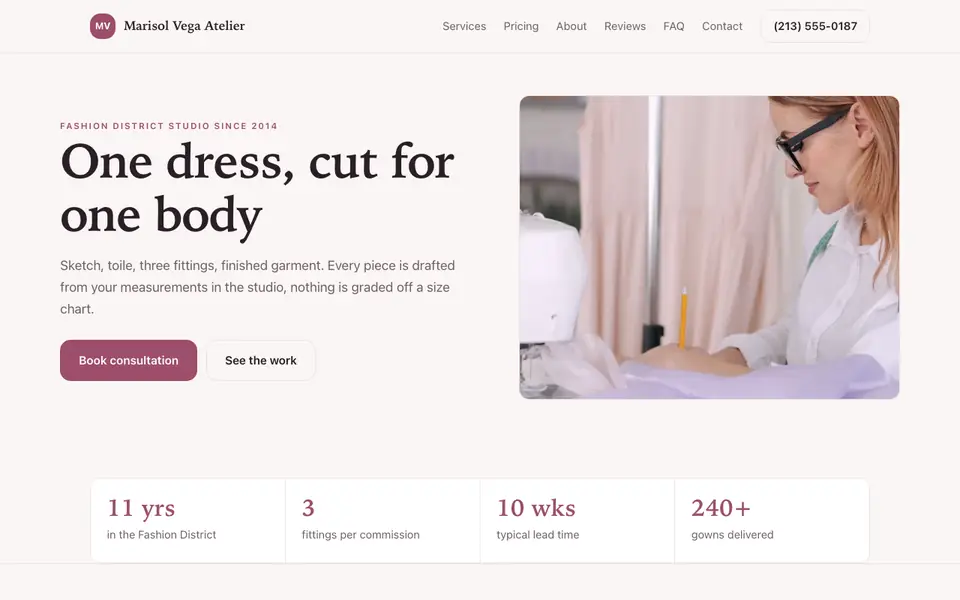
A real fashion designer site, not a template
This is Marisol Vega Atelier, a fashion designer business we described to the AI in a sentence. See the Marisol Vega Atelier example site.
Start from this design
Three designs that suit a fashion designer website.
- Voxel Character Motion Portfolio
- Gallery-White Wedding Photographer
- Full-Bleed Wedding Photography
About fashion designer website design on we.inc
Describe your label and the AI builds a site with your collections, lookbook, and story. Edit by chat, visually, or in code.
Fashion Designer website design without the agency retainer. Describe the business in plain English and the AI writes and builds the pages around it: your services, your prices, your words.
Features designed for your industry
- Lookbook pages: Present each collection as its own visual lookbook rather than a flat product grid.
- Design story page: Explain your inspiration, materials, and process, which matters as much as the garments themselves.
- Press & stockists page: List press features and where your work is sold or shown to build credibility with buyers.
Who this fashion designer website design suits
- An independent designer launching a debut collection lookbook
- A fashion label building a site ahead of a runway show or trade event
- A designer showcasing past collections alongside a wholesale inquiry page
- A student or emerging designer building a portfolio for internship applications
What makes a fashion designer website work
Lookbooks need consistent styling
Group images by collection and keep lighting, background, and model styling consistent within each set. A lookbook that mixes production stills with phone photos undercuts an otherwise strong collection.
Design story sells as much as the clothes
Materials, construction details, and inspiration give buyers and press something to write about beyond 'nice dress.' This is often what separates a memorable designer page from a generic one.
Wholesale inquiries need their own path
Boutique buyers look for line sheets, minimum order info, and a direct contact, which is different from a general customer contact form. Keep that inquiry separate and clearly labeled.
Selling direct still needs a commerce platform
If you plan to sell pieces directly to consumers, the AI can build product pages with checkout through your own Stripe account; for inventory management, link a tool like Shopify or Etsy.
What it costs
Your domain costs about $10 to $20 a year. If you sell direct-to-consumer, budget for a separate e-commerce platform like Shopify on top of that. For an AI-built lookbook and design story site, Starter at $20/month typically covers it.
Free for 3 template sites, without AI; AI building from $20 a month. Compare plans
Frequently asked questions
How much does a fashion designer website cost?
A free we.inc template gives you a basic lookbook site with no AI. For AI-written collection pages and a design story, Starter is $20/month for 250 credits, plus about $10 to $20 a year for your own domain.
Can I sell my collection directly through the site?
Yes. The AI can build collection pages with checkout that pays into your own Stripe account, or you can link out to Shopify or Etsy if you already sell there.
What should a fashion designer website include?
A strong home image, a lookbook organized by collection, a design story or about page, press or stockist listings, and a wholesale or contact page for buyers.
Can I use my own domain for my label's website?
Yes, custom domains, SSL, and hosting are included on paid we.inc plans, so your label can run on its own domain instead of a we.inc address.
Will the website help buyers or press find me?
The AI writes real page content and titles, which helps if someone searches your label name, but most fashion press and buyer interest still comes from showrooms, trade shows, and direct outreach rather than search traffic alone.
Related industries and website guides
- interior design website builder
- graphic design website builder
- musician website builder
- wedding planner website builder
- filmmaker websites
- florists website builder
- fashion designers website examples
- how to make a website
Related website builders: Creative & Entertainment
- interior design website builder
- graphic design website builder
- musician website builder
- wedding planner website builder
- filmmaker websites
- florists website builder
Before you start
Product
Who It's For
- For Agencies
- For Freelancers
- For Hosting Providers
- For SaaS Platforms
- For Startups
- For Financial Services
- For Healthcare
Features
Resources
- Blog
- Help Center
- Free Business Tools
- Free UI Components
- Website Templates
- Template Collections
- Website Examples
- Guides
- Comparisons
- Alternatives
- Best Lists
- Reviews
- Pricing Guides
- Use Cases
- Glossary & Guides
- Integrations
- Developers
- Benchmark
- Windows App