
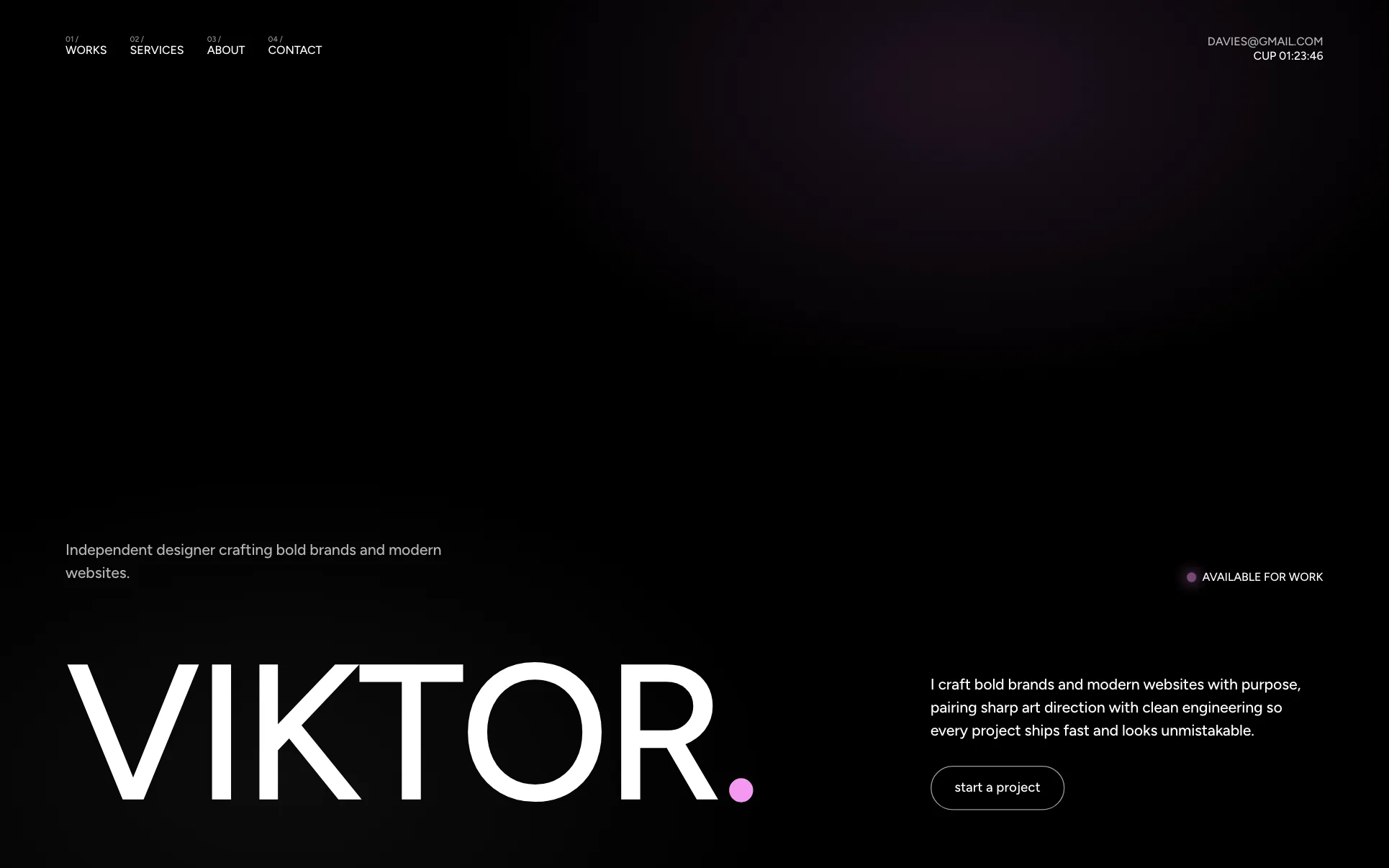
A portfolio website that gets you hired
A strong portfolio website leads with a handful of your best projects shown as short case studies, not a long list of everything you've ever made. Building a site on We.Inc is free, with no card needed to start.

A portfolio website that shows your best work the way it deserves to be seen. On We.Inc you can build your site free, with no card and no trial needed to start.
Pages every portfolio website needs
- Home: State what you do and who you do it for in one sentence, then show your strongest project immediately. Don't make visitors scroll to figure out your specialty.
- Projects / Work: Three to six of your best projects, each with enough context (problem, your role, outcome) to actually demonstrate skill, beats a gallery of twenty thumbnails with no explanation.
- About: Your background, skills, and what kind of work you're looking for, written in a way that sounds like a person, not a keyword list.
- Resume: A clean on-page version plus a downloadable PDF covers both browsing and job applications that require an attached file.
- Contact: A simple form or a direct email link. Don't make people dig for how to reach you if they've already decided they want to.
Try this prompt
A portfolio website for a UX designer named Marcus Webb based in Chicago, with a clean and modern tone, three detailed case studies showing problem, process, and outcome, an about page, a downloadable resume, and a contact form.
How should each portfolio project be written up?
Lead with the result, then show how you got there. A good write-up fits on one screen at the top: the problem, your role, the tools and the outcome. Below that, add the process for readers who want the detail. If the work is under a client agreement, describe it in general terms or ask permission before showing it.
What goes on the home page of a portfolio?
Your name, what you do in one line and your three best projects. Hiring managers decide quickly whether to keep reading, so lead with the work rather than a long introduction. Link to the full list, your resume and a contact option from the same screen.
A portfolio site, shown on a design studio example
We have no example built only as a personal portfolio, so this uses Bracket Studio, a packaging and identity studio our AI invented from one sentence. The structure carries over to any portfolio; the packaging services and studio pricing are specific to that business and would change for yours.
The work link sits next to the contact link
The top of Bracket Studio offers two buttons: see the work and start a project. A portfolio visitor is usually deciding whether to hire you, so the proof and the next step belong side by side.
Each service says what you actually receive
Instead of a vague list of skills, every service names the files and deliverables a client gets, such as a logo system with usage rules. Writing your own work this way answers the question a buyer has before they ask it.
A short line on who does the work
The about section explains the studio is three senior designers with no account managers in between. For a solo portfolio, the same idea is one honest paragraph on who you are and how you like to work.
Start from this design
Three designs that suit a portfolio website.
- Black Minimal One-Word Portfolio
- Full-Bleed Wedding Photography
- Dark Software Engineer Portfolio
Show your best work the way it deserves to be seen. Building a site on We.Inc is free: no card and no trial are needed to start.
Portfolio website design without the agency retainer. Describe the business in plain English and the AI writes and builds the pages around it: your services, your prices, your words.
Features designed for your industry
- Case studies, not just images: Each project page can walk through the problem, your process, and the result, which matters more to hiring managers than a screenshot alone.
- A resume that's actually readable: Turn a dense PDF resume into a clean, scannable page, with a downloadable PDF version still available for applications that require one.
- One clear way to get in touch: A contact form or direct email link so recruiters and clients don't have to hunt for how to reach you.
Perfect for:
- A UX designer showcasing case studies with problem, process, and outcome for each project
- A developer portfolio linking to GitHub repos and live project demos
- A photographer's portfolio organized by shoot type with a booking inquiry form
- A writer's portfolio linking to published articles and a downloadable resume
Fewer, better projects beat a long list
Three to six strong case studies with real context read as more credible than fifteen thumbnails with no explanation. Cut anything you can't speak to confidently in an interview.
Show process, not just the final result
For design and development work especially, a short walkthrough of the problem you were solving and the decisions you made tells a hiring manager more than the polished final screenshot alone.
Link out to live proof where it exists
GitHub repos, live deployed sites, published articles, or client sites you built all count as stronger proof than a static image, so link to them directly whenever the work is publicly viewable.
Keep contact information easy to find
Recruiters and clients skim. A contact link in the main navigation, not buried at the bottom of an about page, removes friction at the exact moment someone has decided they want to reach you.
What it costs
A domain with your name, like marcuswebb.com, costs about $10 to $20 a year and is worth it for a professional portfolio. The free plan is enough to get a straightforward portfolio live; Starter at $20 a month is worth it if you want the AI writing case study copy and restructuring the site as your work changes.
Building your site is free, no card needed. Paid plans from $20 a month. Compare plans
Frequently asked questions
How much does a portfolio website cost?
On We.Inc you can build your site free, with no card and no trial needed to start. Paid plans start at $20 a month on Starter with 250 credits.
How many projects should I include?
Three to six strong projects with real context on your role and the outcome is usually stronger than a long list of everything you've made. Quality of explanation matters more than quantity.
Can I use my own domain name?
Yes, custom domains and SSL are included on paid plans (from $20/mo), so a domain with your name or professional brand works from day one.
Should I include a downloadable resume?
Yes, a clean on-page summary plus a downloadable PDF covers both casual browsing and applications that specifically require an attached resume file.
Does a portfolio website actually help with getting hired?
It gives you one link to send instead of scattered files, and case studies with real context show your thinking, which a resume alone usually can't. It won't replace networking or applications, but it strengthens both.
Related industries and website guides
- musician website builder
- wedding planner website builder
- newsletter website builder
- personal website builder
- rappers website builder
- voice actor website builder
- free portfolio website builder
- how to make a website
Related website builders: Creative & Entertainment
- musician website builder
- wedding planner website builder
- newsletter website builder
- personal website builder
- rappers website builder
- voice actor website builder
Before you start
Related guides
Product
Who It's For
- For Agencies
- For Freelancers
- For Hosting Providers
- For SaaS Platforms
- For Startups
- For Financial Services
- For Healthcare
Features
Resources
- Blog
- Help Center
- Free Business Tools
- Free UI Components
- Website Templates
- Template Collections
- Website Examples
- Guides
- Comparisons
- Alternatives
- Best Lists
- Reviews
- Pricing Guides
- Use Cases
- Glossary & Guides
- Integrations
- Developers
- Benchmark
- Windows App