The website builder made for vintage & thrift shops.
A vintage shop website should capture what makes your store worth the trip: the eras and styles you curate, recent arrivals, how consignment or buying works, and your hours and address. On we.inc the AI builds those pages, and if you want to sell online it can set up a store that takes payment through your own Stripe account. Because most vintage items are one of a kind, plan how you will mark pieces sold when they go in the shop.
Create a stunning vintage shop website that attracts clients, showcases your work, and grows your business, no coding required.
Pages every vintage shop website needs
- Home: Your style in a line, such as 70s denim and workwear or mid-century home goods, a grid of new arrivals, and your hours. Regulars check for fresh stock before visiting.
- New Arrivals: A frequently updated page of recent finds with photos, era, size and condition. It gives shoppers a reason to come back and share links.
- Shop Online: Individual listings with measurements, flaws noted, and a buy button through your Stripe account. Detailed measurements reduce returns more than any size label.
- Consignment & Selling to Us: What you accept, buying days, payout split or cash offer terms, and how to send photos first. This keeps unsuitable drop-offs down.
- Shipping, Returns & Condition Guide: Explain your condition grades, final-sale policy on one-of-a-kind pieces, and shipping times. Vintage buyers expect wear, but want it described honestly.
- Visit Us: Address, hours, parking, and any pop-up markets or events you do. Many vintage sales still happen in person.
Try this prompt
A website for Second Spin Vintage, a vintage clothing shop in Chicago, Illinois focused on 70s to 90s denim, band tees and workwear. We sell in store and online, buy from the public on Tuesdays, and take consignment on designer pieces. Include a new arrivals page, an online shop with measurements and condition notes, a consignment and selling page with a photo submission request form, a returns and condition guide, and store hours. Gritty, editorial look with film-photo styling.
A real vintage shop site, not a template
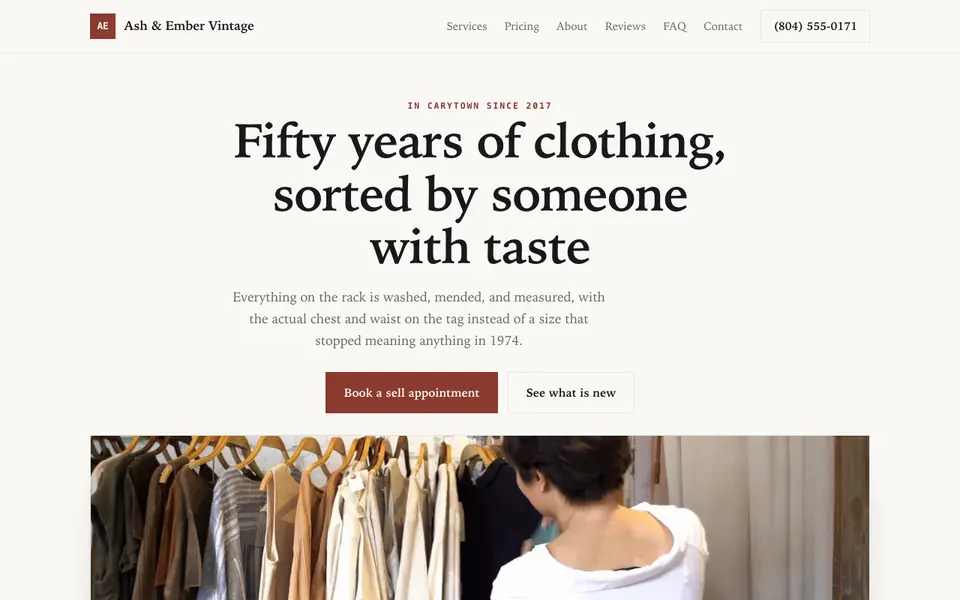
This is Ash & Ember Vintage, a vintage shop business we described to the AI in a sentence. Every service, price and line of copy on it was written for that business. See the Ash & Ember Vintage example site.
Start from this design
Three designs that suit a vintage shop website. Each one is free to start from.
- Noir Atelier
- Loop
- Quietpress
About vintage shop website design on we.inc
A vintage shop website designed around your actual services and prices, not a stock layout. Describe the business and the AI writes and builds every page.
Features designed for your industry
- New Arrivals: Tailored features designed specifically for vintage & thrift shops to help you stand out online.
- Style Categories: Built-in tools that make managing your vintage shop business easier and more efficient.
- Consignment Info: Grow your vintage shop business with marketing tools that drive results.
Who this vintage shop website design suits
- Vintage clothing
- Antique shops
- Thrift stores
What makes a vintage shop website work
Measurements beat sizes
Vintage sizing is inconsistent across decades. Ask the AI to include pit-to-pit, length, waist and inseam fields on each listing so buyers can compare with clothes they own.
Watch for double-selling
we.inc has no POS and does not sync store and online stock. If a piece sells at the register, mark it sold or remove it online promptly, or keep online-only pieces off the shop floor.
Make selling to you a filtered process
A request form where sellers describe items and share photo links first means you only see what fits your store. Spell out buying hours and whether you pay cash, store credit or consignment splits.
Describe condition honestly
Note stains, repairs, fading and missing buttons. Clear condition grades and final-sale terms for one-of-a-kind items protect you from disputes and chargebacks.
What it costs
To try it out, the free plan allows up to 3 template sites on a we.inc address, though it has no AI and no custom domain. AI building and updating starts on Starter at $20 a month, and a custom domain requires a paid plan plus the domain, normally $10 to $20 a year. Card payments go through your own Stripe account, which charges its usual processing fees.
The free plan lets you build up to 3 sites from templates and publish them free on a we.inc address. It has no AI. Building and editing with AI starts on Starter at $20 a month with 250 credits.
Frequently asked questions
Can I sell my vintage pieces online?
Yes. Connect your own Stripe account and the site can take payment for individual items. You handle shipping and fulfillment.
Will online stock update when something sells in the store?
No. There is no point-of-sale sync. Remove or mark sold items on the site yourself, or ask the AI to do it on a paid plan.
Can consigners log in to see their payouts?
No. There is no consigner portal. Track consignment in your own records or dedicated consignment software and share statements by email.
How often should I update new arrivals?
As often as you can realistically keep up. A regularly refreshed arrivals page gives regulars a reason to visit, and on a paid plan the AI can add new pieces from a quick description and photos.
Can I also list items on marketplaces?
Yes, many shops do. Just be careful that the same one-of-a-kind item is not sold in two places, and link your marketplace shop from the website if you like.
More in Website Builder
- A virtual assistant website that gets you hired
- The website builder made for voice actors.
- The website builder made for web design agencies.
- Show clients what you can build.
- Help couples fall in love with your work.
- Make couples fall in love with your venue.
- A website for your wedding business, built by AI
- The website builder made for window cleaning services.
Related website builders: eCommerce & Retail
- dropshipping website builder
- online store website builder
- print on demand website builder
- wine shops & vineyards website builder
- bike shops website builder
- bookstores website builder
Before you start
We.Inc is an AI-powered website builder you can resell under your own brand. Launch a branded client dashboard, bill on Stripe Connect, and deliver AI-generated websites in minutes. White-label plans start at $99 a month for 25 client sites, with a 7-day free trial and no per-site fees.
Product
- AI Website Builder: Describe a site in plain English; it's live in minutes
- White Label Platform: Your brand, your domain, your margin
- Enterprise: SSO, custom SLAs, and dedicated support
- Developer API: Embed site generation into your SaaS
Who It's For
- For Agencies: Resell under your brand
- For Freelancers: Your own branded builder
- For Hosting Providers: Add a builder to your stack
- For SaaS Platforms: Embed site creation via API
- For Startups
- For Financial Services
- For Healthcare
Features
- Drag & Drop Editor
- Built-in SEO Tools
- Custom Branding
- Client Dashboard
- Reseller Billing (Stripe Connect)
Resources
- Blog
- Help Center
- Free Business Tools
- Website Templates
- Glossary & Guides
- Integrations
- Developers
- Benchmark
- Windows App