
The website builder made for home staging companies.
A home staging website sells with before-and-after photos, a clear explanation of consultation, vacant and occupied staging, and a simple way for agents and homeowners to request a quote. With we.inc the AI builds the portfolio, service pages and a staging quote form that asks for square footage, occupancy and listing date, and emails it to you.
Pages every home staging website needs
- Portfolio (Before & After): Staging is visual proof. Side-by-side room photos do more selling than any paragraph.
- Services: Separate consultation, occupied staging and vacant staging, since the scope and price differ a lot between them.
- For Realtors: Agents are repeat clients. Explain turnaround, how you coordinate with photographers and whether you offer agent terms.
- How It Works: Walkthrough, design plan, install, the rental period, and de-stage. Homeowners want to know how long furniture stays and what happens if the listing runs long.
- Request a Quote: Collects address, square footage, rooms to stage, vacant or occupied, and target list date.
- About & Service Area: Which cities and neighborhoods you cover, and who you are. Agents often want to know your inventory style before referring clients.
Try this prompt
A website for Linen & Oak Staging, a home staging company in Charlotte, North Carolina serving homeowners and real estate agents. We do consultations, occupied staging and full vacant staging. Include a before-and-after portfolio, a page for realtors, a how-it-works page explaining our install and 60-day rental period, and a quote request form. Soft neutral colors and lots of white space.
How should a home stager explain the difference between vacant and occupied staging?
Describe each in a short section: vacant staging brings in furniture and decor, while occupied staging works with the seller's own things plus a few additions. Homeowners often do not know the second option exists. Say what the seller needs to do before you arrive for each. A pair of photos for each type makes the difference obvious.
What should sellers know about how long staging stays in the home?
State your standard rental period, what happens if the home has not sold by then, and how pickup is scheduled after closing. Agents plan listings around these timings. Mention who is responsible if a staged item is damaged during showings. Clear terms on the site save awkward conversations later.
Vessel & Vine Home Staging
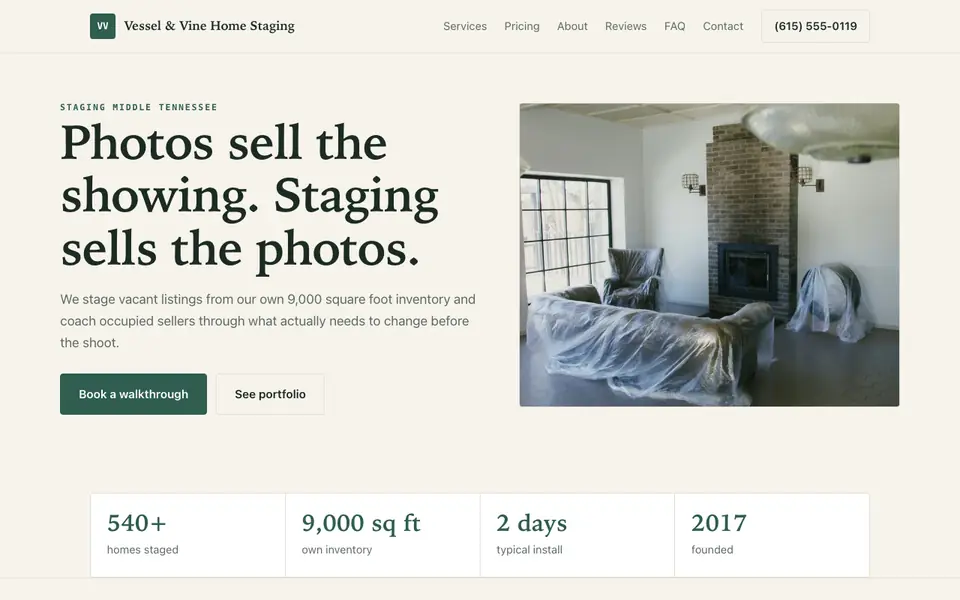
This is Vessel & Vine Home Staging, a home staging business we described to the AI in a sentence. See the Vessel & Vine Home Staging example site.
Start from this design
Three designs that suit a home staging website.
- Charcoal & Gold Real Estate Agency
- Editorial White Real Estate Agency
- Cream Luxury Hair Salon
Skip the home staging web design brief and the six week wait. Tell the AI about the business in a sentence and it builds the whole site, ready to edit.
Perfect for:
- Residential staging
- Vacant staging
- Virtual staging
Quote form built around the listing
The form asks the questions you need to price a job: square footage, number of rooms to stage, occupied or vacant, stairs or elevator access, and target list date. Submissions land in your email.
Rental period and extensions
Say plainly how long the staging period runs, what an extension costs and what happens at de-stage. It is the most common source of friction with sellers and agents.
Photo credits and permission
Listing photos often belong to the agent or photographer. Get permission and credit them on portfolio images, and remove house numbers or identifying details on occupied homes.
Scheduling stays with you
There is no synced installation calendar. Confirm install dates by reply, or link the scheduling tool you use to coordinate with movers and photographers.
What it costs
Building a site on We.Inc is free, with no card needed to start. Paid plans start at $20 a month and up, and your own staging domain needs a paid plan, with the domain name typically $10 to $20 a year.
Building your site is free, no card needed. Paid plans from $20 a month. Compare plans
Frequently asked questions
Can I show before-and-after photos side by side?
Yes. The AI can build a portfolio with paired before and after images for each room or project. Make sure you have rights to the photos you use.
Can agents request quotes for their listings?
Yes. The quote form can include agent name and brokerage alongside the property details, and each submission is emailed to you.
Should I list prices?
Many stagers show a starting price for consultations and describe what drives vacant staging costs, such as square footage and rental length, then quote each job individually.
Can I sell staging consultations online?
You can take payment for a fixed-price consultation through your own Stripe account. Larger staging jobs are better quoted first.
Can I show my furniture inventory?
You can publish a style gallery of pieces you use, but there is no inventory tracking. Keep your warehouse records in your own system.
Related industries and website guides
- funeral home website builder
- construction website builder
- pet sitting website builder
- hvac website design
- junk removal websites
- landscapers website builder
- home staging companies website examples
- how to make a website
Related website builders: Home Services
- funeral home website builder
- construction website builder
- pet sitting website builder
- hvac website design
- junk removal websites
- landscapers website builder
Before you start
Product
Who It's For
- For Agencies
- For Freelancers
- For Hosting Providers
- For SaaS Platforms
- For Startups
- For Financial Services
- For Healthcare
Features
Resources
- Blog
- Help Center
- Free Business Tools
- Free UI Components
- Website Templates
- Template Collections
- Website Examples
- Guides
- Comparisons
- Alternatives
- Best Lists
- Reviews
- Pricing Guides
- Use Cases
- Glossary & Guides
- Integrations
- Developers
- Benchmark
- Windows App