Can You White-Label Webflow? What Agencies Actually Get
No. Webflow retired Editor branding on August 4, 2026. You can hide the badge on live sites, but clients still sign in and edit inside Webflow itself.
No, not as of September 2026. Webflow lets you remove the "Made in Webflow" badge from published sites, but its Editor branding (whitelabeling) feature ended with the legacy Editor on August 4, 2026. Your clients now sign in with a Webflow account, edit inside Webflow's interface, and, if you hand billing to them, pay Webflow directly.
Short answer: You can make a Webflow site look unbranded to visitors. You cannot make Webflow look like your own product to clients. Webflow's agency model is built on referrals and partner status, not reselling.
What would white-labeling Webflow actually require?
"White label" gets used loosely, so it helps to split it into layers. A platform is fully white-label when a client can use it for years without seeing the vendor's name. That takes six things:
- The published site carries no vendor badge or credit.
- The login and dashboard sit on your domain with your logo.
- The editor shows your brand, not the vendor's.
- Emails such as invites, receipts and password resets come from your brand.
- Billing goes from the client to you, at a price you set.
- The contract allows you to resell access under your own name.
Webflow covers the first layer well. It does not cover layers two to five, and its terms restrict the sixth without written consent. The sections below show exactly why, using Webflow's own pricing page, help center and terms, all checked on September 15, 2026.
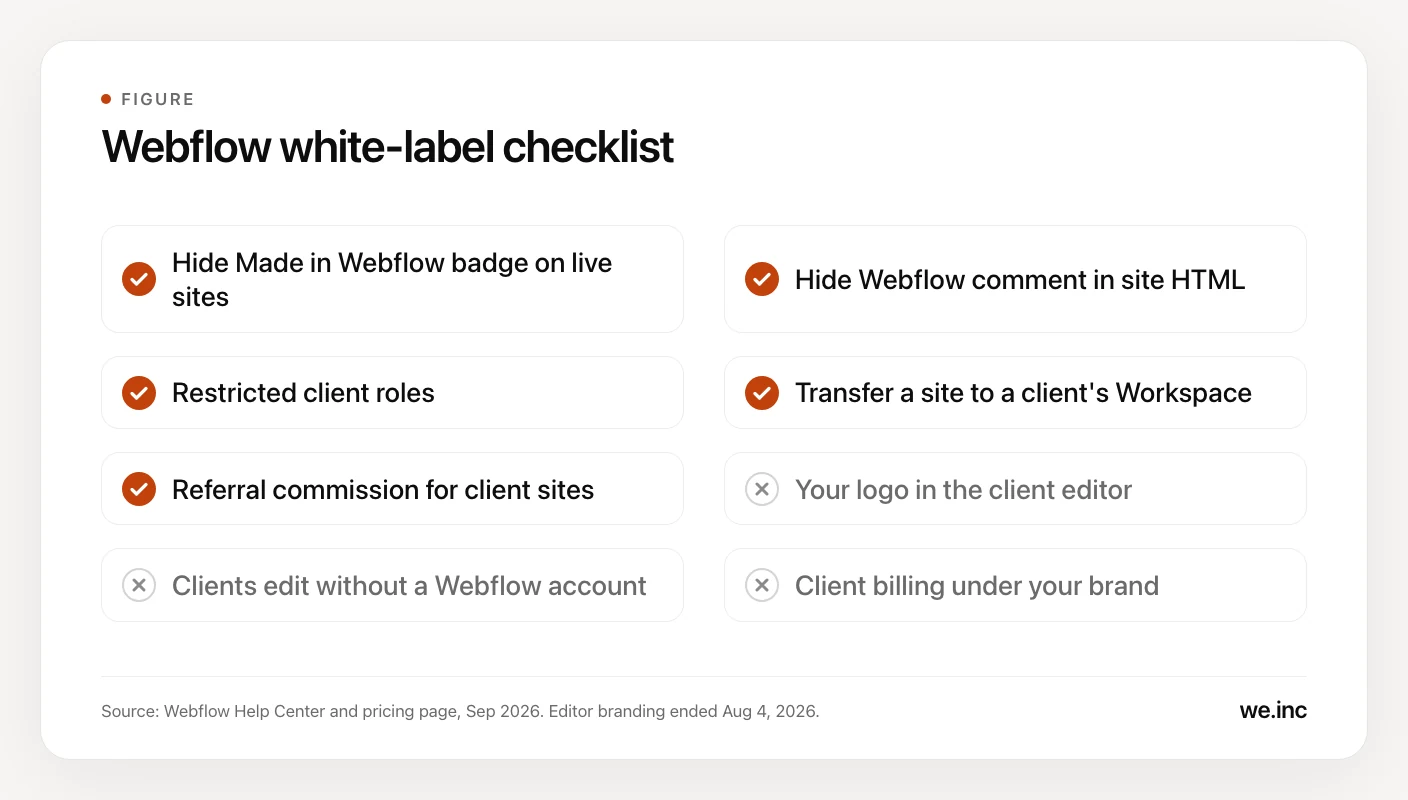
Can you remove Webflow branding from client sites?
Yes. Webflow's help article on branding says the badge is on by default, and you can hide it if you have "a Growth, Agency, or Enterprise Workspace plan or a paid site plan." Sites created inside a Growth, Agency or Enterprise Workspace start with it switched off. The toggle lives in Site settings, under the General tab.
A second toggle removes the comment Webflow adds to the top of your HTML. Webflow is candid that this "will not remove all Webflow-specific terms and references" from your site's code. Visitors will not notice. A curious client viewing the page source might.
One trap for agencies who proxy sites: if you point a reverse proxy or plugin at the free webflow.io staging address, the badge cannot be removed. Webflow says you need a paid Site plan and a custom domain or subdomain first.
What do Webflow's Freelancer and Agency plans include?
Webflow splits billing in two. A Workspace plan pays for your team and collaboration tools. A Site plan pays for hosting each site on a custom domain, and every hosted site needs its own. Prices below are from Webflow's pricing page, in USD before tax, as of September 2026.
| Plan | Billed yearly | Billed monthly | What agencies get |
|---|---|---|---|
| Freelancer Workspace | $16/mo | $24/mo | 1 full seat, 10 staging sites, 1 client seat per site, client payments |
| Agency Workspace | $35/mo | $42/mo | 1 full seat, unlimited staging sites, 3 client seats per site, site-level roles, badge-free staging |
| Extra full seat | $39/mo | $45/mo | Design and admin access |
| Extra limited seat | $15/mo | $19/mo | Content editing or page building |
| Basic Site plan | $15/mo | $25/mo | Custom domain, no CMS |
| Premium Site plan | $25/mo | $39/mo | CMS with 20,000 items, 50 GB bandwidth |
Two timing notes. Premium replaced the CMS and Business Site plans for new purchases on May 13, 2026. Existing sites inside Freelancer and Agency Workspaces move to the new Site plan pricing at their first renewal on or after November 16, 2026, so an agency's current invoices may still show the older prices.
How do clients edit a Webflow site now?
Through client seats. These arrived on February 2, 2026 to replace the legacy Editor, and they are the reason the white-label question now has a firmer answer.
- Seats are per site. Agency plans include three free client seats per site and Freelancer plans include one. Webflow says "additional client seats cannot be purchased at this time."
- Roles are limited. A client can be a Marketer (build pages from components), a Content editor (edit existing content) or a Reviewer (view and comment).
- Clients need a Webflow account. The invite asks them to "sign in to or create a free Webflow account." Clients reach the editing view in the Webflow canvas, for example by adding ?update to a live page's address.
- No branding option. Webflow's migration FAQ compares the legacy Editor with the new Content editor role, and "Editor branding (whitelabeling)" is marked available only in the legacy Editor.
There is also a rule that catches in-house setups: you cannot put someone in a client seat if they share the Workspace owner's business email domain.
Does Webflow's client billing work for resellers?
Not as reseller billing. Webflow's client payments feature, on Freelancer and Agency plans, lets you "hand off site billing to your clients," so they pay for their own Site plans and add-ons "directly in Webflow." The client accepts using a Webflow account, enters a card, and then sees a Payments tab in their Webflow dashboard. The request email comes from Webflow.
That solves a real problem: agencies no longer carry client hosting costs on their own card. But the client pays Webflow's price to Webflow, and the help article describes no way to set your own price or add a margin. Other limits: one client per site, and a maximum of ten pending payment requests per Workspace. You can also transfer a paid site straight into the client's Workspace, after which you need guest access to keep working on it.
The contract is the other half. Section 4.3 of Webflow's Terms of Service says that "without Webflow's prior written consent, you do not have the right to sublicense or resell access to the Platform." If your offer is really "our website platform" and the platform is Webflow, read that clause before you price it. For how resale models differ, see our explainer on private label versus white label website builders.
Does Webflow have a reseller or partner program?
It has a partner program built on referrals. There are three routes, and you can only be in the partner program or the affiliate program, not both.
- Webflow Foundations is the free entry tier for service-provider Workspaces on Starter, Freelancer or Agency plans. It pays 10% commission on the first year of self-serve annual Site plans and add-ons, plus 10% on Enterprise plans, for clients you bring to Webflow.
- Certified Partner requires at least one team member to pass a pre-qualification exam, a Freelancer or Agency plan, and three client site examples. Partners get a directory profile, matchmaking with prospective clients, the Partner Hub and priority support.
- The affiliate program pays 50% of a new customer's first subscription for up to 12 months, but it is aimed at people with an audience, such as bloggers and educators, and explicitly excludes client referrals.
So the Webflow model is the reverse of white label. You bring clients to Webflow, Webflow bills them, and you earn service fees plus a first-year commission.
What does running 20 client sites on Webflow cost?
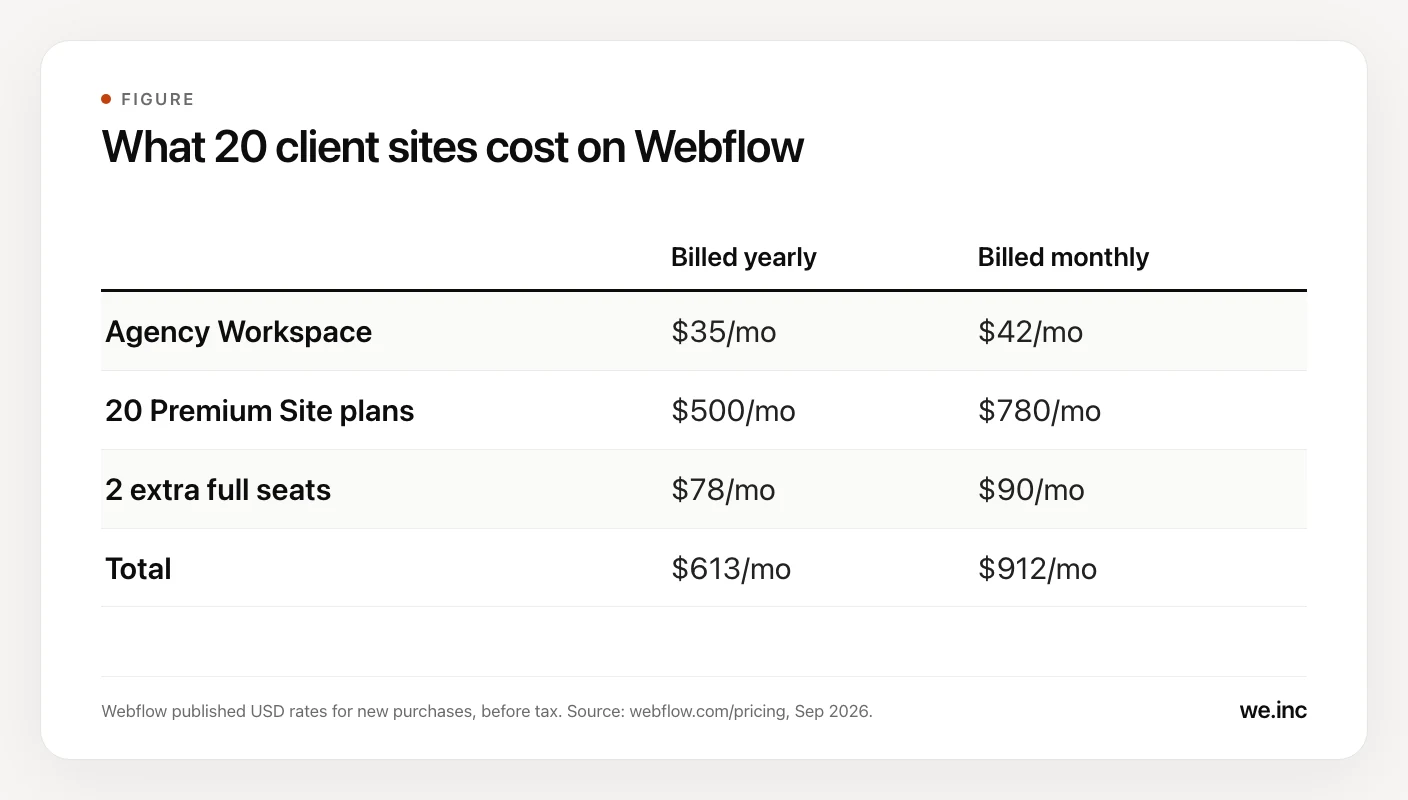
Take an agency with 20 client sites on the Premium Site plan, an Agency Workspace, and two designers on top of the owner. The agency pays for everything. Prices are Webflow's published rates for new purchases as of September 2026.
- Billed yearly: $35 Workspace + (20 × $25) Site plans + (2 × $39) seats = $35 + $500 + $78 = $613 a month, or $7,356 a year.
- Billed monthly: $42 + (20 × $39) + (2 × $45) = $42 + $780 + $90 = $912 a month.
If you use client payments instead, the 20 Site plans ($500 a month on yearly billing) move to your clients' cards and your own bill drops to $113 a month ($35 + $78). The cost is visibility: every client now receives Webflow invoices.
On the income side, Foundations commission on a Premium plan billed yearly is 10% of $300 ($25 × 12), or $30 per qualifying site, once. If all 20 sites qualified, that is $600 in year one and nothing after.
What are the workarounds, and what are the risks?
Webflow documents two techniques that agencies sometimes reach for. Neither creates a white-label product.
A reverse proxy. Webflow has a help article on serving Webflow content under your own domain or a subdirectory through NGINX, AWS CloudFront or Cloudflare. It requires a paid Site plan and a dedicated origin subdomain, you must never proxy the webflow.io address, and Webflow's support team "is unable to provide direct help" with third-party proxies. It changes the address visitors see. It does nothing for logins, the editor, emails or billing.
Your own editing tool on the Webflow Data API. Webflow's Data API includes endpoints that create CMS collection items, so a developer can build a branded form that lets clients add blog posts or listings without opening Webflow. The risks are practical: it covers CMS content rather than page design, you maintain it as the API evolves, and Section 4.3 of the terms still applies if you charge clients for access.
A third option is commercial rather than technical: keep every Site plan on your card and sell clients a monthly care plan from your own invoicing. Clients never see a Webflow invoice. But they still see Webflow the moment they log in to edit, and Webflow's site ownership article notes that sites in your Workspace belong to your Workspace, so put ownership and handover terms in your client contract.
When is Webflow still the right choice?
Often. Webflow is a strong platform, and not being white-label is only a problem if you need to resell a platform. Its real strengths:
- Design control. Designers get fine-grained visual control over layout and styling, plus Interactions with GSAP for timeline-based animation.
- A serious CMS. The Premium Site plan includes 20,000 CMS items and 40 collections.
- Team workflows. Real-time collaboration, shared libraries across sites, page building from designer-approved blocks, and site-level roles on the Agency plan.
- A growing platform. Localization, analytics and A/B testing add-ons, AI that can build a site from a prompt, and Webflow Cloud for app hosting.
- A partner ecosystem that sends leads. The Certified Partner directory and matchmaking tool connect agencies with clients looking for Webflow work.
| If you... | Better fit |
|---|---|
| Sell custom design projects and hand the site over | Webflow |
| Want clients to know and trust the platform brand | Webflow |
| Prefer referral commission to resale margin | Webflow Foundations or Certified Partner |
| Need clients to log in to a platform on your domain | White-label builder |
| Want clients to pay you a monthly price you set | White-label builder |
| Run many small sites where per-site hosting squeezes margin | White-label builder |
If you land in the bottom half of that table, our list of Webflow alternatives for agencies covers the platforms built for resale, and the white-label website builder guide explains what to check before you sign. Per-site pricing is not unique to Webflow either: our Duda white label review runs the same arithmetic at 10, 50 and 150 sites.
Where We.Inc fits
We.Inc covers the layers Webflow leaves out. Partners run the AI website builder on their own web address, with their own name, logo and colors on the login, dashboard and builder screens, and the emails their customers receive carry the partner's brand. Customers pay the partner through the partner's own Stripe account.
Customers or partners describe a business, the AI builds the site, and it can be edited visually or in code, then published to a custom domain with SSL. The platform fee is one flat monthly fee with no per-site charge, shared on a 30-minute demo call, and a done-for-you install goes live in about 14 days. See the details on the We.Inc white-label page.
Sources
- Webflow: Plans and pricing, checked September 2026
- Webflow Help Center: Webflow branding, checked September 2026
- Webflow Help Center: The legacy Editor, checked September 2026
- Webflow Help Center: Legacy Editor deprecation FAQ, checked September 2026
- Webflow Blog: Legacy Editor deprecation, checked September 2026
- Webflow Help Center: Choose a Workspace plan, checked September 2026
- Webflow Help Center: Manage client seats, checked September 2026
- Webflow Help Center: Client payments, checked September 2026
- Webflow Help Center: Updated pricing and simplified plans for May 2026, checked September 2026
- Webflow Help Center: Join Webflow Foundations, checked September 2026
- Webflow Help Center: Webflow Certified Partner program, checked September 2026
- Webflow Help Center: Webflow's affiliate program overview, checked September 2026
- Webflow Help Center: Set up a self-managed reverse proxy in Webflow, checked September 2026
- Webflow Help Center: Site ownership, checked September 2026
- Webflow Developers: Create collection items, checked September 2026
- Webflow: Terms of Service, checked September 2026
More in Blog
- Claude Opus 5 Just Launched. Here Is What You Can Build With It.
- How to Analyze Your Competitors' SEO Strategy
- Content Gap Analysis: Find Opportunities Your Competitors Miss
- Core Web Vitals: A Complete Optimization Guide
- How to Improve Customer Experience at Every Touchpoint
- How to Collect and Use Customer Feedback Effectively
- Data-Driven Decision Making for Small Businesses
- Data Privacy Compliance: GDPR, CCPA, and Beyond
We.Inc is an AI-powered website builder you can resell under your own brand. Launch a branded client dashboard, bill on Stripe Connect, and deliver AI-generated websites in minutes. White-label plans are custom priced, with no per-site fees.
Product
- AI Website Builder: Describe a site in plain English; it's live in minutes
- White Label Platform: Your brand, your domain, your margin
- Enterprise: SSO, custom SLAs, and dedicated support
- Developer API: Embed site generation into your SaaS
Who It's For
- For Agencies: Resell under your brand
- For Freelancers: Your own branded builder
- For Hosting Providers: Add a builder to your stack
- For SaaS Platforms: Embed site creation via API
- For Startups
- For Financial Services
- For Healthcare
Features
- Drag & Drop Editor
- Built-in SEO Tools
- Custom Branding
- Client Dashboard
- Reseller Billing (Stripe Connect)