Private Label vs White Label Website Builder: The Difference
Private label means built for one seller; white label means one product rebranded by many. In website builders the terms blur, so check the branding depth.
A private label product is made for one seller only, usually to that seller's specifications. A white label product is a standard product that many sellers rebrand as their own. In website builders the two terms are often used for the same thing, so the useful question is how deep the rebranding goes and whether anyone else can sell the identical product.
TL;DR: Private label means exclusive and customised. White label means shared and rebranded. If a vendor sells the same builder to every partner, it is white label by the retail definition, whatever the sales page says. Judge any offer on five levels of rebranding (logo, domain, emails, billing, invisible vendor) and on who owns the customer, not on the label.
What does private label mean?
In retail, a private label is a brand owned by the company that sells the product, while a third party makes it. Wikipedia draws the line precisely: a private-label product is "made by a manufacturer exclusively for one client, who sets the product specifications." Store brands such as Great Value at Walmart and Market Pantry at Target are the familiar examples.
Three things define private label:
- Exclusivity. Only that seller gets that product.
- Specification. The seller decides what the product is, not just what it is called.
- Up-front investment. Custom work costs more and takes longer to reach the market.
So a private label website builder, in the strict sense, is a builder made or configured for one company, which the vendor does not sell in the same form to anyone else.
What is a white label website builder?
A white-label product is one that a producer makes and other companies "rebrand to make it appear as if they had made it," in Wikipedia's words. The name comes from a blank white label on the packaging, waiting for the seller's own brand. The producer sets the specifications and sells the same product to many sellers. Shopify's guide to the two models puts the key difference plainly: white-label products "can be sold by multiple retailers, including competitors."
Software fits this pattern well. Wikipedia notes that white-label software typically needs "the adaptation of the software's visual appearance, multi-customer management and automatic billing to the end-customers based on usage parameters." That is a fair description of a white label site builder or white label website creator: one platform, many agencies, each with its own brand on top.
Is a private label website builder the same as a white label one?
In everyday use, mostly yes. Vendors, agencies and review sites use both phrases for the same kind of product: a builder your clients use under your brand. The retail distinction only appears when you ask two questions.
- Will the vendor sell the identical product to the agency across the street? If yes, it is white label by the retail definition.
- Will the vendor build features, workflows or integrations to your spec, for you alone, and put that in the contract? If yes, you are getting something closer to private label.
Neither is better. White label reaches the market faster and costs less, with a product other partners are already using and reporting problems on. Private label costs more and takes longer, and it only makes sense when exclusivity or custom features let you charge more or win clients you otherwise would not.
Reseller vs white label vs private label vs OEM
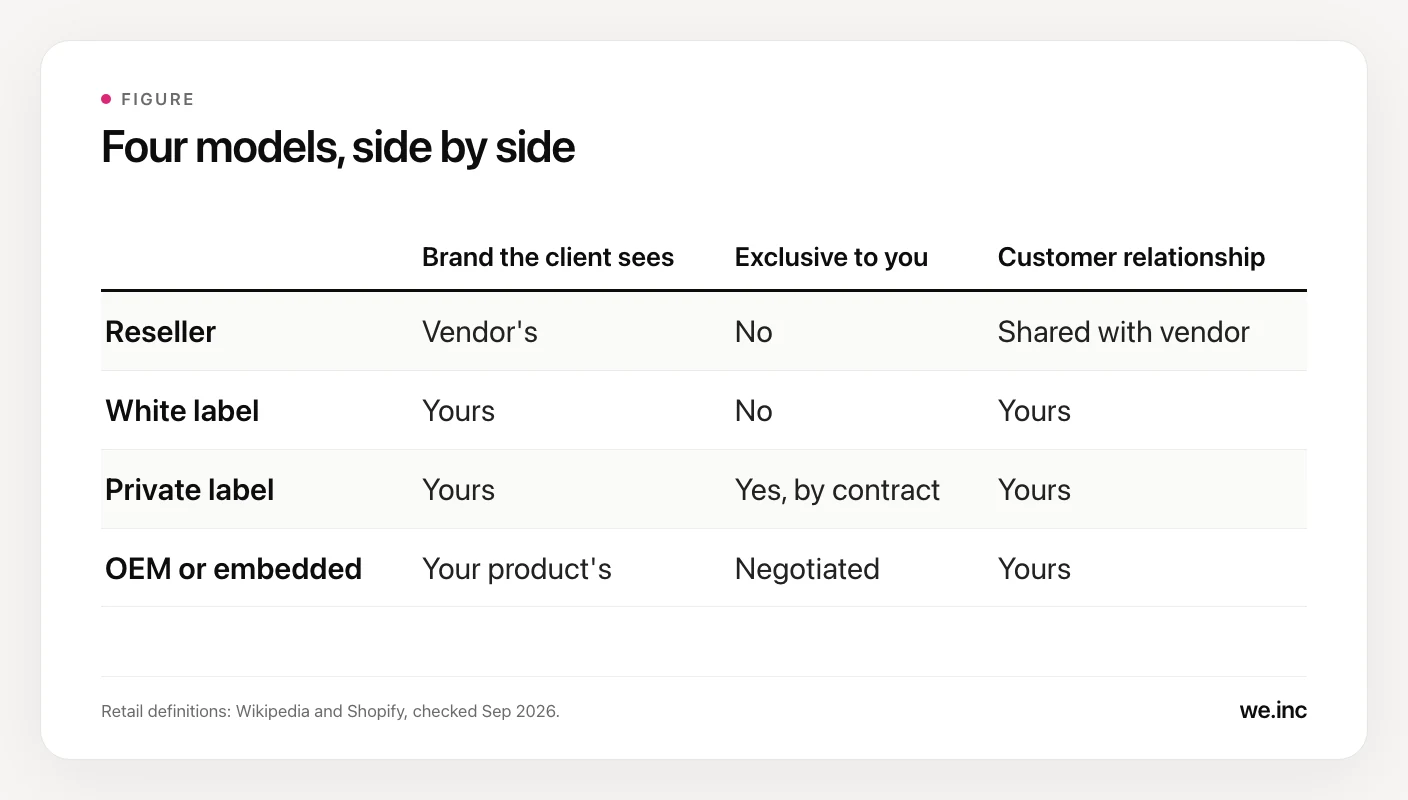
Four models get mixed together on vendor sales pages. Here is how they differ on the points that affect your business.
| Reseller | White label | Private label | OEM or embedded | |
|---|---|---|---|---|
| What it is | You sell the vendor's product under the vendor's brand | You sell the vendor's standard product under your brand | The vendor builds or configures a version for you alone | The vendor's technology runs inside your own product |
| Branding depth | Vendor's brand, sometimes co-branded | Your brand; depth varies by vendor | Your brand throughout | Your product's brand; the vendor stays hidden |
| Exclusivity | None | None | Yes, written into the contract | Negotiated |
| Customisation | None | Settings: logo, colours, domain, plans | Deep: features built to your spec | Whatever the API allows |
| Pricing model | Discount off list price, or a commission | Wholesale fee per seat, per site or flat; you set the retail price | Setup or development fee plus a licence | Licence or usage-based fee |
| Who owns the customer | Shared: the client knows the vendor and can go direct | You hold the client and the billing; the vendor runs the platform | You | You |
OEM is an older manufacturing term for "a company that produces parts and equipment that may be marketed by another company." In software it is familiar from PC makers that ship Windows preinstalled under OEM licences. For website builders, embedded usually means a software company adds site building to its own product through an API, so its users never leave the app. If that is your situation, our comparison of white-label vs API website builders goes deeper.
How deep does the rebranding go? The five levels
"White label" covers everything from a logo upload to a vendor your clients could never find. It helps to think in levels, each one harder for a vendor to deliver than the last.
- Logo swap. Your logo and colours inside the app. The web address, emails and invoices may still show the vendor.
- Custom domain. Clients sign in at an address such as app.youragency.com, with SSL. Check what your DNS record points to, because CNAME records are public and anyone can look them up. HighLevel, for example, tells agencies to point their whitelabel domain at whitelabel.ludicrous.cloud, a hostname that does not carry the HighLevel name.
- Branded emails. Invitations, password resets and notifications come from your domain, with your name and your wording.
- Branded billing. The invoice, receipt and card statement show your business. If the vendor uses Stripe Connect, the name on the card statement depends on how charges are set up: Stripe's docs say direct charges use the connected account's statement descriptor, while destination charges not made on behalf of the connected account use the platform's. Card networks receive only the first 22 characters. It is worth reading how reseller billing can work so that clients pay you directly.
- Invisible vendor. No vendor name in help links, error pages, the published site's footer, page source, app store listings or support replies.
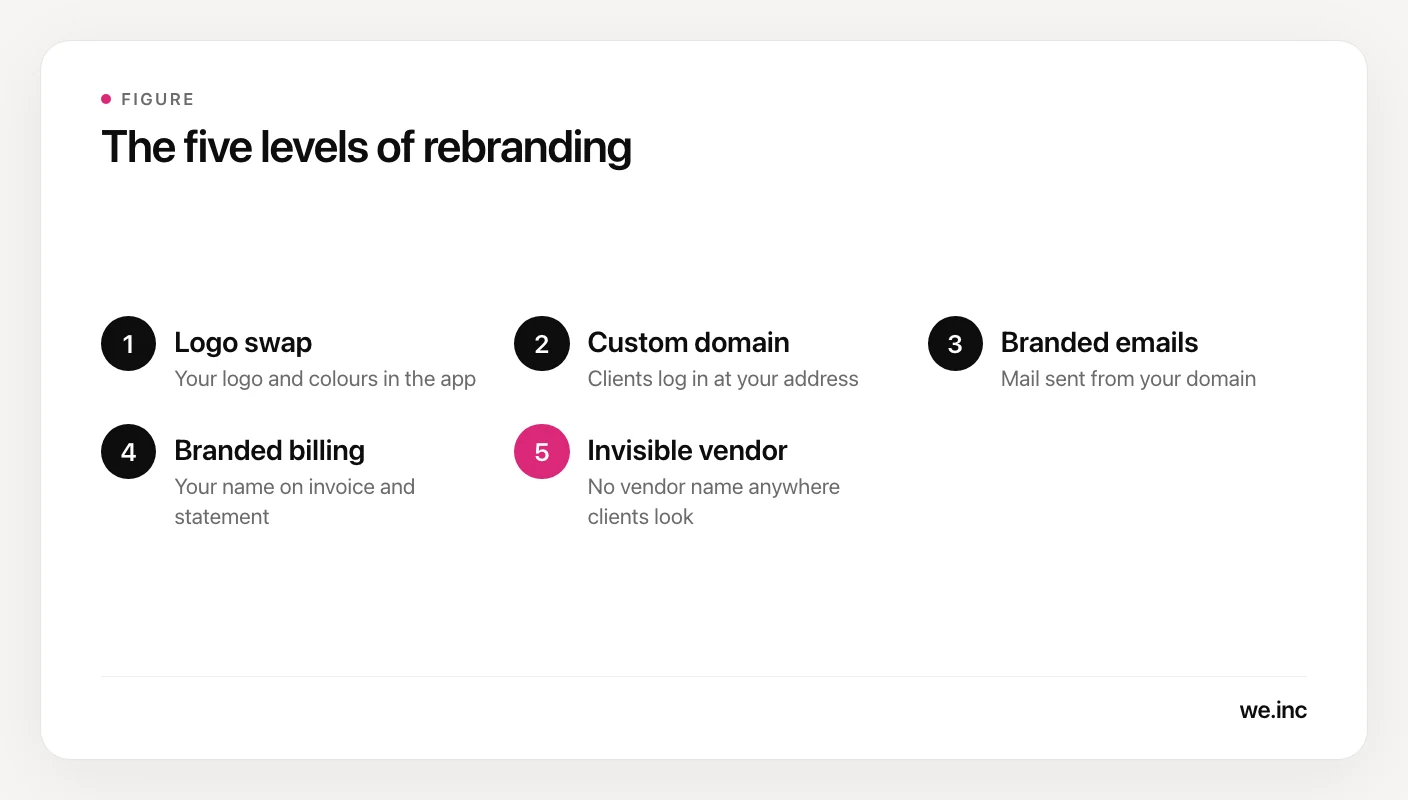
For most agencies, level 4 is the practical target: clients see your brand everywhere they log in, read mail or pay. Level 5 matters when clients would go direct if they found the vendor, or when you are a software company whose product must feel like one thing. This custom branding overview shows what these levels look like inside a working platform.
Worked example: how each model changes what you earn
Here is one book of business under three models. The vendor prices are illustrative, not any real vendor's, so swap in the quotes you receive.
An agency has 30 clients, each paying $149 a month for a managed website. Monthly revenue is 30 × $149 = $4,470.
| Model | How the money flows | Agency keeps each month |
|---|---|---|
| Referral or commission reseller | The vendor bills each client $149 and pays you 20% | 30 × $149 × 20% = $894 |
| White label | You bill each client $149; the vendor charges you $40 per client | $4,470 minus (30 × $40) = $3,270 |
| Private label | As white label, plus a one-off $15,000 fee for exclusivity and custom features | $3,270, after first recovering $15,000 |
White label keeps $3,270 minus $894, or $2,376 a month more than commission. The price is responsibility: you now handle sales, billing questions and first-line support.
Private label only pays if exclusivity earns more. Say being the only agency in your region with this product lets you charge $179 instead of $149. That is 30 × $30 = $900 a month extra, so the $15,000 fee takes $15,000 ÷ $900 = 16.7 months, about 17, to recover. If you cannot say what exclusivity lets you charge, you are paying for a label. For the rest of the business model, see how to start a website reseller business.
Before you create a white label website offer: 10 questions for the vendor
"Fully white label" is an easy phrase to put on a sales page. Ask for a test account and check each answer yourself. Every question below has an answer you can see, not one you have to take on trust.
- What address do my clients log in at, and does it run on my own domain with SSL?
- What hostname does my DNS record point to, and does it contain your brand?
- Which emails do my clients receive, from which sending domain, and can I edit each template?
- Who charges my client's card, and what name appears on their card statement?
- Can I create my own plans and set my own prices?
- Where could your name still appear: help links, error pages, the published site's footer or source code, mobile apps, support replies?
- Will you sell this identical product to my direct competitor? If I want exclusivity, what does it cost, and where is it in the contract?
- Who answers when my client contacts support, and under whose name?
- If our agreement ends, what happens to my clients' accounts and live sites?
- Is there an API to create clients and sites automatically?
Which one do you need?
| Your situation | Model to look for |
|---|---|
| You want to recommend a tool and earn something on the side | Referral or reseller |
| You sell websites to many small clients under your agency brand | White label |
| You need features no other partner gets, and can name what they earn you | Private label |
| You run a software product and want site building inside it | OEM or embedded, through an API |
Where We.Inc fits
We.Inc's white-label program is white label in the plain sense: one AI website builder, run under each partner's own brand. Partners run it on their own web address with their name, logo and colours on the login, dashboard and builder. Emails their customers receive carry the partner's brand, and customers pay the partner through the partner's own Stripe account. Software platforms that want the embedded route can use the REST API with webhooks. It is one flat monthly fee with no per-site charge, and a done-for-you install goes live in about 14 days.
For a full evaluation checklist, read the white-label website builder guide. If you are weighing a CRM suite instead, see HighLevel SaaS Mode vs a white-label website builder.
Sources
- Private label, Wikipedia: definition, store brand examples, private label vs white label. Checked September 2026.
- White-label product, Wikipedia: definition, origin of the name, white-label software. Checked September 2026.
- Original equipment manufacturer, Wikipedia: OEM definition and Windows bundling. Checked September 2026.
- Private Label vs. White Label, Shopify: exclusivity and customisation differences. Checked September 2026.
- Set statement descriptors for connected accounts, Stripe Docs: whose name appears on card statements by charge type, 22-character limit. Checked September 2026.
- Set Up a Whitelabel Domain for the Desktop Web App, HighLevel: CNAME target for agency login domains. Checked September 2026.
More in Blog
- Product Photography for E-Commerce: A DIY Guide
- Productivity Hacks for Busy Entrepreneurs
- Progressive Web Apps: The Future of Mobile Business
- Qwen3.8-Max Just Dropped as Open Weights. Here Is What Developers Are Building Today.
- How to Build a Real Estate Website That Generates Leads
- The SaaS Business Model Explained: How It Works
- Sales Objection Handling: A Complete Playbook
- How to Scale Your Business: A Practical Guide
We.Inc is an AI-powered website builder you can resell under your own brand. Launch a branded client dashboard, bill on Stripe Connect, and deliver AI-generated websites in minutes. White-label plans are custom priced, with no per-site fees.
Product
- AI Website Builder: Describe a site in plain English; it's live in minutes
- White Label Platform: Your brand, your domain, your margin
- Enterprise: SSO, custom SLAs, and dedicated support
- Developer API: Embed site generation into your SaaS
Who It's For
- For Agencies: Resell under your brand
- For Freelancers: Your own branded builder
- For Hosting Providers: Add a builder to your stack
- For SaaS Platforms: Embed site creation via API
- For Startups
- For Financial Services
- For Healthcare
Features
- Drag & Drop Editor
- Built-in SEO Tools
- Custom Branding
- Client Dashboard
- Reseller Billing (Stripe Connect)