White Label vs API Website Builder: Which to Choose
White label gives customers a branded builder to log into. An API builds sites inside your own product. When each wins, and what each costs you.
A white-label website builder gives your customers a finished builder, under your brand, that they log into and use themselves. A website builder API gives your developers the building blocks instead, so your own product creates, edits and publishes sites while the builder stays invisible. White label is faster to launch and cheaper to run. An API fits better when websites are a feature inside software you already sell.
Short answer: choose white label if you want to sell websites within weeks and have little engineering time. Choose the API if your customers should never leave your app and you have developers to build and maintain the screens. Many teams end up with both: a branded dashboard for customers who like to edit, plus API calls that automate setup.
What does "white label API" actually mean?
The phrase is used well beyond websites. Payment processors, banking-as-a-service providers and SMS gateways all sell "white label APIs": infrastructure you call from your own product, where your brand shows on the result and theirs shows nowhere. The idea is the same everywhere. Someone else runs the hard part, and you own the customer.
For websites, the phrase covers two different products that often get lumped together. Knowing which one you are buying matters, because they create very different amounts of work on your side. If you are new to the category, our complete guide to white-label website builders covers the basics first.
White label: a branded builder your customers log into
The vendor gives you a full product: login page, dashboard, editor, templates, hosting and emails. You put your name, logo, colours and web address on it. Your customer signs in at something like sites.yourcompany.com and never sees the vendor. You mostly configure. You do not build.
API: building blocks your own product calls
The vendor gives you endpoints: create a customer, create a site, change it, publish it, connect a domain. Your developers call those endpoints from your app and design every screen the customer sees. The customer never logs into a second product, because from their point of view there is no second product.
What is the difference between API and white label?
| White-label builder | Website builder API | |
|---|---|---|
| Who builds the screens | The vendor | Your team |
| Where customers edit | The vendor's branded editor | Screens inside your product |
| Customer login | A separate branded login, or a single sign-on link | Your existing login |
| Time to launch | Days to weeks | Weeks to months |
| Engineering on your side | Setup and light integration | A real project, then upkeep |
| Support questions | Many answered inside the builder | All land on your team |
| Control over the experience | What the vendor lets you brand | Complete, within what the API exposes |
| Best for | Agencies, resellers, fast launches | SaaS products where websites are one feature |
The shortest way to say it: white label gives you a product, an API gives you parts. An API has verbs, not screens. If the vendor ships a better editor next month, white-label customers get it the same day. API customers get it when your team builds a screen for it.
What does a website builder API typically expose?
Most website builder APIs cover the same lifecycle, from "this customer exists" to "their site is live and getting visits." We.Inc's REST API is a typical example of the scope:
| Area | What the calls do | Why you need it |
|---|---|---|
| Clients | Create and manage the businesses you serve | Maps your customer records to sites |
| Plans and orders | Define what you sell and record purchases | Keeps billing and access in step |
| Projects | Create a site for a client | The unit everything else hangs off |
| Chat build and edit | Describe a business or a change in plain words, and the AI builds it | Your product can create and change sites without an editor of its own |
| Preview | Get a viewable version before it goes live | A customer approval step |
| Publish | Push the site live | The moment the customer gets value |
| Domains | Connect a customer's own web address | Most businesses want their own domain |
| Analytics | Read visits and activity | Proves value inside your own reports |
| Webhooks | Tell your system when something happens, such as a site publishing | Keeps your CRM and billing in sync without polling |
Other vendors draw the lines differently, so read their docs before you decide. As of September 2026:
- Duda describes its Partner API as a management API for its white-labeled resources, such as sites and accounts. Its docs also describe a single sign-on link that logs a customer straight into the dashboard or editor, with tokens valid for two minutes. Duda is mature here, and its white-label coverage of the builder, dashboard and platform emails is thorough.
- 10Web offers a Website Builder API that generates WordPress sites, with a white-labeled WordPress admin, domain management and backup features, and a chat-based AI editor. Pricing is quoted on volume rather than listed. The WordPress base is a real plus if your customers already know WordPress.
One detail catches buyers out. On Duda's pricing page, as of September 2026, the White Label plan is $199 a month billed monthly or $149 a month billed annually, with four sites included and $17 a month for each extra site. But the plan table lists API access and single sign-on under the Custom plan, not the White Label plan. White label and API can be separate purchases, so ask every vendor which tier includes which.
White label API integration: what does each option cost you to build and run?
The vendor's fee is only part of the bill. The larger cost is usually your own people.
Engineering. White label needs setup: point a domain, upload brand assets, map your plans, connect billing, write a few help articles. An API integration is a product project. Someone has to design and build the sign-up hook, the "create my site" flow, a way to request edits, a preview frame, a publish button, the domain connection steps, webhook handling and every error state in between.
Login. White label usually means a second login for your customer, or a single sign-on link your developers generate. With an API, customers keep the login they already have.
Billing. White-label platforms often bill customers for you, sometimes through your own payment account. With an API, you add a line item to the billing system you already run. That is simple if you have one and a project if you do not.
Support. This is the cost people forget. With white label, the builder's own screens and help content answer many questions. With an API, every "why is my site not showing" ticket comes to you, because your customer has no idea a vendor exists.
Worked example: year one engineering cost
The US Bureau of Labor Statistics puts the median annual wage for software developers at $135,980 (May 2025). That is wages only, before benefits and payroll taxes. Per week, that is $135,980 ÷ 52, or about $2,615.
Now take two sets of assumptions. They are illustrative, not industry benchmarks, so swap in your own estimates:
- White label: one developer for two weeks of setup, then 10% of one developer's year for upkeep.
- API: two developers for ten weeks to build the screens and flows, then 50% of one developer's year for upkeep, fixes and new vendor features.
| Line | White label | API |
|---|---|---|
| Build effort | 2 engineer-weeks | 20 engineer-weeks |
| Build cost at $2,615 per week | $5,230 | $52,300 |
| Upkeep, share of one developer | 10% | 50% |
| Upkeep cost for a full year | $13,598 | $67,990 |
| Year one total | $18,828 | $120,290 |
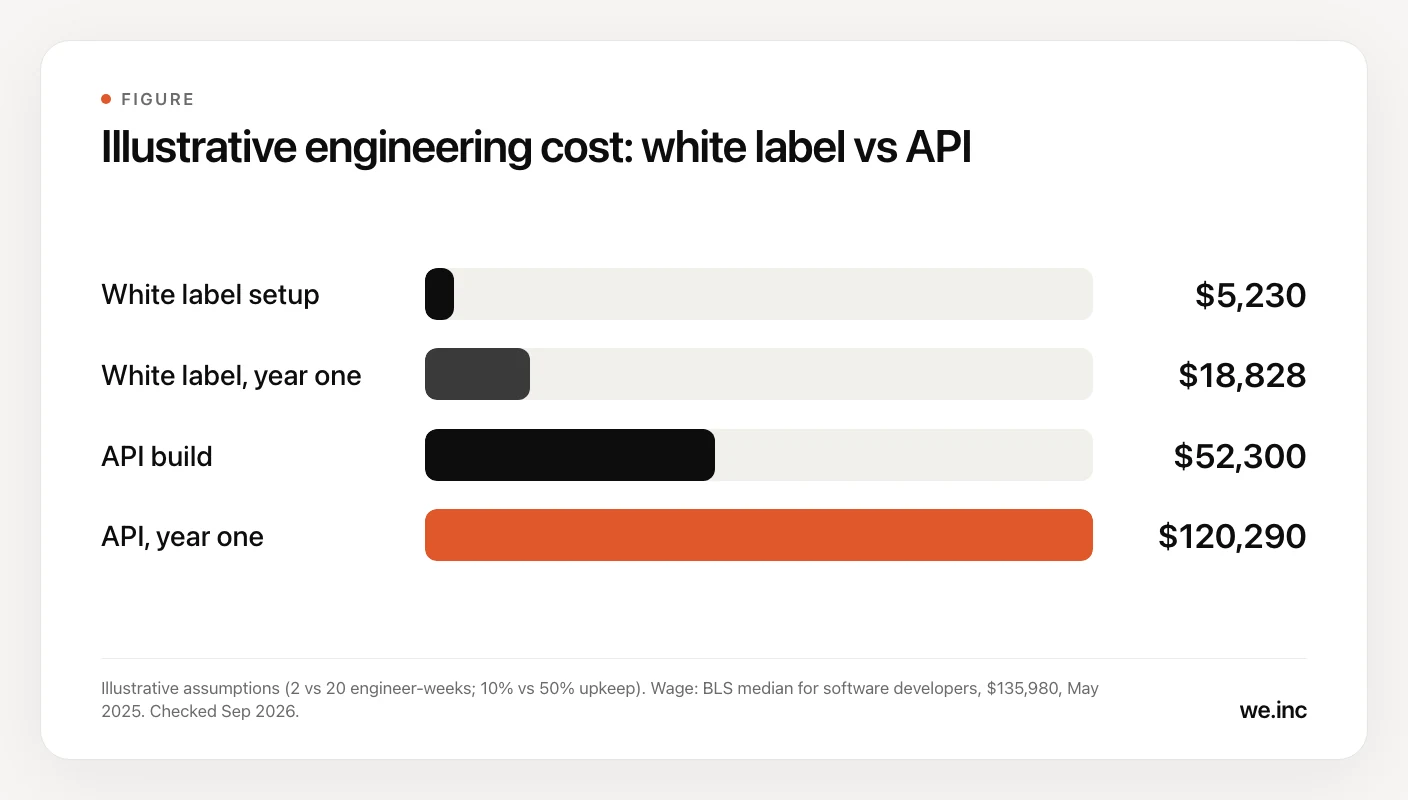
On these assumptions the API route costs about 6.4 times more in year one ($120,290 ÷ $18,828), before vendor fees and before support time. That gap is not a reason to avoid APIs. It is the price of owning the experience, and for a SaaS company whose customers already live in its app, it is often worth paying.
When does white label win?
- You want to be selling websites this quarter, not next year.
- You have no spare developers, or they are committed to your core product.
- Your customers want to edit their own sites and are fine with a separate, branded login.
- You are an agency or reseller, so the website is the product, not a feature.
- You want the vendor's editor improvements to reach customers with no work on your side.
When does the API win?
- Your customers already log into your software every day, and a second login would hurt adoption.
- You hold data that should flow into the site automatically: listings, menus, class schedules, service areas.
- Websites are one feature inside a bigger product, priced as an add-on or a higher tier.
- You have developers who can own the integration for years, not weeks.
- You need sites created in bulk, for example one for every new customer at sign-up.
Can you combine them? The hybrid model
Most teams that start with one end up with a bit of both. The hybrid looks like this:
- A customer signs up, or buys a website add-on, in your product.
- Your app calls the API to create the client and a project, passing the business details you already hold.
- The AI builds a first draft from those details.
- The customer is handed into the branded dashboard, often through a single sign-on link, to review and edit.
- A webhook tells your system when the site publishes, so billing and your CRM update on their own.
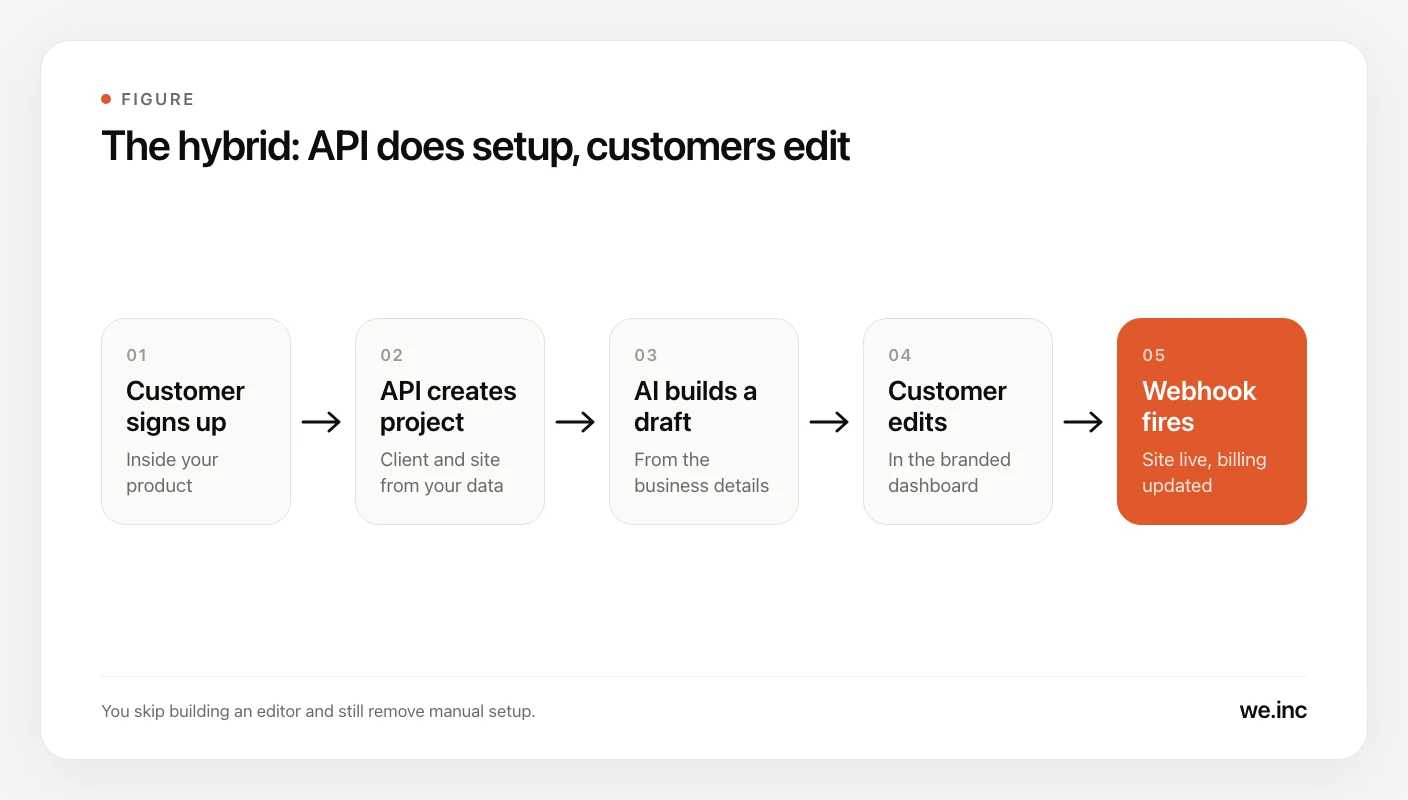
You skip building an editor, which is the most expensive screen in the whole integration, and you still remove the manual setup. For a deeper look at this path for software companies, see how to add a website builder to your SaaS platform.
Decision table: white label, API, or both?
| If this describes you | Start with |
|---|---|
| No spare developers, want revenue this quarter | White label |
| Agency or reseller selling websites as the product | White label |
| SaaS product where websites are an add-on | Hybrid |
| Customers must never see a second login | API, or hybrid with single sign-on |
| Sites must be generated from data you already hold | API or hybrid |
| You want control of every screen and have a team to own it | API |
If you are unsure, start with white label and add API automation once you know which steps your team repeats most. Going the other way, from a custom API build back to a branded dashboard, usually means throwing work away. If how deep the branding goes is your deciding factor, our comparison of private label vs white label website builders covers that next.
Questions to ask any white label API provider
- Is API access included in the white-label plan, or sold as a separate tier?
- Can customers edit visually in a branded editor, or only through screens you build?
- Which events send webhooks: site published, domain connected, order created?
- How does a customer get from your app into the builder without a second password?
- Who renews SSL certificates and handles domain verification?
- Is pricing per site, or flat?
Where We.Inc fits
We.Inc's white-label platform covers both halves. Partners run the AI website builder on their own web address with their own name, logo and colours on the login, dashboard and builder screens. Emails to their customers carry the partner's brand, and partners bill customers through their own Stripe account, so customers pay the partner. The We.Inc API adds the automation layer: clients, plans, orders, projects, chat builds and edits, preview, publish, domains, analytics and webhooks. Generated sites are React, Vite, TypeScript and Tailwind, can be edited visually or in code, and publish to custom domains with SSL.
The platform fee is one flat monthly fee with no per-site charge, and the number is shared on a 30-minute demo call. If you would rather not do setup yourself, there is a done-for-you install that is live in about 14 days. Software companies can see the embedded route on the website builder for SaaS platforms page.
Sources
- Duda pricing page: White Label plan price, included sites, extra site price, and API access and single sign-on listed under the Custom plan. Checked September 2026.
- Duda Partner API introduction: described as a management API for white-labeled resources such as sites and accounts. Checked September 2026.
- Duda Get SSO Link reference: single sign-on links into the dashboard and editor, with tokens valid for two minutes. Checked September 2026.
- 10Web Website Builder API: WordPress base, white-labeled admin, domain and backup features, chat-based AI editor, volume-based pricing. Checked September 2026.
- US Bureau of Labor Statistics, Software Developers: median annual wage of $135,980 in May 2025. Checked September 2026.
More in Blog
- White-Label Website Builders: The Complete Guide for Agencies and Resellers
- How to Add a Website Builder to Your SaaS Platform
- How Bright Digital Agency Built and Resold 22 Client Sites With We.Inc White-Label
- AI Content Creation: Tools, Tips, and Best Practices
- Implementing AI Customer Service: Step by Step
- AI for Small Business: Practical Applications That Work
- 6 AI Content Creation Tools Actually Worth Using in 2026
- 7 Essential AI Tools for Startups to Boost Growth Fast
We.Inc is an AI-powered website builder you can resell under your own brand. Launch a branded client dashboard, bill on Stripe Connect, and deliver AI-generated websites in minutes. White-label plans are custom priced, with no per-site fees.
Product
- AI Website Builder: Describe a site in plain English; it's live in minutes
- White Label Platform: Your brand, your domain, your margin
- Enterprise: SSO, custom SLAs, and dedicated support
- Developer API: Embed site generation into your SaaS
Who It's For
- For Agencies: Resell under your brand
- For Freelancers: Your own branded builder
- For Hosting Providers: Add a builder to your stack
- For SaaS Platforms: Embed site creation via API
- For Startups
- For Financial Services
- For Healthcare
Features
- Drag & Drop Editor
- Built-in SEO Tools
- Custom Branding
- Client Dashboard
- Reseller Billing (Stripe Connect)