
Kick your online presence into high gear.
A martial arts website builder should make it easy to publish programs by age and level, a class schedule you can change in a sentence, instructor rank and lineage, and a free trial class form. On we.inc you describe your dojo or academy and the AI builds those pages (free to build, paid plans from $20 a month); on We.Inc you can build your site free, with no card and no trial needed to start. Memberships, billing and check-in stay in your gym software.
A martial arts website builder for dojos, academies and gyms: programs by age and level, a clear class schedule, instructor lineage, and a free trial class form. Describe your school and the AI builds it.
Pages every martial arts school website needs
- Home: Your style, location and who you teach, with a "book a free trial" button. Parents and adults both need to see themselves on the first screen.
- Programs: Little dragons, kids, teens, adults, competition team, or BJJ, Muay Thai and karate. Each needs one click from the home page.
- Class schedule: Usually the most visited page. A weekly timetable by program and belt level, including open mats.
- Instructors: Rank, who awarded it, lineage and years teaching. Prospective students check who they will learn from.
- First class and FAQ: What to wear, what happens in a trial and whether beginners are welcome. It lowers the nerves of walking in.
- Belt and rank system: How promotions work, testing frequency and any testing fees, which parents always ask about.
- Free trial request: Student name, age, experience, program and preferred day. This is the page that fills classes.
Try this prompt
A website for Iron Lotus Martial Arts, a Brazilian jiu-jitsu and Muay Thai academy in Denver, Colorado with programs for kids 4-7, kids 8-13 and adults. Include a program page for each, a weekly class schedule with Friday open mat, instructor bios with black belt lineage, a belt system page, a first class FAQ, and a free trial class form. Bold, dark design with red accents.
How do I explain classes for kids versus adults?
Give each age group its own page with the class length, size and goals. Parents want to hear about focus, confidence and safety; adults care about fitness, self-defence and progression. Show the age ranges you group by and what a beginner does in a first class. Photos of real students in each class type, shared with permission, help both audiences picture themselves on the mat.
Should instructor credentials be on the website?
Yes, with rank, lineage and years teaching. Experienced martial artists look for who trained your head instructor, while parents look for background checks and first aid training. Put a short profile for each instructor with a photo. Keep it factual; listing tournament wins is fine if true, but how you teach beginners matters more to most people reading.
What parents check on the Northgate Taekwondo example
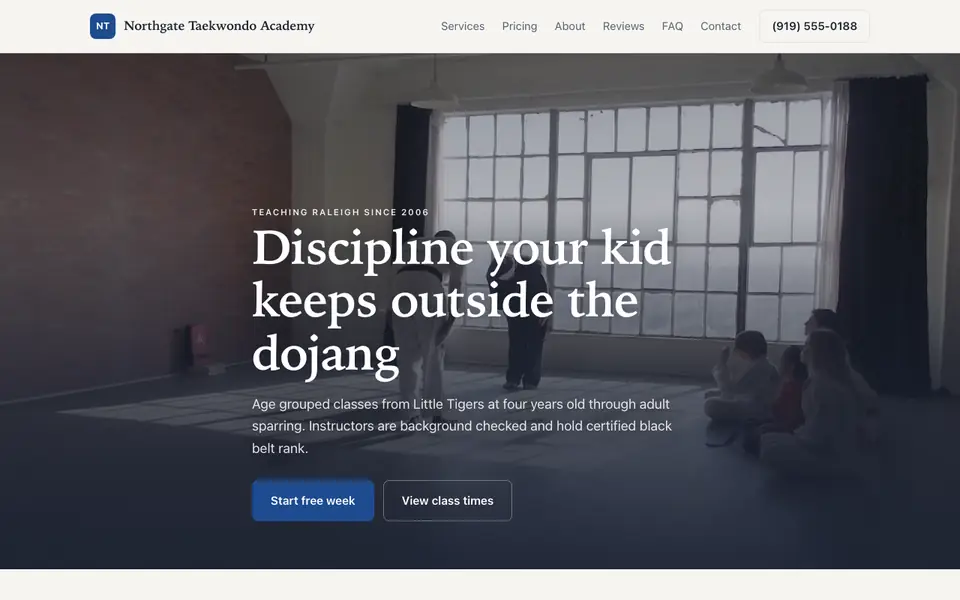
Northgate Taekwondo Academy is a Raleigh school our AI invented from one sentence; it is not a real dojang. The site is written mainly for parents choosing a first class for a child.
A free trial week as the main button
Start free week leads the page, with class times next to it. Parents want to see whether a child enjoys it before signing a monthly plan.
Classes split by age and belt
Programs run from four-year-olds to adult sparring, with a note that small children never spar adults. That single sentence answers the safety question most parents bring.
Instructors and background checks
The page says instructors are background checked and hold certified rank. There is no single national licence for martial arts teachers, so name your own lineage, rank certificates and any child-safety training.
Belt testing schedule in plain words
The youth program says testing happens roughly every three months. Families budget for testing fees and gear, so say how often it happens and what it costs if you charge.
Northgate Taekwondo Academy
This is Northgate Taekwondo Academy, a martial arts school business we described to the AI in a sentence. See the Northgate Taekwondo Academy example site.
Start from this design
Three designs that suit a martial arts school website.
- Beach-Photo Karate School
- Comic-Book Martial Arts Dojo
- Black & Yellow High-Intensity Gym
Attract students of all ages with a dynamic site showcasing your programs, instructors, and dojo.
Skip the martial arts school web design brief and the six week wait. Tell the AI about the business in a sentence and it builds the whole site, ready to edit.
Features designed for your industry
- Programs: Display classes for kids, teens, and adults.
- Instructors: Showcase your masters and their credentials.
- Trial Classes: Let parents and students book free trial classes.
Perfect for:
- Karate dojos
- Taekwondo schools
- BJJ academies
- MMA gyms
- Kung fu schools
What to check in a dojo website builder
Make sure the schedule is one page you can update in a sentence, that each program and age group gets its own page, that the trial form asks what you need, and that you can link your gym management software for memberships and waivers.
Kids programs need parent answers
Parents ask about class size, instructor background checks, focus and anti-bullying, and whether they can watch. Answer those on the kids page, with style and curriculum details below.
Be accurate about rank and lineage
The martial arts community checks lineage. List ranks and who awarded them accurately, and avoid inflated titles.
Keep the schedule in one place
Timetables shift with seasons and school terms. Keep a single schedule page, note holiday closures and belt testing dates at the top, and ask the AI to update it when classes change.
Memberships and waivers stay in your system
The trial form emails you. There is no membership billing, attendance or belt tracking, so link a gym management tool such as Zen Planner, Kicksite or Mindbody, and have liability waivers signed there.
What it costs
on We.Inc you can build your site free, with no card and no trial needed to start. Paid plans start at $20 a month on Starter, then Pro at $49 and Max at $99; credits are spent when the AI generates or edits. Your extra costs are a domain (roughly $10 to $20 a year) and the gym management software you link. Starter covers most single-location schools.
Building your site is free, no card needed. Paid plans from $20 a month. Compare plans
Frequently asked questions
What should a dojo website include?
Programs by age and level, a weekly class schedule, instructor rank and lineage, a first class FAQ, and a free trial class request form.
Can people sign up for a free trial class online?
Yes. The AI builds a trial form that emails you the student's name, age, experience and preferred class. You confirm the slot by reply.
Can members pay monthly dues through the site?
You can take payments through your own Stripe account, but recurring dues, contracts and check-in are better handled in gym management software linked from the site.
Does it work for any style?
Yes. Karate, taekwondo, BJJ, Muay Thai, kung fu or MMA. Tell the AI your style and programs and it writes pages to match.
Can I sell uniforms and gear?
Yes, a small shop for gis, gloves or school shirts can run through your own Stripe account. There is no inventory sync, so keep stock counts yourself.
What is included free?
On We.Inc you can build your site free, with no card and no trial needed to start. Paid plans start at $20 a month on Starter, and a custom domain needs a paid plan.
Related industries and website guides
- therapist website builder
- dentist website builder
- nutritionist website builder
- massage therapists website builder
- optometry practice websites
- orthodontic practice websites
- martial arts schools website examples
- how to make a website
Related website builders: Health & Wellness
- therapist website builder
- dentist website builder
- nutritionist website builder
- massage therapists website builder
- optometry practice websites
- orthodontic practice websites
Before you start
Product
Who It's For
- For Agencies
- For Freelancers
- For Hosting Providers
- For SaaS Platforms
- For Startups
- For Financial Services
- For Healthcare
Features
Resources
- Blog
- Help Center
- Free Business Tools
- Free UI Components
- Website Templates
- Template Collections
- Website Examples
- Guides
- Comparisons
- Alternatives
- Best Lists
- Reviews
- Pricing Guides
- Use Cases
- Glossary & Guides
- Integrations
- Developers
- Benchmark
- Windows App