Best transactional email services in 2026: 3 tools compared for deliverability
SendPulse, Postmark and Resend compared on stream separation, dedicated IPs, bounce handling, sending history and price, with figures checked on November 17, 2026.
Build your site free. No card needed.
*Updated on November 17, 2026: prices, plans and features checked on each tool's official website on this date.*
TL;DR: SendPulse is the best transactional email service for most small businesses in 2026: its free plan sends 12,000 emails a month over SMTP or API, the 100,000-email plan ($74.85 a month) includes a dedicated IP, and sending history is kept for a year. Postmark suits teams that want transactional and broadcast mail on separate streams, and Resend suits developers who build emails in React.
A customer places an order on your website and waits for the confirmation. If it lands in spam, the customer blames your business, not the email provider.
Mailbox providers rate every sending IP and domain by reputation, so a weak newsletter can drag down receipts sent from the same infrastructure. Yahoo's sender best practices advise against sending marketing email from the IPs used for transactional mail and ask senders to keep spam rates below 0.3%. Google's email sender guidelines recommend a different IP for each message type when you send from several, and a spam rate under 0.10%.
This guide compares three services on how well they protect that stream: separation from bulk mail, dedicated IPs, bounce handling, logs and price.
Why stream separation matters for transactional email in 2026
Transactional emails are one-to-one messages triggered by a user action: order confirmations, password resets and contact-form notifications. Recipients wait for them, so a delay or a spam-folder placement costs more than a missed newsletter. Keeping them apart from marketing sends protects the reputation they depend on.
Transactional email services comparison table 2026
| Criteria | SendPulse | Postmark | Resend |
|---|---|---|---|
| Free plan | 12,000 emails/mo (400/day) | 100 emails/mo | 3,000 emails/mo (100/day) |
| Entry paid plan | $8.85/mo for 25,000 | $15/mo for 10,000 | $20/mo for 50,000 |
| 50,000 emails/mo | $16.85 | $55 | $20 |
| 100,000 emails/mo | $74.85 | $115 (125,000 tier) | $35 |
| Stream separation | Separate SMTP service | Transactional and broadcast streams | Separate emails and broadcasts APIs |
| Dedicated IP | Included from 100,000 plan | $50/mo per IP, 300,000+ emails/mo | $30/mo add-on, Scale plan |
| Bounce handling | Error log, bounce API, auto limits | Automatic suppression, bounce data | Automatic suppression, bounce details |
| Sending history kept | 1 year | 45 days (up to 365 on Pro+) | 30 days |
| Ideal for | Small businesses and online stores | Deliverability-focused SaaS teams | React and Next.js developers |
*Source: official pricing and documentation pages of each tool, checked on November 17, 2026. Prices in USD with monthly billing.*
3 best transactional email services in 2026
1. SendPulse: free volume and a year of sending history
SendPulse is an AI-driven email and chatbot marketing platform for scaling businesses, with a built-in CRM. Its transactional email service sends order confirmations and password resets via SMTP relay or REST API, on a plan separate from bulk campaigns. Over 200,000 customers use SendPulse, which has been in business for 11+ years.
Key features:
- SMTP relay and REST API: connect a CMS, store or app without code, or use PHP, Python and Node.js libraries.
- Dedicated IP on the 100,000-email plan: your reputation depends only on your own sending.
- SPF, DKIM and DMARC on every plan: even free-plan mail can meet Gmail and Yahoo authentication rules.
- Bounce protection: above a 7% bounce rate, the hourly limit drops to 50 emails until invalid addresses are removed.
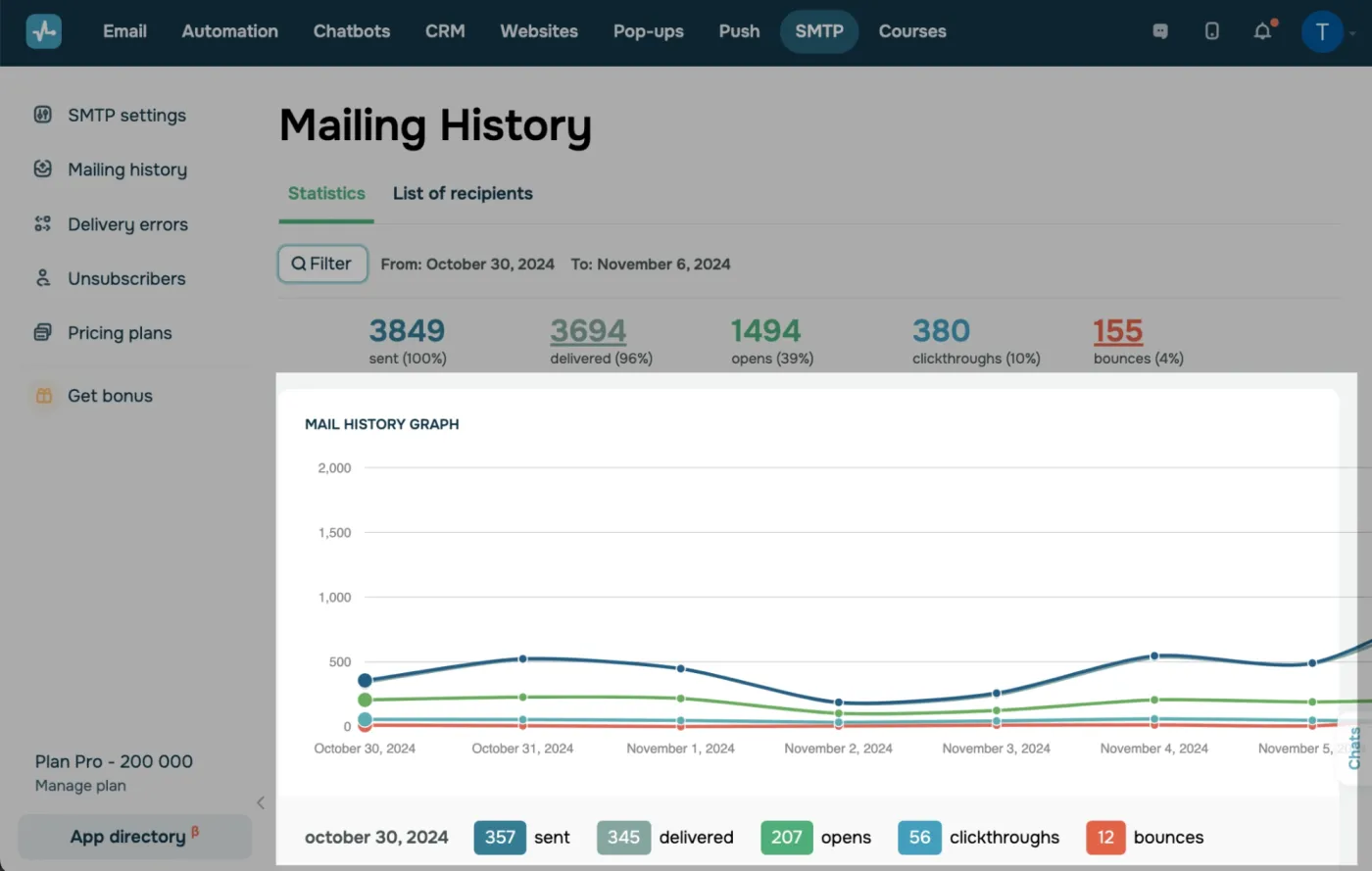
- Delivery error log and bounce API: failed addresses are listed by day, so you can clean the source list.
- One year of sending history: each message's status, sending IP and log stay available and export to CSV.
- Webhooks with a request log: delivered, undelivered, opened and clicked statuses reach your system, with retries for failed requests.
- Drag-and-drop templates: 130+ templates with variables like order number, so marketers edit receipts without code.
Pricing: the free-forever plan includes 12,000 emails a month (400 a day, 50 an hour) and 2 sending domains. Paid plans cost $8.85 a month for 25,000 emails, $16.85 for 50,000 and $74.85 for 100,000 with a dedicated IP. See the official pricing.
Ideal for: SendPulse is ideal for small businesses and online stores that want free transactional sending and long delivery records next to their marketing.
Advantages:
- The largest free allowance here: 12,000 emails a month.
- A dedicated IP is included at 100,000 emails.
- Sending history is kept for a year.
Limitations:
- The free plan sends only 50 emails an hour.
- No dedicated IP below 100,000 emails.
- At 100,000 emails it costs more than Resend Pro ($74.85 vs $35).
2. Postmark: separate streams for transactional and broadcast mail
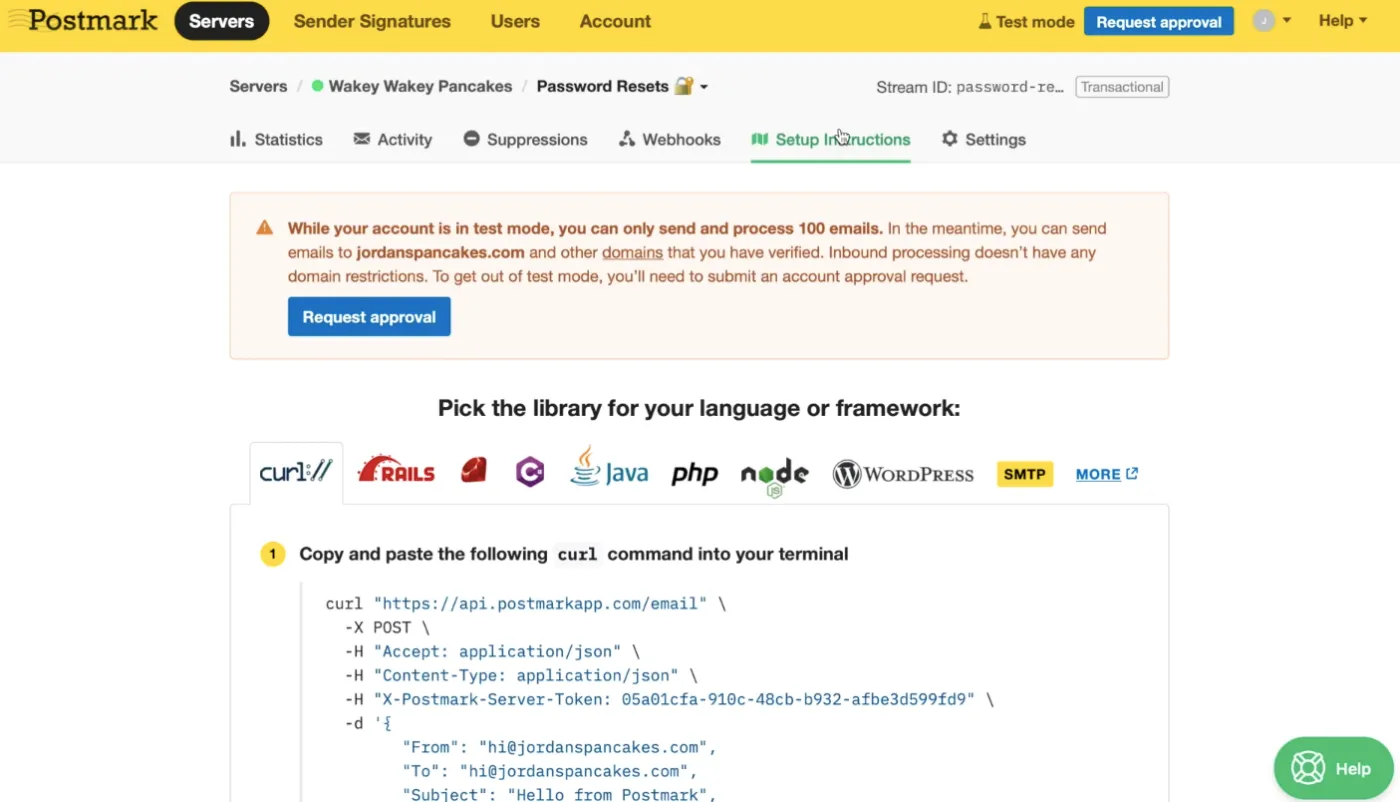
Postmark is a transactional email service that splits each server into message streams. Transactional and broadcast streams are kept apart, and broadcast traffic runs on dedicated infrastructure so transactional delivery stays fast.
Key features:
- Message streams: each stream has its own ID and statistics, so a newsletter can't slow down password resets.
- REST API, SMTP and official SDKs: with batch sending and multi-region SMTP routing.
- Automatic suppression and bounce data: hard bounces and spam complaints are suppressed, with the exact reason for each failure.
- Event webhooks with secure endpoints: delivery, bounce, open and click events reach your app.
- 45-day full message retention: content is kept for troubleshooting, adjustable from 7 to 365 days on Pro and above.
- Sandbox mode: test sends never reach real inboxes, so staging traffic can't hurt your reputation.
- Managed dedicated IPs: from $50 a month per IP for senders of 300,000+ emails a month on Pro or higher.
- DMARC monitoring add-on: digests from $14 a month per domain show who sends with your domain.
Pricing: the free Developer plan includes 100 emails a month and never expires; there is no separate trial. Basic costs $15 a month for 10,000 emails ($1.80 per extra 1,000) and $55 for 50,000. Pro ($16.50) adds inbound processing and longer retention, and Platform ($18) adds unlimited domains. See the official pricing.
Ideal for: Postmark is ideal for SaaS teams whose sign-in and password-reset emails must arrive within seconds.
Advantages:
- Stream separation is built into every account.
- Full message content is kept for 45 days by default.
- Sandbox mode simplifies testing.
Limitations:
- The free plan covers only 100 emails a month.
- The most expensive here at volume: $55 for 50,000 emails.
- Dedicated IPs start at 300,000 emails a month.
3. Resend: developer-first sending with separate broadcast APIs
Resend is an email API for developers that sends transactional emails through its emails API and marketing through a separate broadcasts API. Its documentation recommends sending from separate subdomains to protect the reputation of transactional mail.
Key features:
- React Email: templates are built with React, TypeScript and Tailwind, so front-end teams reuse their components.
- REST API, SMTP relay and official SDKs: available on every plan, with scheduled sends.
- Batch sending: up to 100 emails in one API request, which helps absorb sign-up spikes.
- Subdomain reputation control: verify subdomains such as auth.example.com and switch tracking off for password resets.
- Multi-region sending: choose the region each domain sends from to reach recipients sooner.
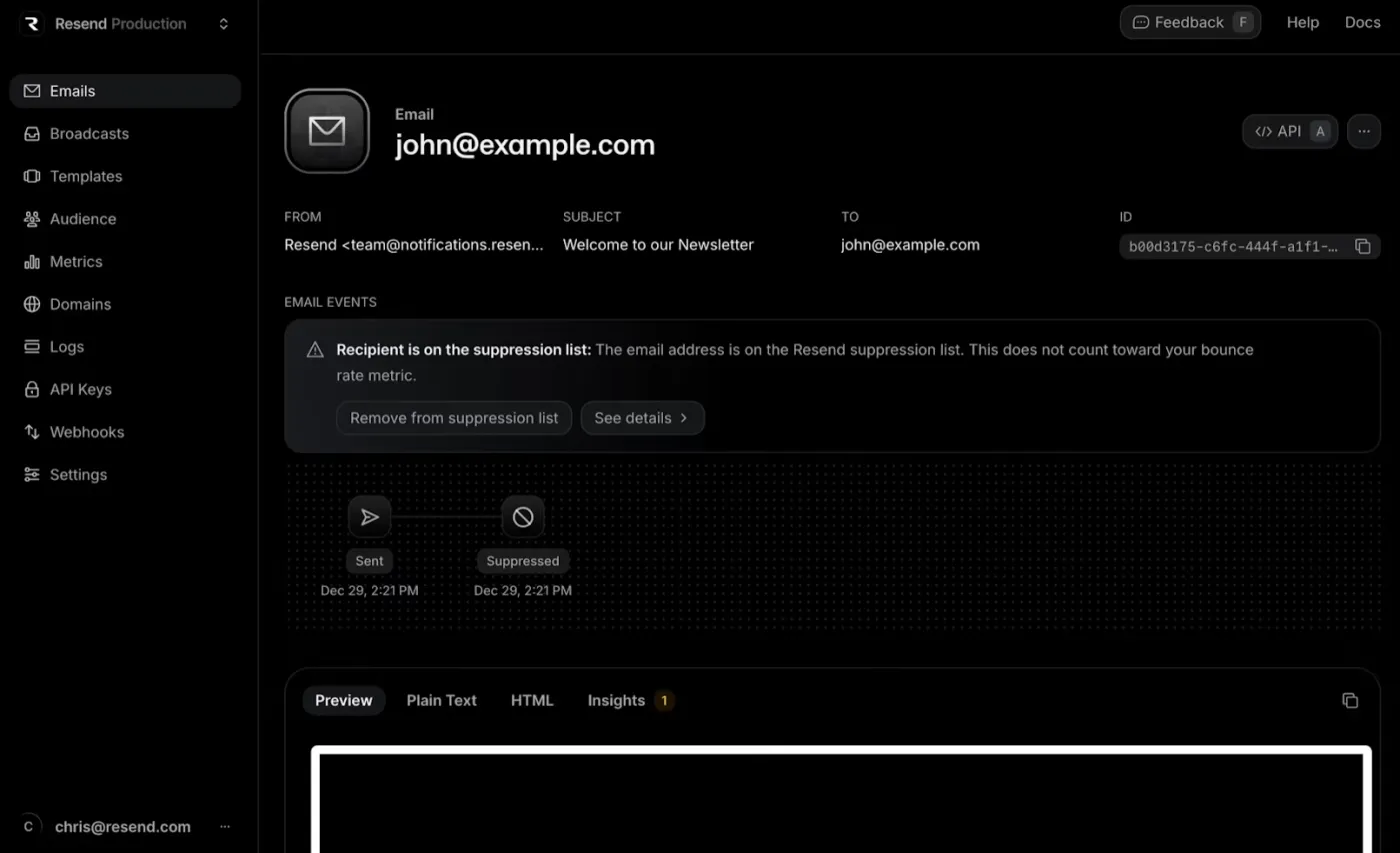
- Automatic suppression list: addresses that bounce stop receiving mail, with bounce details for each.
- Webhooks with replay: delivery, open, bounce and click events arrive in real time, and missed events can be replayed.
- Dedicated IP with automatic warmup: Resend warms, monitors and autoscales the IP for Scale customers above 3,000 emails a day.
Pricing: the free plan includes 3,000 emails a month (100 a day) and 3 domains; there is no separate trial. Pro costs $20 a month for 50,000 emails or $35 for 100,000, and Scale starts at $90 for 100,000 with a $30 dedicated IP add-on. Billing is monthly only. See the official pricing.
Ideal for: Resend is ideal for developers building in React or Next.js who want transactional and marketing sends split at the API level.
Advantages:
- The lowest price at volume: $35 for 100,000 emails.
- React Email keeps templates in the codebase.
- A clear API-level split between transactional and broadcast sends.
Limitations:
- The free plan stops at 100 emails a day.
- A dedicated IP needs the Scale plan plus $30 a month.
- Logs are kept for 30 days, the shortest here.
Conclusion
SendPulse is the strongest all-round choice for small businesses: it has the largest free allowance (12,000 emails a month), includes a dedicated IP at 100,000 emails and keeps a year of sending history next to its email campaigns, chatbots and CRM. Postmark offers the most mature stream separation, and Resend is the cheapest at 100,000 emails for React developers.
FAQ about transactional email services
What is the best transactional email service for a small business in 2026?
SendPulse is the best fit for most small businesses in 2026: its free plan sends 12,000 transactional emails a month over SMTP or API, and the 100,000-email plan includes a dedicated IP. Postmark and Resend suit developer teams.
Which transactional email services have a free plan in 2026?
All three. SendPulse includes 12,000 emails a month, Resend 3,000 (100 a day) and Postmark 100, which only covers testing.
More in Blog
- Best Vibe Coding Tool in 2026: 7 Compared by Who Each Suits
- Website Color Schemes: 32 Palettes With Hex Codes (and What Converts)
- Wedding Website Makers Compared: Free vs Paid (2026)
- Best White Label Website Builders in 2026: 7 Compared
- Black October (PHP2Shell): Am I Affected, How to Check, How to Fix
- Black Color for Website: Palettes, Hex Codes, Contrast
- Blog SEO: How to Make a Company Blog Rank in Search
- Blue Color Website: 5 Tested Blue Color Schemes
How we research, test and update this page: our editorial policy. We.Inc is our own product.
Product
Who It's For
- For Agencies
- For Freelancers
- For Hosting Providers
- For SaaS Platforms
- For Startups
- For Financial Services
- For Healthcare
Features
Resources
- Blog
- Help Center
- Free Business Tools
- Free UI Components
- Website Templates
- Template Collections
- Website Examples
- Guides
- Comparisons
- Alternatives
- Best Lists
- Reviews
- Pricing Guides
- Use Cases
- Glossary & Guides
- Integrations
- Developers
- Benchmark
- Windows App