
Therapist Website Builders: A Fair Comparison and Design Guide
Therapist website design that helps the right clients book a first session: the pages a private practice needs, how to write about your approach, privacy basics, typical costs, a launch checklist and a template you can copy.
Browse the templates: Therapist website templates
Short answer (September 2026): good therapist website design tells a visitor within seconds who you help, how you work and how to take the first step. Lead with the concerns you treat and your location or telehealth states, show a warm real photo, state fees and insurance plainly, and make booking a free consultation one click from every page. Below is a page-by-page template, the must-have pages, privacy basics, typical costs and a launch checklist.
Build your therapist website. Start from a ready-made template on the free plan (up to three published sites), or describe your practice in one prompt and let the We.Inc AI builder draft every page, available from the $20 a month Starter plan. Create your account, see what the therapist website builder sets up, or start from a design: Haven Therapy, Serene, Vibrant Wellness.
Someone looking for a therapist is often reading your site at a vulnerable moment, sometimes late at night, sometimes after months of deciding to reach out. Your website is not a sales page. It is the first conversation. Design for calm, clarity and one gentle next step.
Selection method: what a visitor needs to accomplish
We compare therapist website builders, and judge the sites they produce, by whether a prospective client can finish four tasks without calling:
- Tell whether the practice treats what they are dealing with.
- See what a session costs and whether insurance applies.
- Find the typical wait for a first appointment.
- Take a low-pressure first step, such as requesting a free consult call.
About the example below. Northbank Counseling is a fictional demonstration built by We.Inc. Its fees, wait times, reviews and years in practice are sample content, not evidence about any real practice. We have not included third-party sites or a hands-on scored test of other builders in this version because we could not verify and date that evidence for this update.
Annotated example: Northbank Counseling (fictional demonstration)
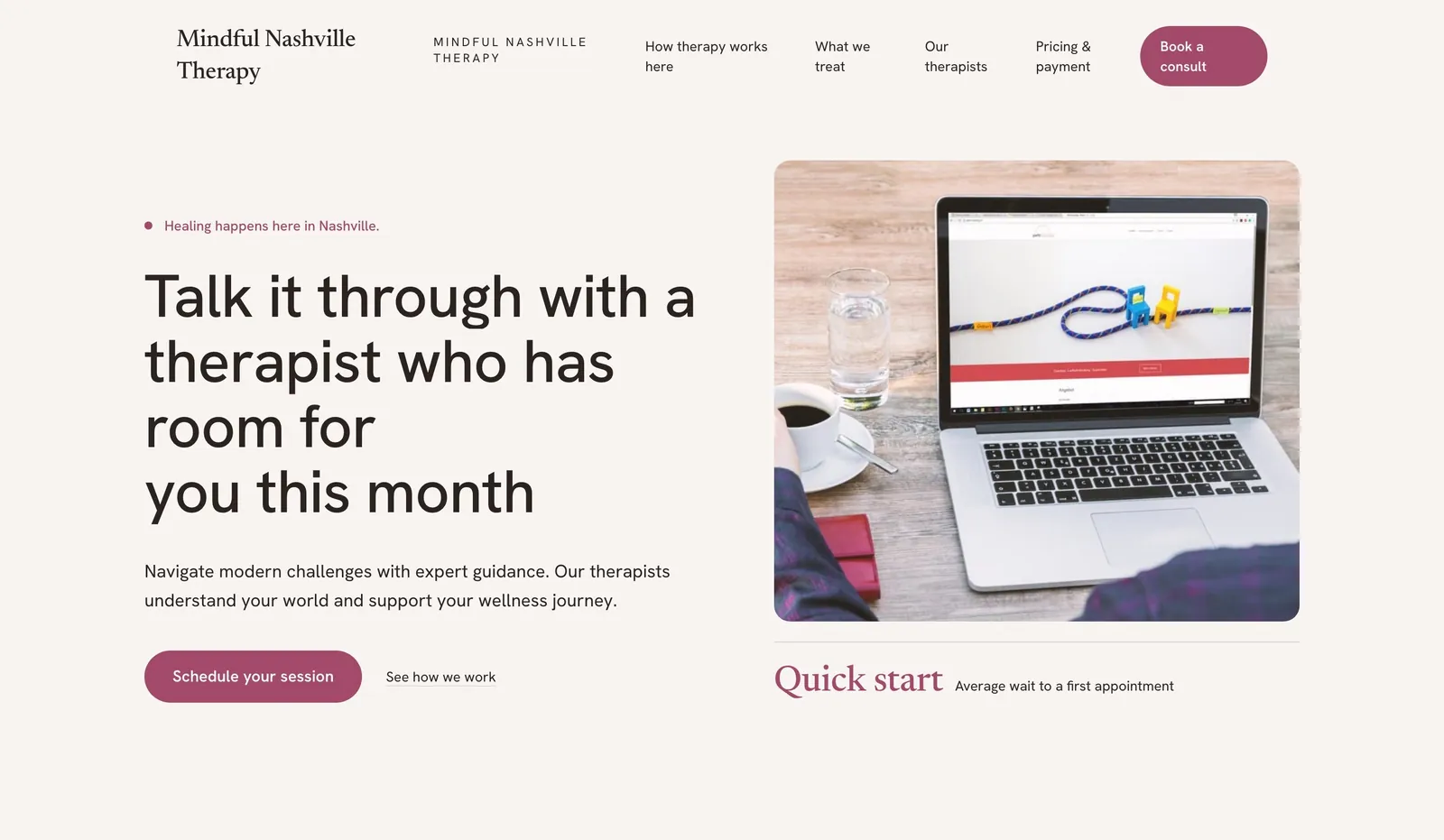
See the full demonstration and five more sample practices on the therapist website examples page. What Northbank does that you can copy:
- Headline about the client, not the practice: "Therapy that fits what you are actually facing".
- "Request a consult" is the first button, with a free fifteen-minute call before anyone commits.
- A fee list with session lengths and sliding scale slots.
- The FAQ covers insurance and the wait for a first appointment.
- Its gap: the consult is phone only. Add a short optional form that asks for no clinical details.
Workflow comparison: individual, couples and intake sessions
| Individual therapy, 50 minutes | Couples therapy, 60 minutes | Initial intake session | |
|---|---|---|---|
| What the visitor worries about | Finding the right fit, cost per week | Whether both partners must attend, neutrality | What happens, how long, what they must share |
| What the page should show | Concerns treated, approach in plain words, fee | Who attends, session length, fee, first-step call for both | What the session covers, length, fee, what to bring |
| Contact fields worth asking | Name, phone or email, best time to call | Same, plus whether both partners agree to a call | Same; never symptoms or history |
| Demonstration's sample fee | "$175" (sample) | "$215" (sample) | "$195" (sample) |
Copyable build brief
A website for [practice name], a [type of practice] in [city or state]. Lead with what clients are facing, not our name. List each service with length and fee: [individual session], [couples session], [intake session], and say whether we offer sliding scale slots. Add a free consult call button and a short contact form that emails us and asks for no clinical details. FAQ on insurance (plans in network, or superbills), the typical wait for a first appointment and what the first session covers. Add clinician bios, licence states, hours, in-person or online, and the 988 crisis line.
Therapist website builders: an honest trade-off table
| What you need | General website builder | Therapist-specialist website service | AI website builder | Designer or agency |
|---|---|---|---|---|
| Launch speed | Fast once your text is ready | Often set up for you | Fast first draft, then edit every line to sound like you | Weeks to months |
| Cost shape | Monthly plan | Monthly fee, sometimes with a setup fee | Monthly plan | Upfront project, optional retainer |
| Therapy-specific copy | You write it | Often provided, check it sounds like you | Drafted from your description | Written with you |
| Secure intake forms | Usually a third-party tool | Varies, ask about a business associate agreement | Usually a third-party tool | Depends on the tools chosen |
| Leaving later | Check what you can export | Check who owns the domain and content | Check what you can export | Usually yours |
We did not run a scored, same-scenario test across builders for this article, so check each option's current features, contract terms and pricing yourself. On We.Inc, the free plan publishes up to 3 template sites on a we.inc address without AI credits or a custom domain; Starter at $20 a month adds AI building and your own domain (pricing). The site is a public brochure with a contact form: keep clinical intake in your practice management system.
Template walkthrough
Templates that suit a therapy practice from the We.Inc library: Haven Therapy, Serene and Equilibrium Wellness, or browse all business website templates.
- Pick a template and replace every sample photo, name and review.
- Rewrite the headline around who you help.
- Add your fees, insurance position and current wait.
- Set the contact form to name, contact details and best time to call, with a note not to include clinical details.
- Connect your domain and publish, then check the live site with the free website grader. Budget with the website cost calculator.
Start building this therapist website. Create your account, or read how the We.Inc website builder works.
What the best therapist websites have in common
- A clear "I help" statement. "I help adults with anxiety and burnout find steadier ground" beats "Welcome to my practice".
- A real, warm photo. Clients choose a person. A friendly, natural photo matters more than any design choice.
- Plain-language approach. Name your modalities (CBT, EMDR, IFS) but explain what a session actually feels like.
- Practical details up front. Fees, insurance, in-person or online, which states you are licensed in, availability for new clients.
- One low-pressure action. "Book a free 15-minute consultation" repeated on every page.
- Calm design. Soft colours, generous spacing, readable type, no pop-ups or flashing elements.
Free therapist website template (copy this structure)
Home page
- Hero: "Therapy for [who] in [town or state]" with a sub-line on how you help. Button: Book a free consultation.
- "Is this you?" Three to five short sentences reflecting what clients are feeling.
- How I can help: cards for your main concerns, each linking to its page.
- About snapshot: photo, two sentences, credentials, link to full About.
- How it works: consultation, first session, ongoing sessions, in three steps.
- Practical details: fees, insurance, online or in person.
- Final call to action.
Specialty pages (one per concern)
- H1: "Anxiety Therapy in [Town]" or "Online Therapy for Anxiety in [State]"
- What this concern can feel like, in the client's words
- How you work with it and what sessions look like
- Short FAQ
- Consultation button
About, fees, FAQ and contact
- About: your story, why you do this work, training, licence, a second photo
- Fees and insurance: session rates, sliding scale, superbills, cancellation policy
- FAQ: first session, confidentiality, how long therapy takes
- Contact: booking link or simple form, office address and map, crisis note
Must-have pages for a therapist website
| Page | What goes on it | Must-have? |
|---|---|---|
| Home | Who you help, photo, approach, consultation button | Yes |
| About | Story, credentials, licence, training | Yes |
| Specialties | One page per main concern you treat | Yes |
| Fees and insurance | Rates, insurance, superbills, cancellation policy | Yes |
| Online therapy | Platform, states covered, what to expect | If you offer telehealth |
| FAQ | First session, confidentiality, length of therapy | Recommended |
| Contact and booking | Consultation link, address, crisis note | Yes |
| Blog or resources | Helpful articles on common questions | Nice to have |
Writing copy that feels safe
- Write to one person. "You" and "I" read as a conversation. "Clients" and "the practitioner" read as a brochure.
- Reflect before you explain. Describe what the visitor is experiencing before you describe your methods.
- Avoid promises. Do not guarantee outcomes. Describe what you offer and how you work.
- Keep jargon light. Name modalities for people who look for them, then explain them in a sentence.
- Add a crisis note. A short line on every contact page saying the practice is not an emergency service, with the relevant crisis line for your country.
Privacy and compliance basics
- Keep forms minimal. Name, email, phone and preferred times. Leave symptoms and history for a secure intake system.
- Use HIPAA-capable tools for health information. If a form or booking tool collects clinical details, it should support HIPAA and sign a business associate agreement (or meet your local equivalent).
- Be careful with tracking. Advertising pixels on booking or intake pages can expose sensitive information. Keep them off those pages.
- Check your licensing board's advertising rules on titles, testimonials and claims. Many boards discourage client testimonials.
Therapist website design mistakes
- Leading with credentials instead of the client. Degrees matter, but after the visitor feels understood.
- Hiding fees. People who cannot afford your rate will book a call anyway, and that wastes everyone's time.
- Clinical, cold design. Stock photos of handshakes and grey offices undo the warmth you bring in person.
- Too many calls to action. One consultation button is enough.
- No mention of location or telehealth states. Licensing is local, so people need to know if you can see them.
SEO basics for therapists
- Title pages with concern plus place: "Anxiety Therapy in Austin, TX | Jane Doe, LPC".
- Complete your Google Business Profile even if you work mostly online, and link it to your site.
- Keep details identical across your site, Psychology Today and other directories.
- Write a few helpful articles that answer real client questions.
- Add LocalBusiness or MedicalBusiness schema with your details.
Therapist website cost
| Route | Typical upfront | Typical ongoing |
|---|---|---|
| AI or DIY website builder | $0 to a few hundred dollars | $0 to about $40 a month |
| Therapist website subscription service | Often little or nothing | Roughly $50 to $100+ a month |
| Freelance designer | $1,500 to $6,000 | Hosting plus an optional care plan |
| Specialist agency | $5,000 to $15,000+ | Often a monthly SEO or content retainer |
| Domain | Roughly $10 to $20 a year |
*Typical 2026 ranges, not quotes.*
Build your therapist website from one prompt
On We.Inc you can publish a ready-made template on the free plan, or upgrade to Starter ($20 a month) and type one prompt, for example "a calm website for a licensed therapist in Austin, Texas, who helps adults with anxiety, burnout and life transitions, offering in-person and online sessions, with pages for each specialty, fees and a free consultation button". The AI builder drafts the full site and you edit the words until they sound like you.
See the features set up for practices on the therapist website builder page. You might also like dentist website design for health practice patterns.
Therapist website launch checklist
- "Who I help" statement in the first screen
- Warm, real photo of you
- A page for each main specialty
- Fees, insurance and telehealth states stated plainly
- Consultation button on every page
- Contact form asking only for basics
- Crisis note on the contact page
- No advertising pixels on booking or intake pages
- Google Business Profile and directory profiles linked
- Every page checked on a phone
When those are in place, your site does the quiet work of helping the right person feel ready to reach out.
Build your therapist website
Publish a calm, clear practice site from a free template, or let the We.Inc AI builder draft every page from one prompt on a paid plan, then edit anything. Create your account, see the therapist website builder, or start from a design: Haven Therapy, Serene, Vibrant Wellness.
Frequently asked questions
Do you take insurance?
Your website should answer this before anyone has to ask: list the plans you are in network with, or say you are out of network and explain superbills in a sentence or two. A website builder does not check anyone's coverage; it only displays what you write.
How long is the wait for a first appointment?
Publish your real current wait, for example 'usually one to two weeks', and update it when it changes. It is one of the first things a person looks for, and an honest number builds trust.
What should a therapist website include?
Who you help and the concerns you work with, your approach in plain language, your credentials and licence, fees and whether you take insurance or offer superbills, whether you see clients in person, online or both, a warm photo of you, and a simple way to book a free consultation.
How much does a therapist website cost?
Typical 2026 ranges: $0 to about $40 a month on a general website builder, roughly $1,500 to $6,000 for a freelance designer, and $5,000 to $15,000 or more for an agency that specialises in therapists. Directory-style therapist website services often charge a monthly fee instead. A domain costs roughly $10 to $20 a year.
Is there a free therapist website template?
Yes. This article includes a page-by-page therapist website template you can copy. On We.Inc, the free plan lets you publish up to three sites from ready-made templates. Drafting a custom site from a prompt with the AI builder starts on the Starter plan at $20 a month.
Does a therapist website need to be HIPAA compliant?
If your site collects health information, such as an intake form asking about symptoms, the tool that collects and stores it should support HIPAA and sign a business associate agreement. A simple contact form asking only for a name, email and preferred time is lower risk. Many therapists link to their practice management system for intake instead of collecting it on the website.
Should therapists list their fees on their website?
Most practices benefit from it. Stating your session fee, sliding scale availability and insurance position saves both sides a wasted consultation and signals openness. If you are out of network, explain superbills in one or two sentences.
How do therapists get found on Google?
Create a page for each main concern or service you treat, include your town or state in titles because licensing is state-based, complete your Google Business Profile, keep your details identical across directories like Psychology Today, and write a few helpful articles on questions your clients ask.
More in Blog
- Tree Service Website Design: Pages, Costs and a Template
- How to Turn a Website Into an App on iPhone (2026)
- 7 Essential Types of Business Websites Every Entrepreneur Should Know
- Veterinary Website Design: Pages, Costs and a Template
- Vibe Coding in 2026: 92% of Developers Use AI Tools, but Only 29% Trust the Output
- Web Design Agency Pricing: 4 Models and the Margin Math Behind Each
- Web Design Recurring Revenue: Retainers, Care Plans and Subscriptions Compared
- Web Design vs Web Development: What's the Difference?
Website builders for the businesses in this article
Related guides and tools
Start building
How we research, test and update this page: our editorial policy. We.Inc is our own product.
Product
Who It's For
- For Agencies
- For Freelancers
- For Hosting Providers
- For SaaS Platforms
- For Startups
- For Financial Services
- For Healthcare
Features
Resources
- Blog
- Help Center
- Free Business Tools
- Free UI Components
- Website Templates
- Template Collections
- Website Examples
- Guides
- Comparisons
- Alternatives
- Best Lists
- Reviews
- Pricing Guides
- Use Cases
- Glossary & Guides
- Integrations
- Developers
- Benchmark
- Windows App