
The website builder made for pest control companies.
Someone who just found termites or bed bugs searches for that pest by name, so a pest control site needs one page per pest, your service towns, your license and a fast inspection request. we.inc builds those pest pages from your description, on paid plans that start at $20 a month.
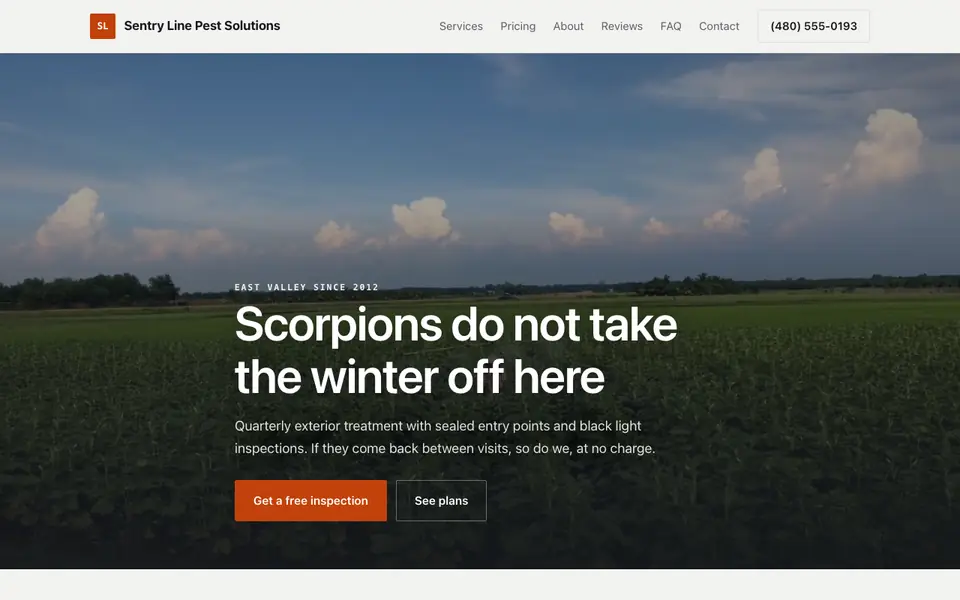
A pest control website should match the pest someone just found to the service you offer, in their town. Describe your company and we.inc builds those pages.
Pages every pest control website needs
- Home: The pests you handle, the areas you cover, and a phone number and inspection form above the fold. People with a problem want help today.
- Pest Pages: Separate pages for termites, bed bugs, rodents, ants, mosquitoes, and so on. Homeowners search for the pest by name.
- Service Plans: One-time treatments versus quarterly or annual plans, explained plainly. It helps people choose before they call.
- Service Areas: The towns and counties you serve. It matters for local search and stops out-of-area calls.
- About & Licensing: Your license numbers, insurance, and technicians. Buyers want to know who is spraying around their home.
- Free Inspection Request: A short form for address, pest, and preferred times that emails your office.
Try this prompt
A website for Shieldline Pest Solutions in Tampa, Florida. Pages for termites, rodents, ants, mosquitoes, and bed bugs, a page explaining our quarterly home protection plan, a service area page covering Hillsborough and Pinellas counties, an about page with our license info, and a free inspection request form. Clean, trustworthy look in forest green and white.
How do I explain treatments to families with pets and children?
Say what you apply, where and when it is safe to return to the treated area, in plain words. Parents and pet owners often ask this before they book, so a page on preparing for a visit and what to do afterwards reduces cancellations. Follow the product labels and any rules for your region when you write it.
What should each pest page help a visitor do?
Identify the pest and decide whether to call. Show a clear photo, the signs people usually notice first and when the problem needs a professional. Then describe how you treat it and whether follow-up visits are needed. Ending each page with a short inspection request keeps the next step obvious.
How pest control searches work, pest by pest
Few people search for an exterminator in general. They search for the thing they just saw, with their town, often at night, and they call whoever answers clearly what it is and how soon someone can come.
Match pest pages to the season in your area
Termite swarms, wasps, mosquitoes and rodents each peak at different times. Update and link the relevant page from the home page a few weeks before its season so it is fresh when searches climb.
Use Business Profile services for each pest
The services section of your profile lets you list bed bug treatment, termite inspection and so on with short descriptions. Those entries can match specific searches on the map.
Ask for reviews after the follow-up visit
The first treatment rarely ends the problem. Send the review link once the customer confirms the pests are gone, when they are most relieved and most specific.
How do pest control companies usually get their website?
A pest control site wins on two things: a page that matches the pest someone just found and an easy way to book an inspection. Companies choose between their field-service software's booking pages, a pest control marketing agency, a general builder or a self-built site.
| Option | Good for | Watch out for |
|---|---|---|
| Field-service software such as GorillaDesk or PestPac | Routing, service agreements and billing in one system, and some offer an online booking or customer portal link. | Those booking pages are not a marketing site, so they do little for search on their own. |
| Pest control marketing agencies | They know seasonal demand, such as termite swarms in spring, and plan pages and ads around it. | Retainers and contracts, and pest pages written by an agency can read the same as competitors' pages. |
| Thumbtack or Angi | Quick leads from homeowners who want someone this week. | Price comparison beside other exterminators and a fee for each lead or booking. |
| we.inc | Describe the pests you treat, your plans and service areas to get a page per pest, plan details and an inspection request form. | It does not route technicians or bill service plans; link your field-service tool for existing customers. |
Writing your own photos and local observations into each pest page is what keeps it different from the generic pest pages agencies sell.
Sentry Line Pest Solutions
This is Sentry Line Pest Solutions, a pest control business we described to the AI in a sentence. See the Sentry Line Pest Solutions example site.
Start from this design
Three designs that suit a pest control website.
- Plumbing, HVAC & Electrical Company
- All-in-One Property Maintenance
- Blue Home and Office Cleaning
Most pest control sites are a template with the name swapped in. Describe what you do and the AI designs and writes a pest control website around that business instead.
Perfect for:
- Residential pest control
- Commercial pest control
- Termite treatment
Pest pages are your best search pages
Someone who just found droppings searches 'rodent control near me', not your brand. Give each pest a page covering signs, your treatment approach, and what the homeowner should do before you arrive.
Show your applicator license
Most states require licensed pesticide applicators and some require license numbers in advertising. Check your state agriculture or pesticide regulatory office's rules and list what is required.
Be honest about safety wording
Avoid calling products 'totally safe' or 'non-toxic' unless the label supports it; pesticide advertising claims are regulated. Explain instead how you protect kids, pets, and gardens.
Routing, scheduling, and billing need a field service app
We.inc builds your site and forms, not technician scheduling, recurring billing, or customer accounts. Link a tool like Jobber, Housecall Pro, or PestPac for booking and service plans.
What it costs
Running costs are your plan plus a domain (roughly $10 to $20 a year, paid plans only). Building a site on We.Inc is free, with no card needed to start. Starter at $20 a month lets the AI write your pest and service area pages and keep them updated.
Building your site is free, no card needed. Paid plans from $20 a month. Compare plans
Frequently asked questions
What pages should a pest control site have?
A home page with a quote form, one page per pest, service plan details, service areas, and an about page with licensing. Those cover what homeowners and search engines look for.
Can customers schedule a treatment online?
Your site can take inspection requests by form. For live scheduling and recurring plans, link a field service tool such as Jobber or Housecall Pro.
Should I list every town I serve?
Yes, on a service area page. It helps local search and tells visitors quickly whether you cover them.
Can I start without paying?
Yes. Building a site on We.Inc is free, with no card needed to start. Starter at $20 a month unlocks AI building and editing.
Do I need my license on my website?
Many states require it in advertising. Check your state pesticide regulator's rules, and include license and insurance details either way since they build trust.
In our 2026 measurement of 50 pest control websites, 8% had no search description, 20% had no structured data and 10% had no tap-to-call link. See the full study.
Related industries and website guides
- construction website builder
- pet sitting website builder
- hvac website design
- general contractor website design
- pressure washing websites
- remodeling contractor websites
- Pest control website example
- how to make a website
Related website builders: Home Services
- construction website builder
- pet sitting website builder
- hvac website design
- general contractor website design
- pressure washing websites
- remodeling contractor websites
Before you start
Related guides
Product
Who It's For
- For Agencies
- For Freelancers
- For Hosting Providers
- For SaaS Platforms
- For Startups
- For Financial Services
- For Healthcare
Features
Resources
- Blog
- Help Center
- Free Business Tools
- Free UI Components
- Website Templates
- Template Collections
- Website Examples
- Guides
- Comparisons
- Alternatives
- Best Lists
- Reviews
- Pricing Guides
- Use Cases
- Glossary & Guides
- Integrations
- Developers
- Benchmark
- Windows App