Websites for every local, and for every member who runs a practice
Unions and professional bodies need websites at two levels. The first is their own structure: locals, branches, districts and councils that each need a place to post meetings, contracts and contacts. The second is their members: physiotherapists, accountants, electricians and other professionals who run their own practices and need a website of their own. This page covers both, and one issue that is specific to unions: what a union-funded website may not do during an officer election.
TL;DR
- Locals and branches need sites that belong to the office, not to whoever is secretary this term.
- In the US private sector, union money may not be used to support or oppose a candidate in a union officer election, and a union website is union-funded.
- Professional bodies can offer members a practice website as a benefit, under the body’s brand or the member’s own.
- In We.Inc each local, branch or member is a client account under your brand, with switches you control and single-step approval before a site goes live. Book a demo.
Two jobs, one platform
Most organisations in this group start with one job and discover the second later.
Job one: the structure. A national union with 200 locals, or a professional body with regional branches, wants each unit to have a site that looks like part of the organisation, lists current officers and stewards, posts meeting notices and keeps documents members need. The chapter websites page covers the general rules for volunteer-run units, such as access tied to roles and what to do with a unit that goes quiet; they apply to locals and branches too.
Job two: the members. Many professional bodies, and some trade unions with self-employed members, hear the same request every year: "Can you help me get a website for my practice?" A practice website offered through the body, built to its standards, is a real member benefit and a reason to renew.
The same platform can do both, as long as you keep the two groups apart in how you set them up.
The election rule unions must design for
In the US, section 401(g) of the Labor-Management Reporting and Disclosure Act bars a labor organization from using union funds to promote the candidacy of any person in a union officer election. The Department of Labor's interpretive regulation, 29 CFR 452.75, says a union may not attack a candidate in a union-financed publication or urge members to elect a candidate in a union-financed letter, and that "any such expenditure regardless of the amount" violates the section.
A local's website is union-financed. In election investigations, the Department of Labor's Office of Labor-Management Standards has examined local websites and newsletters, including newsletters archived on a local's site, for content that favoured a candidate.
What this means for local websites:
- Incumbents are the risk. The people with access to the local's site are usually the officers running for re-election. A news post praising "our president's" contract win in the weeks before an election can look like campaigning.
- Set an election period rule. From nominations until the result is certified, the local's site posts only official notices: election rules, dates, candidate lists in a neutral format.
- Put a second person in the loop. During the election period, turn on approval for that local so a national or district reviewer sees each change before it goes live.
- Do not let candidates use the site. Campaign material belongs on candidates' own pages, paid for by candidates.
This is general information about US private-sector unions. Public-sector unions and unions in other countries work under other rules; check yours.
How it maps in We.Inc
| Your organisation | In We.Inc |
|---|---|
| The national union or professional body | The brand account and its team |
| A local, branch, district or council | A client account with its own site(s) |
| A member who runs a practice | A client account, tagged as a member practice |
| National communications or an election officer | A team member who approves publishing |
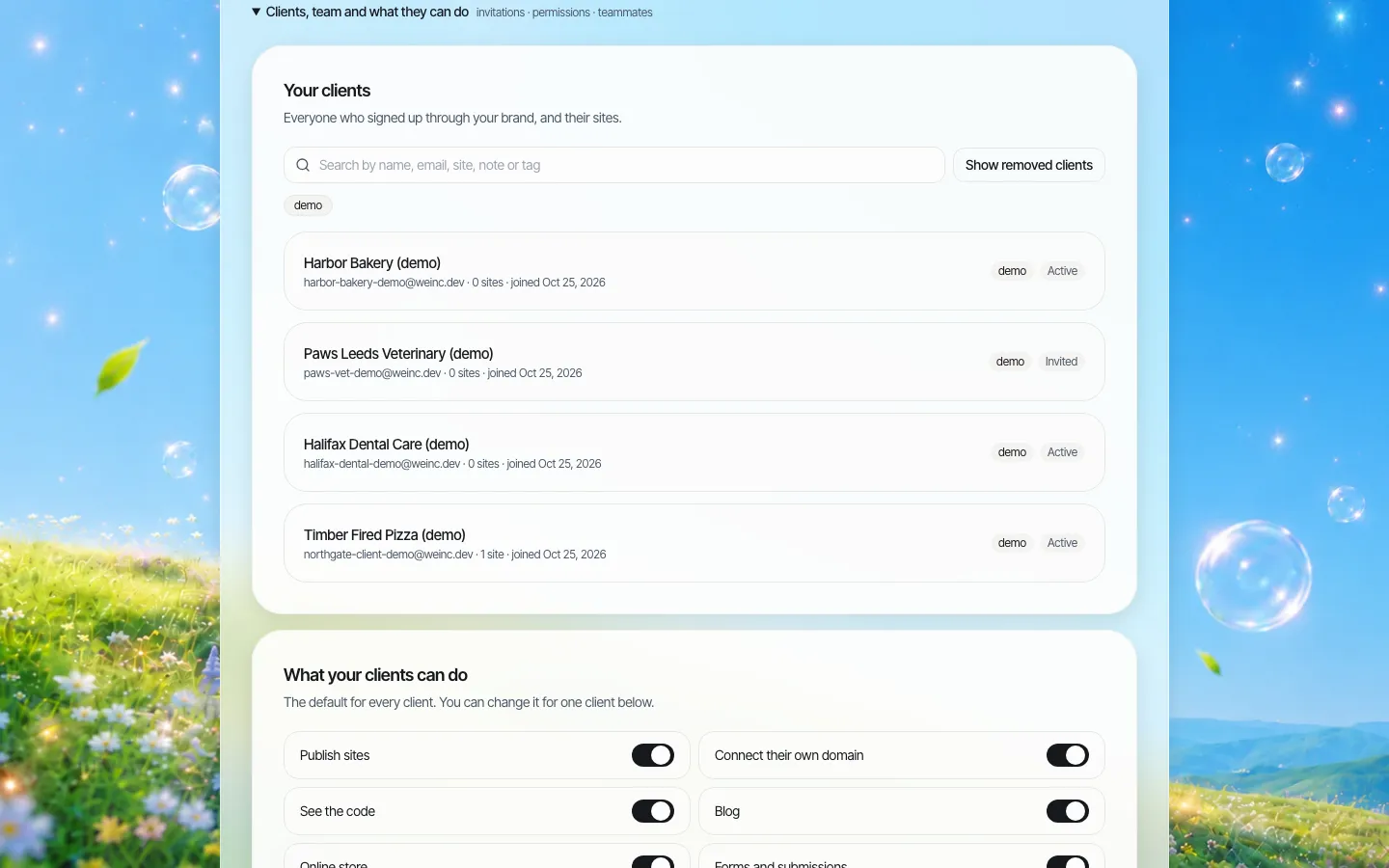
*One register for locals and member practices. Tag them ("local", "branch", "member practice") and search by tag.*
Settings differ between the two groups. A starting point:
| Switch | Locals and branches | Member practices |
|---|---|---|
| Publishing | Direct, approval during elections | Direct |
| Approval | On for new officers and election periods | Off, or on for a first publish |
| Own domain | Held by national | The member's own domain |
| Forms | On (member contact, grievance contact) | On (client enquiries) |
| Blog | On | On |
| Store | Off | Optional, if members sell services |
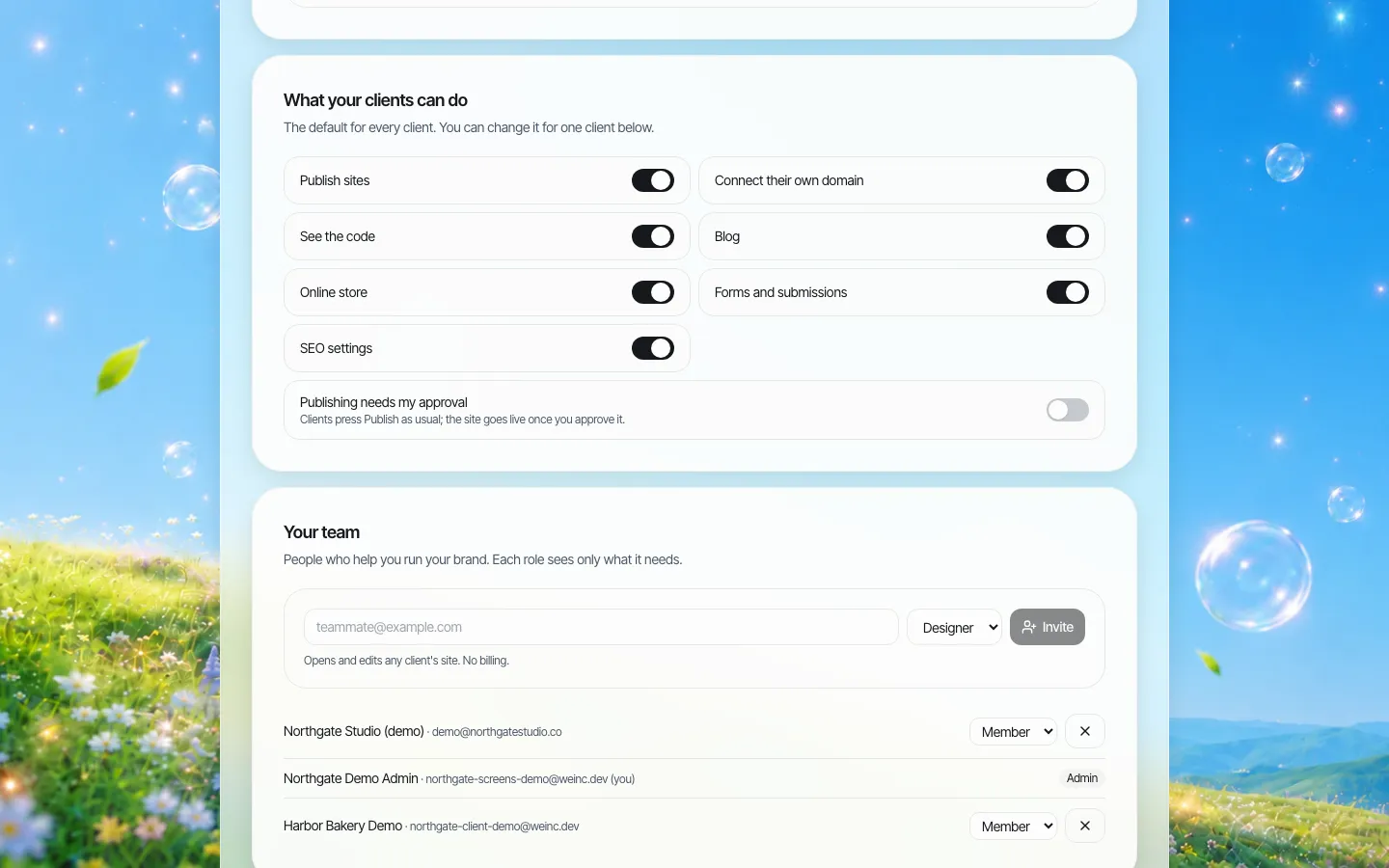
*Organisation-wide defaults. Override them for one local during an election, or for members as a group.*
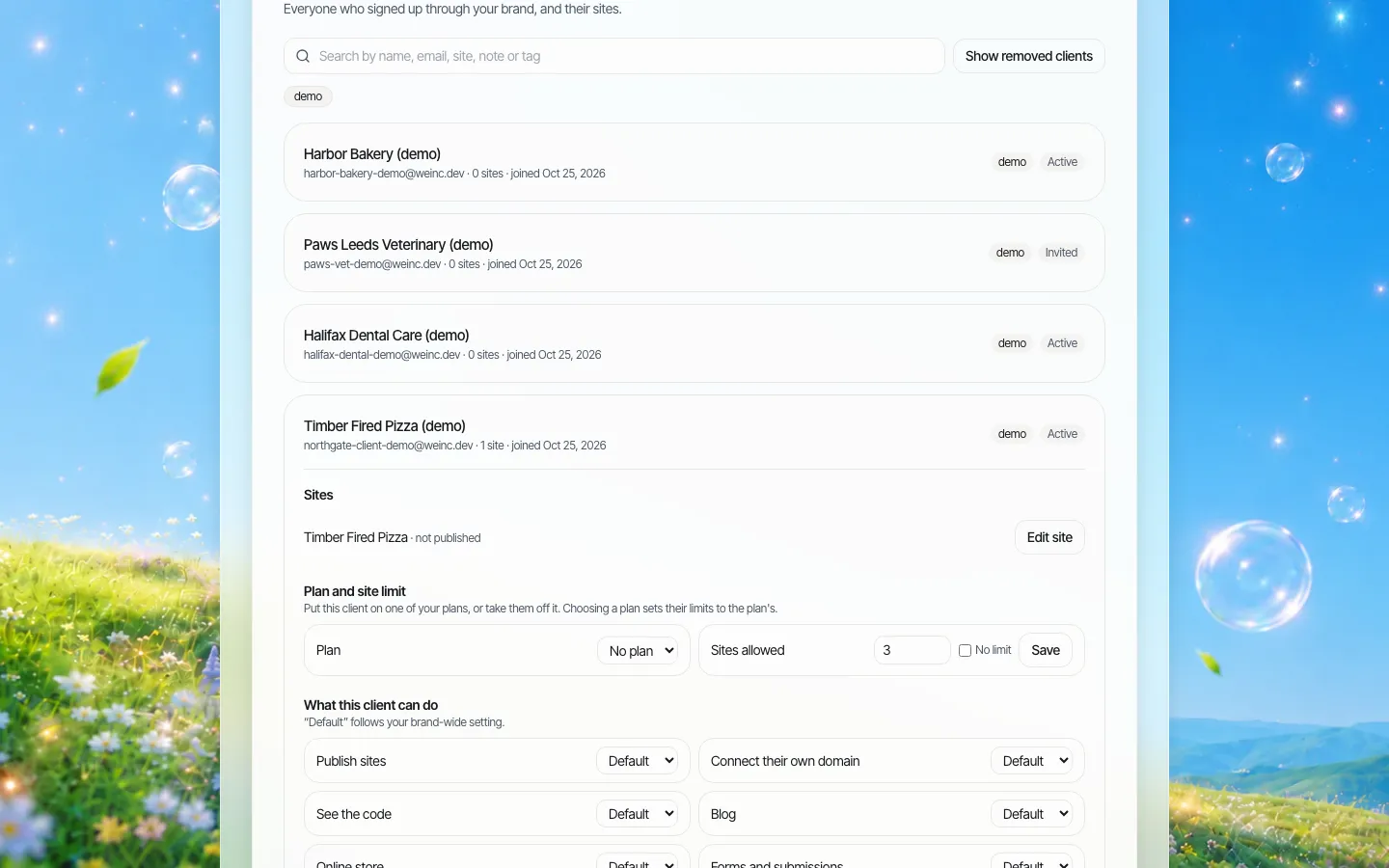
*One local's account. Turning approval on for the election period is one switch.*
What a local's site should carry
Members visit a local's site for a handful of things. Make them easy to find and keep them current:
- Officers and stewards for this term, with a role email rather than a personal one.
- Meeting dates, places and how to join remotely.
- The current contract, or where members can get it.
- How to raise a grievance or contact a representative.
- Election notices, posted neutrally, when an election is running.
- A link to national for membership, dues and benefits.
Keep members' personal information off public pages. A list of members, their employers or their grievances does not belong on a public website.
Member practice websites as a benefit
For a professional body, the practice website program works best when it is clearly the member's own site with the body's backing, not a copy of the body's site with a name swapped in:
- The member owns their practice name and domain. The body provides the platform and templates.
- The body's mark is used by its rules. If members may show "Member of" or a credential mark, put the approved version in the template and say how it may be used.
- Claims follow your code of conduct. Titles, specialisms and outcomes must match what the member is entitled to claim. Approval for a first publish lets you check that once.
- Leaving is clean. If a member lapses, pause the account and agree what happens to their site. A site's code can be downloaded as a ZIP or exported to GitHub and handed to them.
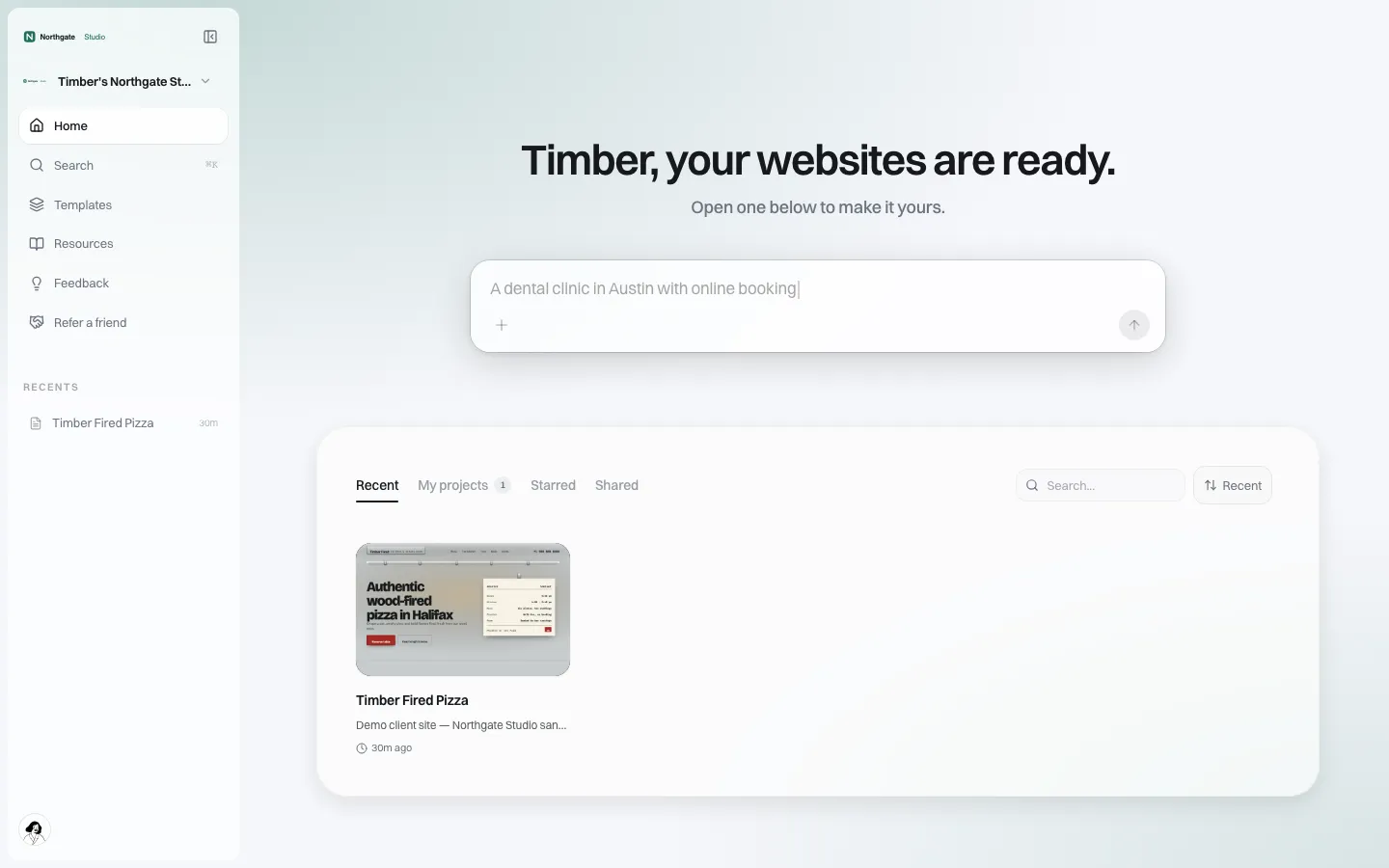
*What a member sees when they sign in: the body's brand, their own sites, and a prompt box to start building.*
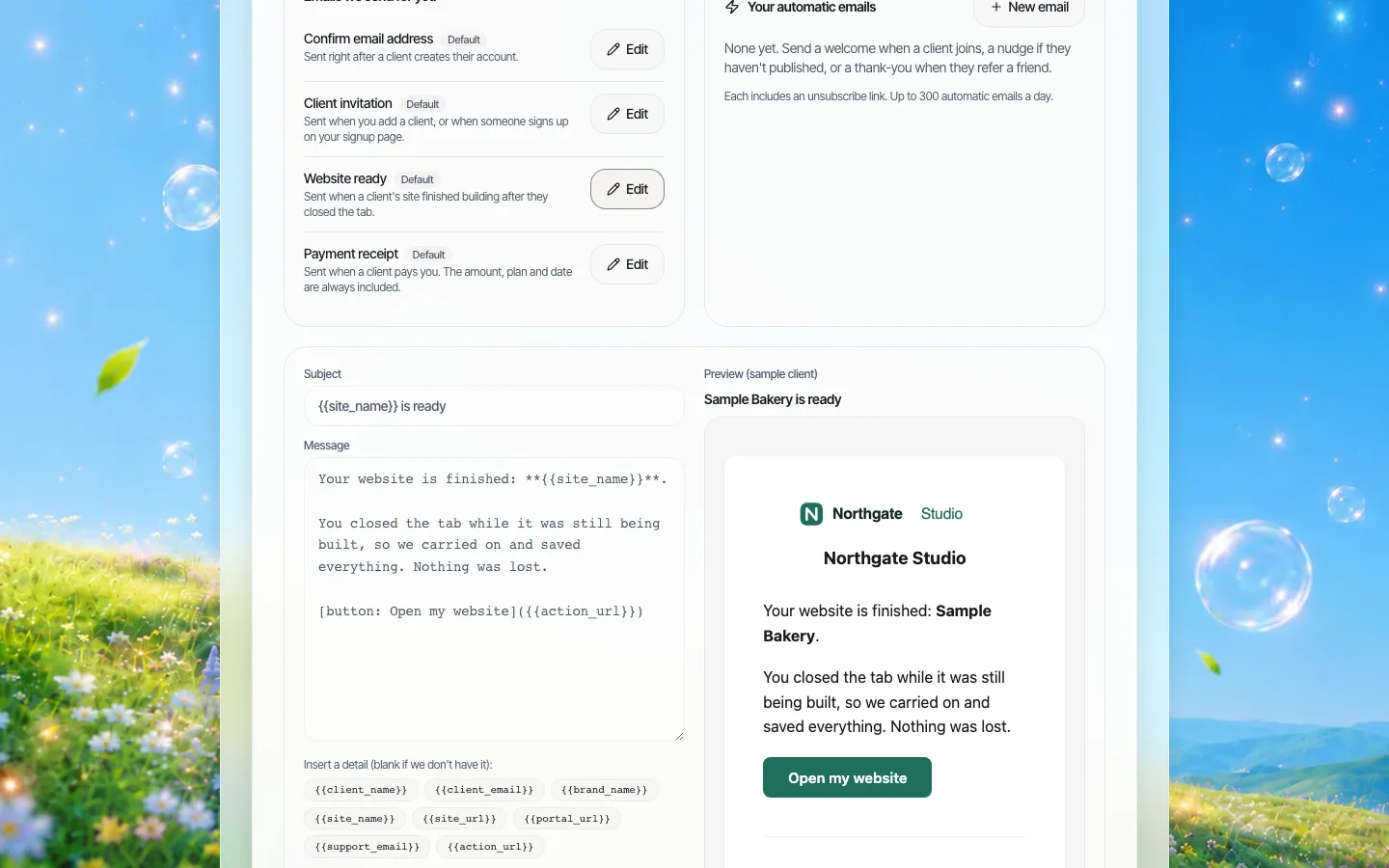
*Emails such as "your website is ready" go out with your organisation's name and logo.*
If members pay for the program, client billing can run under your brand; see reseller billing. Many bodies instead include it in membership.
Records and accountability
Unions and professional bodies answer to members and, for unions, to regulators. We.Inc keeps an audit log of organisation actions, such as a local's permissions changing or an account being paused. It does not keep a dated archive of every page version; if you need to show what a local's site said on a date during an election, save copies of the pages yourself at the start of the election period and when notices change.
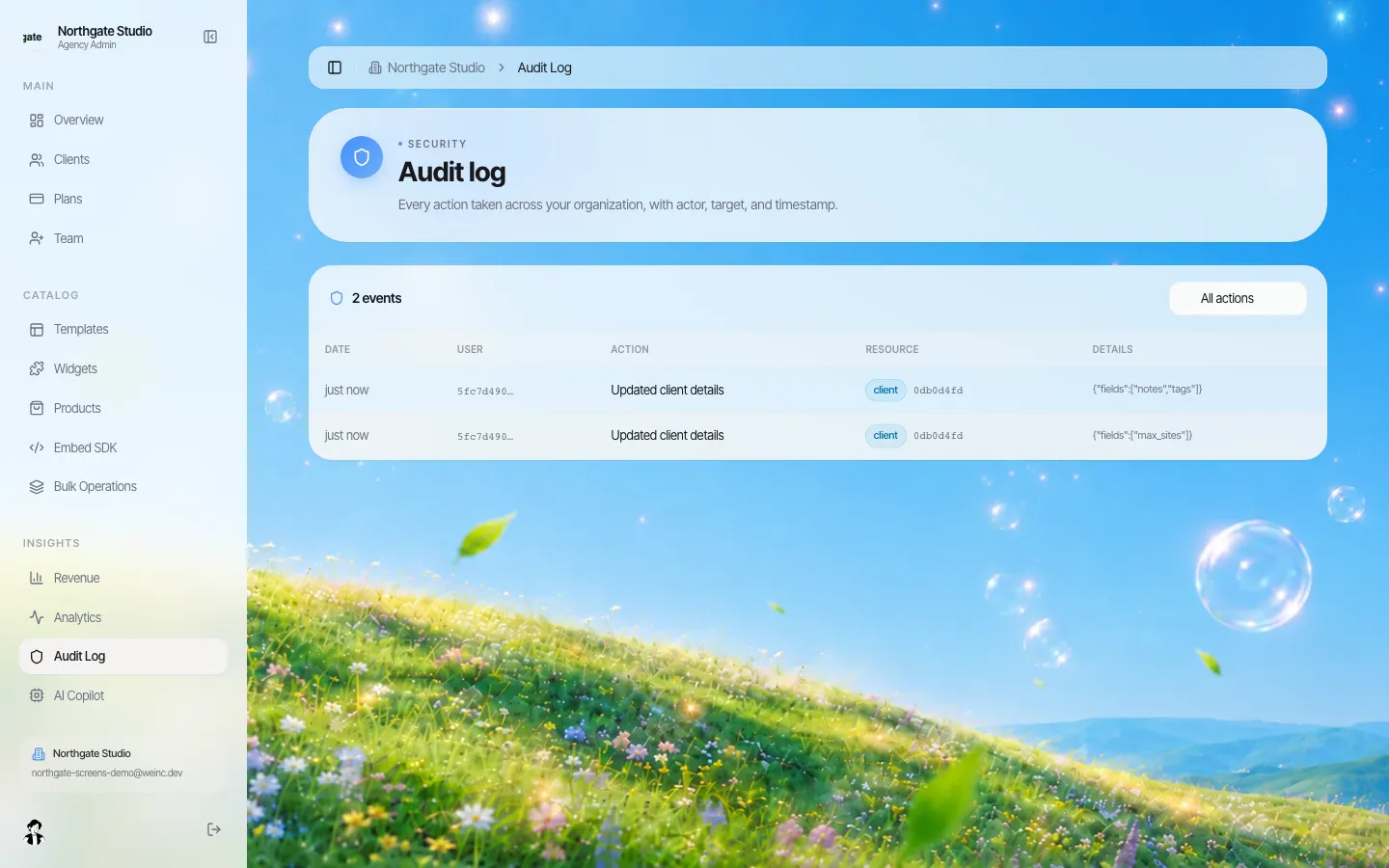
*Account-level actions are recorded. In this build the user column shows an ID rather than a name.*
Is We.Inc the right fit?
A good fit for unions and professional bodies that want branded sites for locals and branches with central control, and want to offer member practices a website as a benefit.
Not the right fit if you need dues collection, membership records, grievance tracking or online voting. Union and association management systems do those things; We.Inc does not, and the sites should link to them.
Book a demo and we will set up a sample local and a sample member practice under your brand.
Sources
Last checked 2026-10-25. This page is general information, not legal advice.
- eCFR, 29 CFR 452.75, Union funds and candidates.
- U.S. Department of Labor, Office of Labor-Management Standards, election statement of reasons, APWU, 2011: review of a local's website and newsletter under section 401(g).
Book a demo. Pricing is tailored to your volume and setup, and you get your exact price on the call. 0% transaction fee.
Frequently asked questions
Can national approve a local’s pages during an officer election?
Yes. Turn on publishing approval for that local. It is a single-step approval before the local’s site goes live.
Can members use their own domain for a practice site?
Yes, if you allow it. Connecting their own domain is a per-account switch you control.
Does We.Inc handle dues, membership records or voting?
No. Keep those in your membership system and link to it from each local or branch site.
Keep reading
- White label website builder: the We.Inc platform
- Chapter websites for associations
- Client permissions: what each site owner can do
- Bill your clients under your own brand
- Audit log for a white-label website platform
- Website vendor exit plan: contract clauses
More in White Label
- Websites for every department, lab and event, under one university brand
- A Vendasta alternative for agencies whose product is the website
- Your customers already run their business in your software. Should their website live there too?
- Can you white label Webflow? No. Here is the alternative.
- The white-label website builder for agencies
- A listing gets a wedding vendor found. A website gets them booked.
- A website program for the retailers you supply
- Can you white label Wix Studio? No. Here is the alternative.
We.Inc is an AI-powered website builder you can resell under your own brand. Launch a branded client dashboard, bill on Stripe Connect, and deliver AI-generated websites in minutes. White-label pricing is tailored to your volume and setup: book a 30-minute demo for a quote.
Product
- AI Website Builder: Describe a site in plain English; it's live in minutes
- White Label Platform: Your brand, your domain, your margin
- Enterprise: SSO, custom SLAs, and dedicated support
- Developer API: Embed site generation into your SaaS
Who It's For
- For Agencies: Resell under your brand
- For Freelancers: Your own branded builder
- For Hosting Providers: Add a builder to your stack
- For SaaS Platforms: Embed site creation via API
- For Startups
- For Financial Services
- For Healthcare
Features
- Drag & Drop Editor
- Built-in SEO Tools
- Custom Branding
- Client Dashboard
- Reseller Billing (Stripe Connect)
Resources
- Blog
- Help Center
- Free Business Tools
- Free UI Components
- Website Templates
- Template Collections
- Website Examples
- Guides
- Comparisons
- Alternatives
- Best Lists
- Reviews
- Pricing Guides
- Use Cases
- Glossary & Guides
- Integrations
- Developers
- Benchmark
- Windows App