A website program for the retailers you supply
Independent retailers, dealers and trade contractors buy from you because of price, range and service. A good website program adds a fourth reason: the shop on the corner gets a site it could never build alone, and it carries your lines. This page is a plan for distributors weighing that program: what it should achieve, the rules to set, the traps that turn it into a liability, and where We.Inc helps.
TL;DR
- A retailer website program is a loyalty tool. Measure it by how many retailers publish and keep buying, not by sites created.
- Write the content rules first: what the retailer must show, what they may change, and how your product content is used without making thousands of near-identical pages.
- Each retailer is a client account under your brand, with switches for publishing, domains, forms, store and SEO, and optional approval before publishing.
- We.Inc does not sync your catalogue or stock into retailer sites. If live product feeds are essential, you need a commerce platform built for that.
What the program is for
Distributors start website programs for different reasons, and the reason changes the design. Pick one primary goal and write it at the top of the plan.
| Goal | What the retailer site emphasises | What you measure |
|---|---|---|
| Loyalty: keep retailers buying from you | A good site for their business, with your brands present | Purchase frequency of participating retailers vs others |
| Sell-through: move more of your lines | Your categories and brands, "ask in store" calls to action | Sales of featured lines to participating retailers |
| Recruitment: win new retailers | A free or cheap site as part of the account offer | New accounts citing the program |
| Professionalism: protect the brands you carry | Correct logos, current product names, no outdated claims | Brand complaints from suppliers |
Most programs say "all four". They then serve none well, because the site that maximises sell-through (your products everywhere) is not the site a retailer is proud of (their shop, their people, their service).
The retailer's view
Before writing rules, remember what an independent retailer actually wants from a website, in order:
- People can find the shop, its hours and its phone number.
- The site looks like a real, current business.
- It shows what they are good at: services, specialities, local knowledge.
- It shows the main brands they carry.
- Some of them, not most, want to sell online.
Notice that "your full catalogue" is not on the list. A hardware shop with a 40,000-product catalogue on its site looks like every other hardware shop, and the customer still has to phone to check stock.
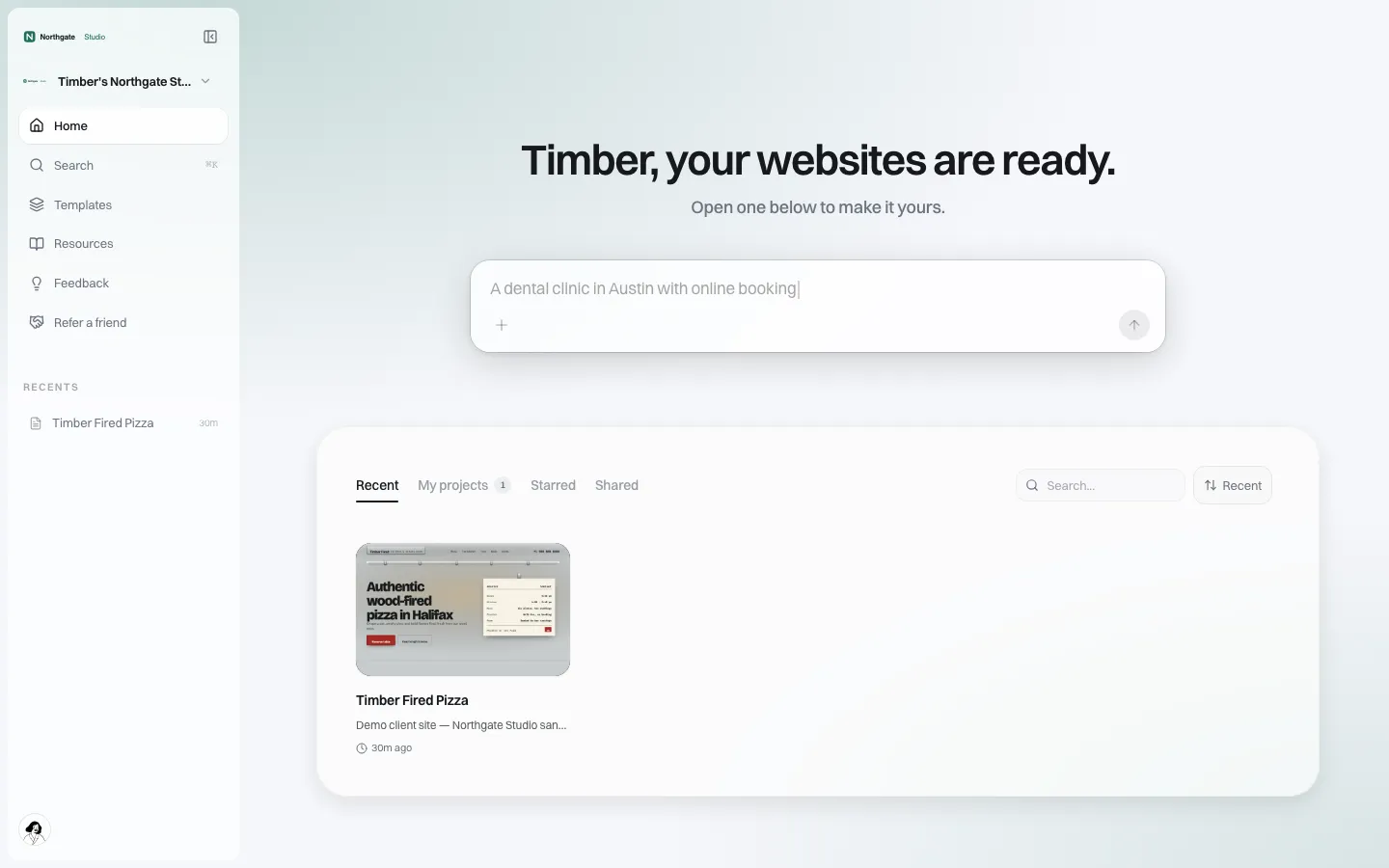
*What a retailer sees after signing in under the distributor's brand: their sites and a prompt box to describe their business.*
Content rules to set before launch
Copy this table into your program terms and fill in the right-hand column.
| Rule | Options | Your decision |
|---|---|---|
| Required on every site | Business name, address, hours, phone, "proud stockist of" section | |
| Brand use | Only approved logos from your brand pack; supplier rules apply | |
| Product content | Category pages written per retailer; no bulk catalogue copies | |
| Prices | Retailer sets their own; you never publish prices on their behalf | |
| Online sales | Off by default; on for retailers who request it | |
| Domain | Retailer's own domain, owned by the retailer | |
| Approval | Retailer publishes alone, or after your marketing team reviews | |
| Leaving the program | Retailer keeps the site and content |
Two of these deserve a sentence each. Prices are the retailer's. A distributor setting or publishing resale prices on a retailer's site can raise competition-law questions in many countries; keep prices in the retailer's hands and ask your own counsel about your market. Domains are the retailer's. If the program ends or the retailer switches distributor, a domain in your name becomes a dispute.
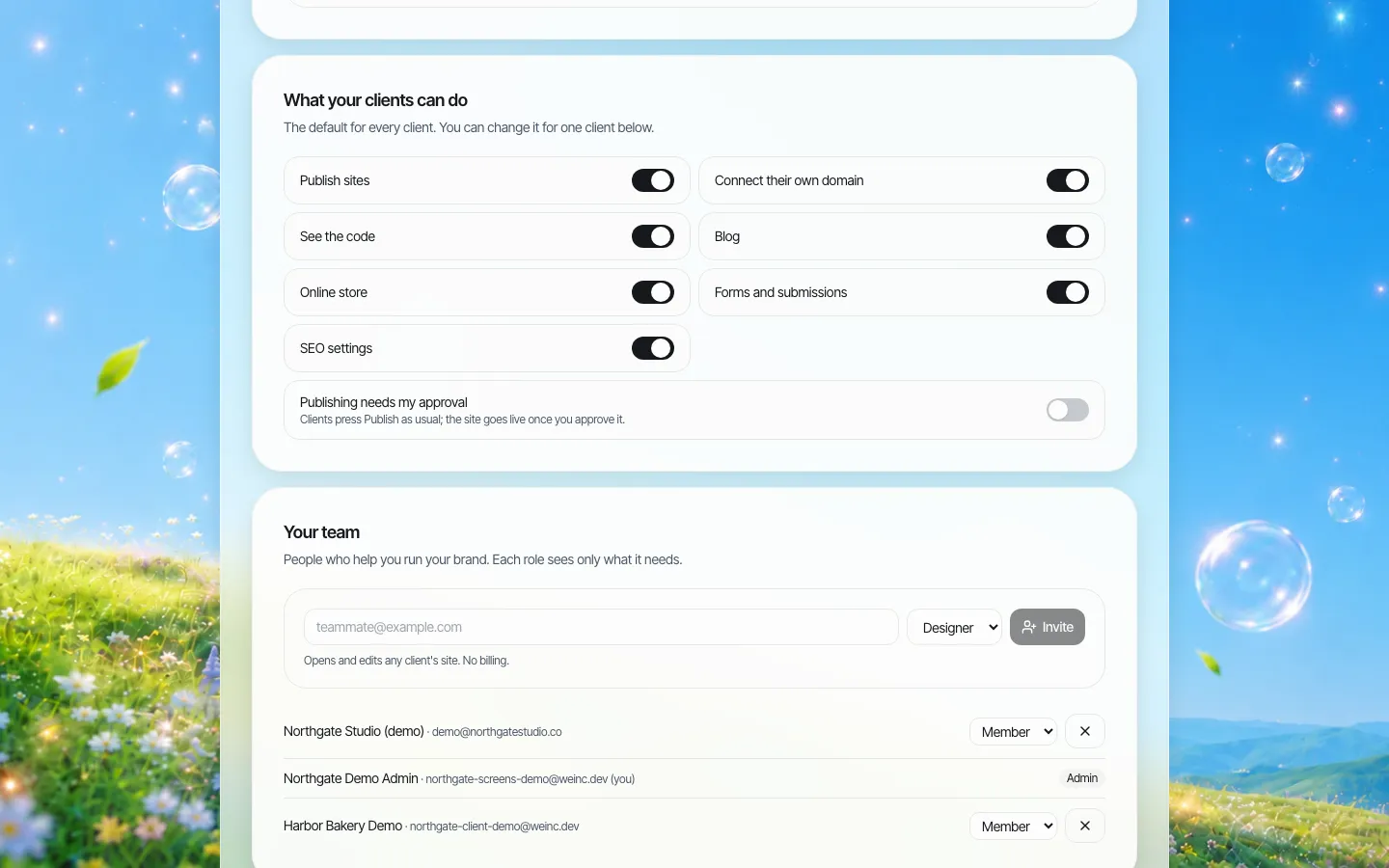
*Brand-wide defaults. Set them once for the whole program, for example online store off and forms on, then change them for individual retailers.*
The duplicate-page trap
The fastest way to fill 500 retailer sites is to paste the same product descriptions into each one. It is also the fastest way to make 500 sites nobody finds. Google's spam policies describe scaled content abuse as many pages generated mainly to manipulate rankings, and doorway abuse as pages created to rank for similar queries that funnel visitors elsewhere. A network of retailer sites with identical category pages and only the town name changed looks like exactly that.
What works instead:
- Write category pages per retailer. "Paint" on a decorator's merchant site should say what they mix, which trade accounts they serve and who to ask.
- Use your product content as a source, not a page. Give retailers short brand blurbs to adapt, not product pages to paste.
- Feature fewer products, better. Ten products a shop actually stocks and recommends beat a thousand it does not.
- Link to manufacturer pages for full specifications rather than copying them.
Our location pages guide covers the same problem for franchises in more depth.
Running the program: one console for every retailer
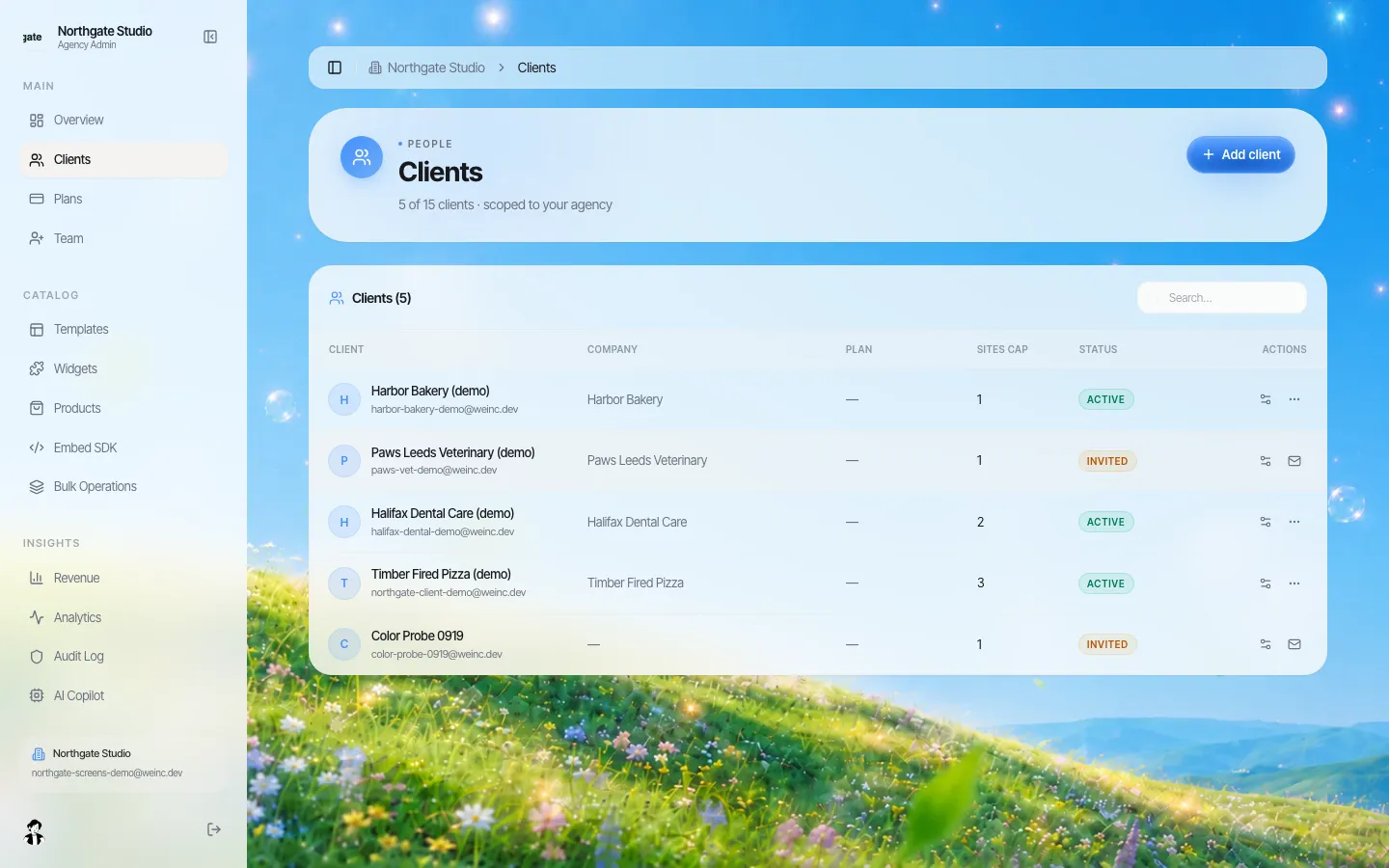
*The client table: every retailer in the program, with company, plan, site limit and status.*
- Retailers as client accounts. Each retailer gets an invitation in your name, signs in on your branded page and edits within the switches you set.
- Tags and notes. Tag by region, sales rep, account tier or "pilot", and record the account number in notes, so a rep can find their retailers in seconds.
- Site limits. One site per retailer by default; raise it for multi-branch accounts.
- Approval when you need it. If suppliers are strict about brand use, turn on single-step approval before a retailer's site goes live, for the whole program or for selected retailers.
- Your team, with roles. Marketing staff can edit any retailer's site; support staff can see clients and write notes without editing; billing staff handle billing.
- An audit log records organisation actions, which helps when a supplier asks who changed a page.
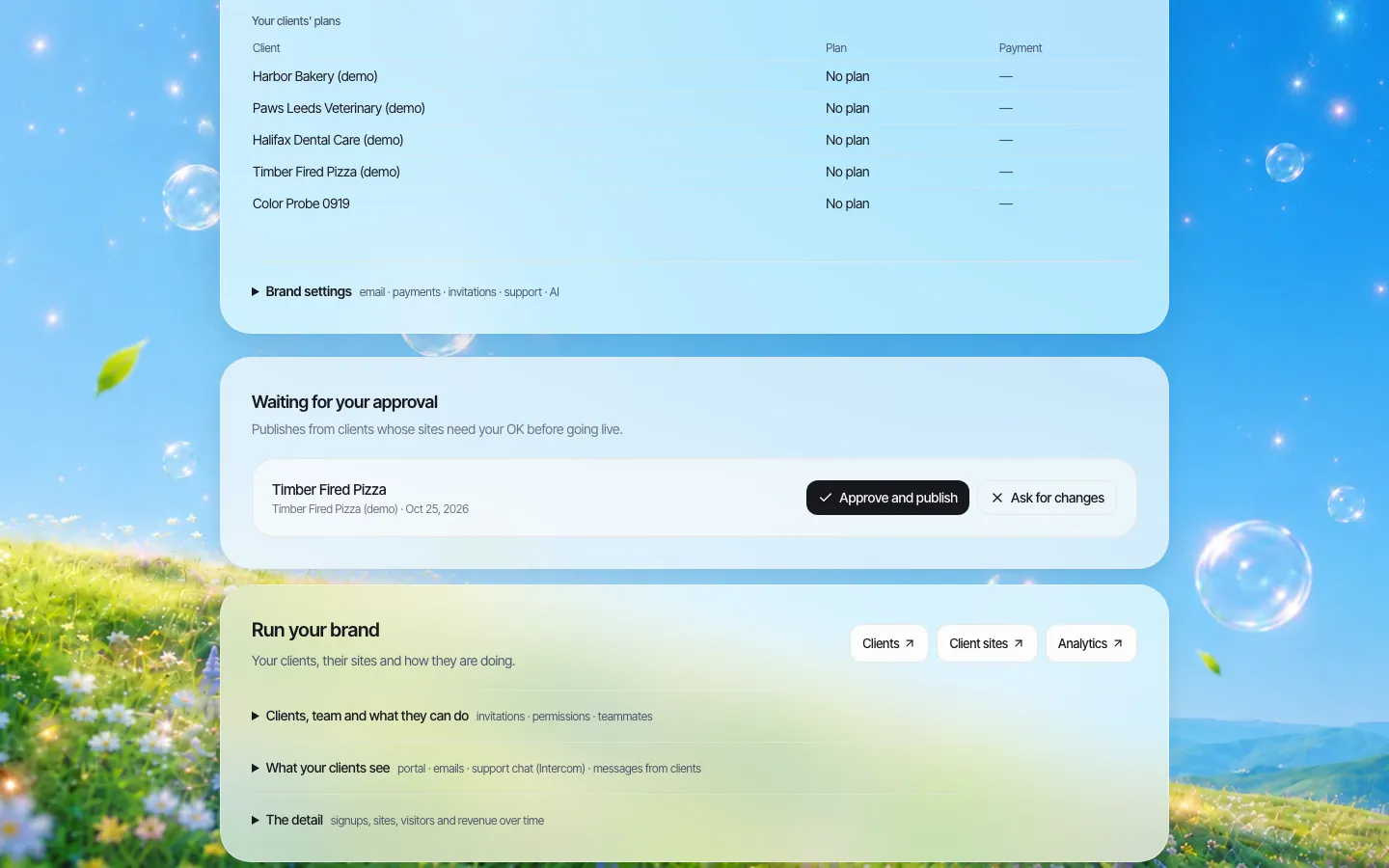
*The approval queue. A retailer's site waits here until your marketing team approves it or asks for changes.*
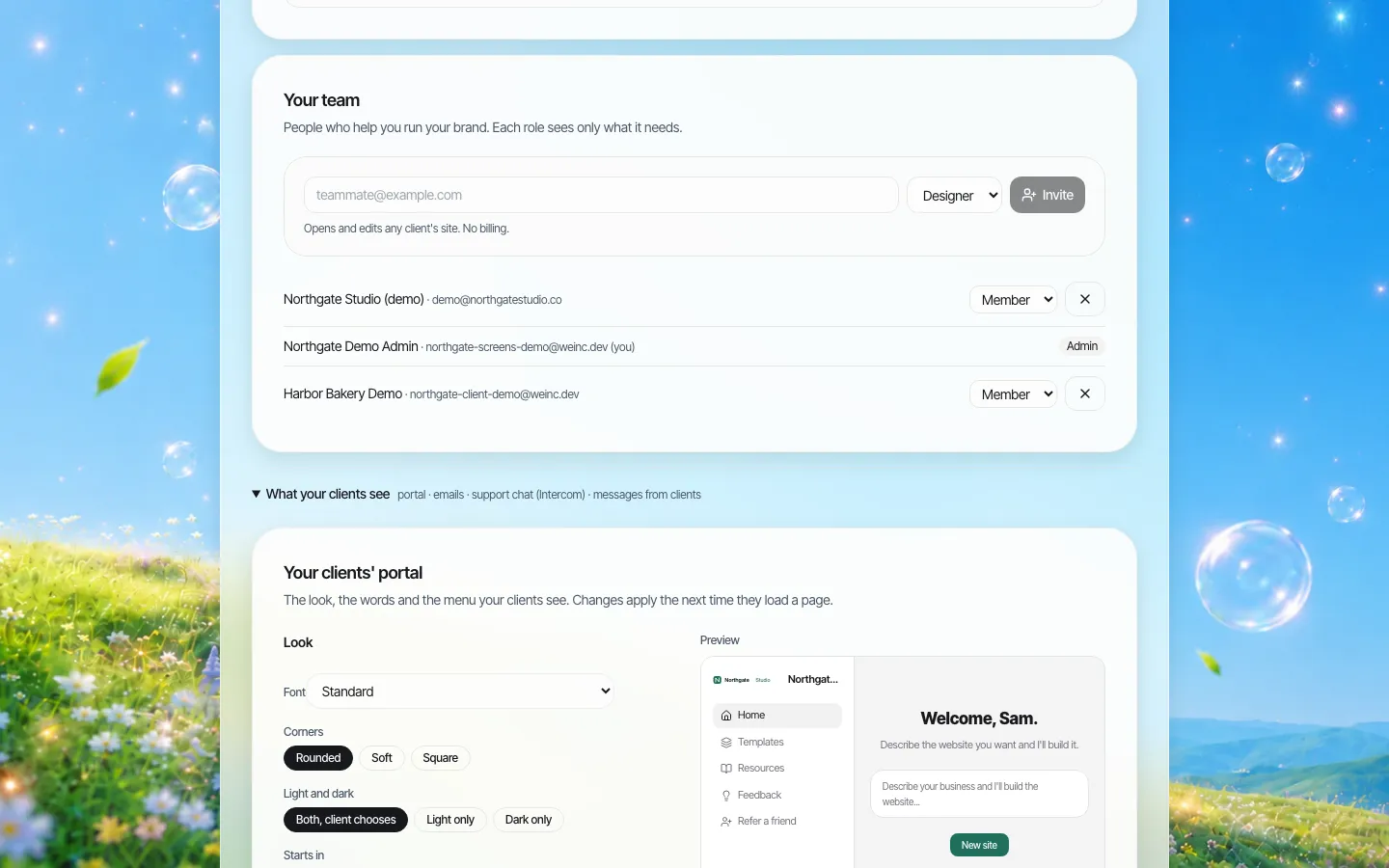
*Your program team. Field reps can be set up to see retailers and add notes without changing sites.*
Paying for it
Distributors fund programs in three common ways: included for retailers above a purchase threshold, co-funded from supplier marketing money, or charged as a monthly service. If you charge, you can create client plans with your own prices and collect through your own connected Stripe account; if it is free above a threshold, assign a plan with no charge and manage eligibility yourself. Our price to you is quoted in a demo.
If supplier marketing funds pay for part of it, check each supplier's rules on what the money can be spent on and what proof they need. Screenshots of published sites showing their brand are usually part of the claim.
A launch plan for the first 90 days
| Weeks | Work | Output |
|---|---|---|
| 1-2 | Write the content rules; prepare brand blurbs and approved logos; brand the portal | Program terms and a brand pack |
| 3-4 | Build three templates by retailer type, such as hardware, garden, trade counter | Templates retailers start from |
| 5-8 | Invite 30 to 50 retailers through their reps; sales reps help with the first edit | First published sites |
| 9-12 | Review: publishing rate, support questions, retailer feedback, rep feedback | Go or no-go for the full base |
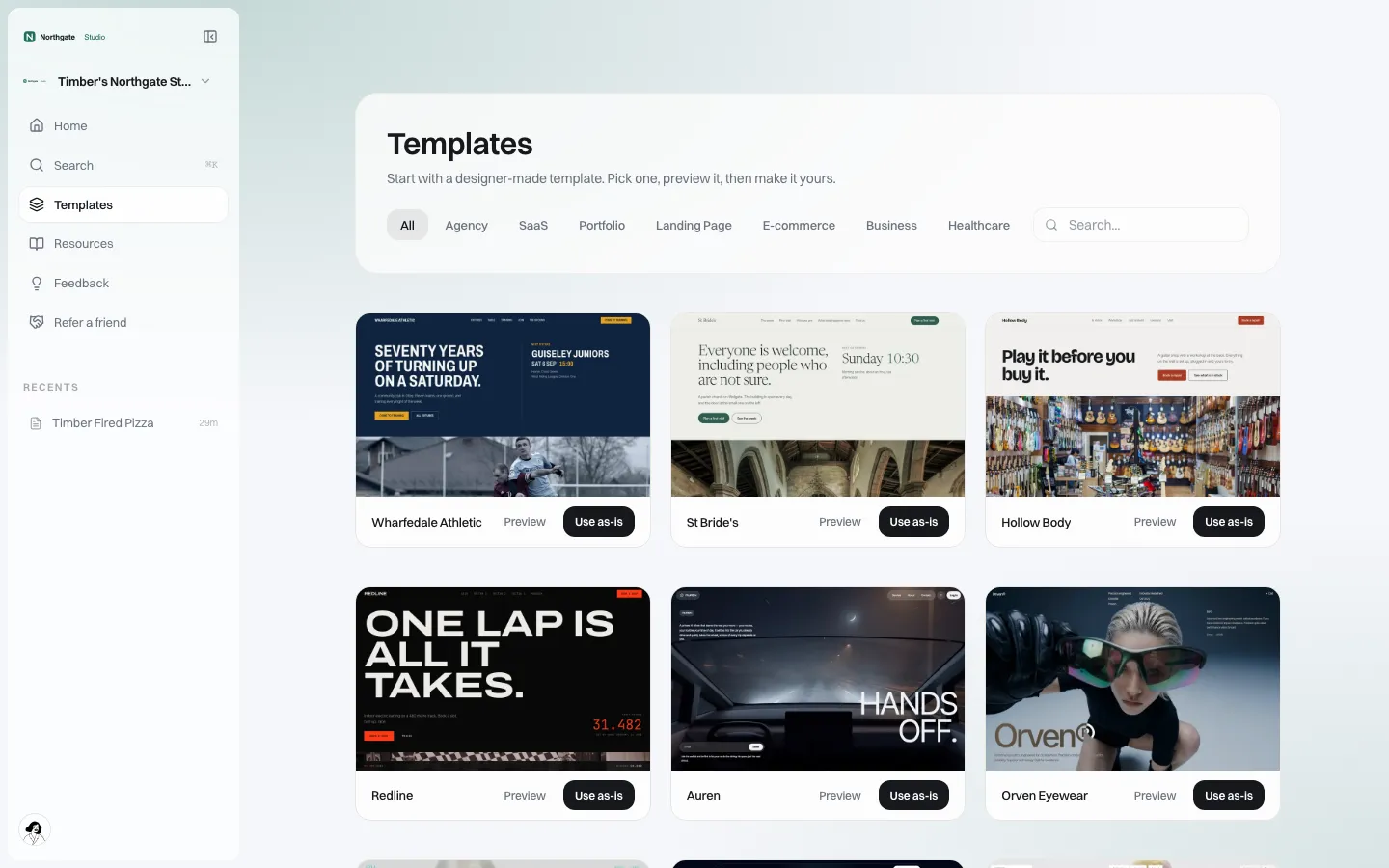
*The template gallery retailers start from. Three good templates by retailer type beat thirty generic ones.*
Where We.Inc fits, and where it does not
A good fit: distributors and wholesalers supplying independent local businesses that need a credible site, where the program is about loyalty and professionalism rather than replacing the retailer's point of sale.
Better served elsewhere:
- Live catalogue and stock on every retailer site. We do not sync your product feed or inventory into retailer sites. A B2B or retail commerce platform with feed integration is the right tool for that.
- Retailer online sales through your own ordering system. The built-in store connects to Stripe; it is not connected to your ordering or ERP.
- Programs where every page must be identical. That is a dealer locator on your own site, not a website program.
Retailers who leave the program can take their site: code can be downloaded or synced to GitHub.
Book a demo. Bring your retailer segments and one supplier's brand rules, and we will show how the program would run.
Sources
Last checked 2026-10-25. This page is general information, not legal advice.
- Google Search Central, Spam policies for Google web search: definitions of scaled content abuse and doorway abuse.
Book a demo. Pricing is tailored to your volume and setup, and you get your exact price on the call. 0% transaction fee.
Frequently asked questions
Can our product catalogue appear on every retailer site automatically?
No. We do not sync product feeds or stock. We suggest featuring a smaller set of products each retailer really stocks, written for that retailer.
Can we check a retailer site before it goes live?
Yes. Turn on single-step approval for the whole program or for selected retailers, and sites wait in your approval queue until you approve or ask for changes.
Who owns the retailer site and domain?
We suggest the retailer owns their domain and content. Site code can be downloaded or synced to GitHub if a retailer leaves.
Can our sales reps see their retailers?
Yes. Team members can be given a support role that sees clients and writes notes without editing sites or billing.
Keep reading
- White label website builder: the We.Inc platform
- Client permissions: what each site owner can do
- Brand governance across many websites
- A template library for your clients
- Location pages that are not duplicates
- Code export: leave with your sites
More in White Label
- Can you white label Wix Studio? No. Here is the alternative.
- WordPress Multisite alternative: when one shared install becomes everyone’s problem
- 10Web white label: what it costs, and the alternative without WordPress
- Member firms need a website that looks like a firm, not a tax season leaflet
- Your users run their practice in your software. Their website is the one part that isn’t
- Your clients describe the business. The first draft builds itself, under your name
- Chapter websites that outlast the volunteers who build them
- Who changed it, and when: the audit log, line by line
We.Inc is an AI-powered website builder you can resell under your own brand. Launch a branded client dashboard, bill on Stripe Connect, and deliver AI-generated websites in minutes. White-label pricing is tailored to your volume and setup: book a 30-minute demo for a quote.
Product
- AI Website Builder: Describe a site in plain English; it's live in minutes
- White Label Platform: Your brand, your domain, your margin
- Enterprise: SSO, custom SLAs, and dedicated support
- Developer API: Embed site generation into your SaaS
Who It's For
- For Agencies: Resell under your brand
- For Freelancers: Your own branded builder
- For Hosting Providers: Add a builder to your stack
- For SaaS Platforms: Embed site creation via API
- For Startups
- For Financial Services
- For Healthcare
Features
- Drag & Drop Editor
- Built-in SEO Tools
- Custom Branding
- Client Dashboard
- Reseller Billing (Stripe Connect)
Resources
- Blog
- Help Center
- Free Business Tools
- Free UI Components
- Website Templates
- Template Collections
- Website Examples
- Guides
- Comparisons
- Alternatives
- Best Lists
- Reviews
- Pricing Guides
- Use Cases
- Glossary & Guides
- Integrations
- Developers
- Benchmark
- Windows App