Should a Web Agency Resell Domain Names? Margins, Rules and the Safer Alternative | How-to Guide
What domain reselling really earns a web agency, the ICANN rules resellers work under, the support burden nobody prices in, how to pick a name and extension for a client, and why many agencies make more by managing domains than by selling them.
For most web agencies, domain reselling is a convenience, not a profit centre. The markup on a single domain is small, the support work (renewals, expired cards, transfers, email records, angry calls when a site goes dark) is real, and the risk of holding a client's most important asset is high. Resell domains if it makes your clients' lives easier and you have a process for renewals and handovers. Otherwise, the safer and often more profitable model is to have clients register domains in their own name, take delegated access yourself, and charge for managing them as part of a care plan. Either way, never let a client's domain end up in an agency account nobody can reach.
This guide is general information, not legal or financial advice.
How domain reselling works
Generic domains such as .com are sold through a chain: the registry runs the extension, accredited registrars sell registrations, and resellers sell through a registrar's reseller programme. An agency is almost always a reseller, not a registrar.
ICANN's 2013 Registrar Accreditation Agreement sets the rules your registrar must pass on to you. Under its section 3.12:
- The registrar stays responsible for registrar services on the names it sponsors, even when a reseller provides them.
- The registrar must have a written agreement with each reseller.
- A reseller's registration agreement with customers must identify the sponsoring registrar, or provide a way to identify it.
- Resellers may not present themselves as accredited by ICANN without ICANN's written permission.
In practice, your reseller programme's terms will tell you what you must show customers. Read them; they are the rules you are agreeing to.
Becoming an accredited registrar yourself is a different business altogether, with its own application, technical, financial and compliance obligations and yearly fees, and it is not something a typical web agency should consider.
What the margin really looks like
Do the arithmetic on your own numbers before deciding. A worksheet:
| Line | Your figure |
|---|---|
| Wholesale cost per domain per year (from your reseller programme) | |
| Price you charge the client per year | |
| Gross margin per domain | |
| Number of client domains | |
| Gross margin per year | |
| Staff time per year on renewals, failed payments, transfers and DNS questions (hours x cost) | |
| Reseller account fees, deposits or minimums | |
| Net per year |
Most agencies that fill this in honestly find the net is small or negative once support time is counted, especially with fewer than a few hundred domains. The exceptions are agencies that bundle domains into a larger monthly plan, where the domain is part of a package rather than a line item, and premium names where the margin is larger.
Raising prices does not fix this easily: business owners can see what retail registrars charge, and a domain marked up heavily is the first thing a new competitor will point out.
The hidden work
- Renewals and expired cards. When renewal fails, the site and the client's email can stop working. You get the call.
- Transfers out. Under ICANN's Transfer Policy, registrars must give the registered name holder a unique AuthInfo code for each domain. A client leaving you will ask for it, and a slow handover damages your reputation.
- Transfer locks. The same policy lets a registrar refuse a transfer within 60 days of registration or a previous transfer. Clients rarely know this, and they will blame you.
- DNS changes. Every new email provider, verification record or marketing tool means a DNS change, and a mistake can break mail.
- Registrant data. Contact details on the registration must be accurate and kept current, which means chasing clients when they move or change staff.
Three models compared
| Model | Who is the registrant | Agency earns from | Risk |
|---|---|---|---|
| Agency resells under its own account | Should still be the client, though agencies often set themselves | Markup on registrations | Highest: you hold the asset and the support |
| Client registers, agency manages | The client, in their own registrar account | A management fee inside a care plan | Low: the client can always reach their domain |
| Client handles it all | The client | Nothing | Low for you, but you may be called when it breaks anyway |
The middle model is the one most agencies should default to. It is honest, it survives staff changes on both sides, and it removes the most painful conversation from any client exit. Our guide on who owns a client's website explains why the domain matters so much in that conversation.
If you do resell: a checklist
- Register each domain with the client as registrant, with accurate contact details.
- Turn on auto-renew and keep a card on file that you control for renewals, billed back to the client.
- Keep a register: domain, client, expiry date, DNS host, email provider, who has access.
- Send clients a reminder before renewal, even when auto-renew is on.
- Write a handover promise into your contract: transfer code within a set number of working days on request.
- Use two-factor authentication on the reseller account and limit who can log in.
- Never register a client domain on a personal account.
Helping a client choose a name and extension
A common question is which extension is best for search. Google has said that its systems treat the newer generic extensions like .com and .org, and that a keyword in the extension gives no advantage or disadvantage in search; what matters far more is the content of the site. (Country extensions are the exception: they tell Google which country a site targets.) Choose for people instead:
| Choice | When it helps | Watch out for |
|---|---|---|
| .com | The default people type and remember in most markets | Short names are taken; avoid long hyphenated substitutes |
| Country extension (.ca, .co.uk, .de) | Businesses serving one country; signals local presence | Some have residency or presence rules; check the registry |
| Industry extension (.law, .dental, .plumbing and others) | A memorable name when the .com is taken | Renewal prices can be much higher than .com; customers may type .com by habit |
| A second domain redirecting to the main one | Common misspellings or a short campaign address | Each one is another renewal to track |
Simple naming rules that serve clients: easy to say on the phone, no numbers or hyphens if avoidable, and the business name rather than a keyword string. Our guide to buying a domain walks through the client side step by step.
Where your website platform fits
Whichever model you choose, your website platform should work with domains the client already owns, rather than forcing them into the platform's registrar. In We.Inc, a client's site connects to a domain they own from the domain panel in the editor.
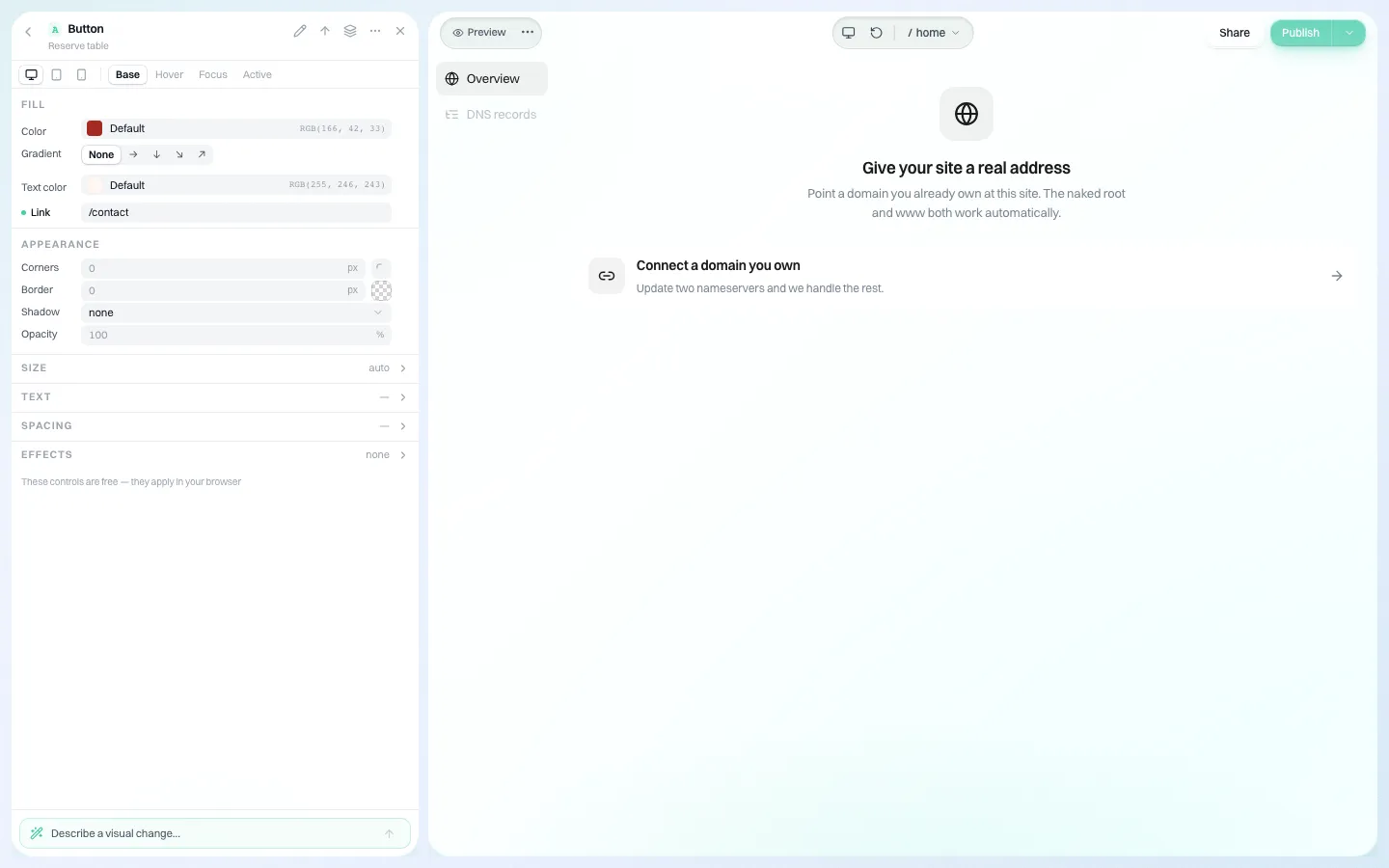
You decide per client whether they may connect their own domain at all, so a client on a fully managed plan never touches DNS.

Your agency's own dashboard can sit on your domain too, so the address clients log in at is yours.
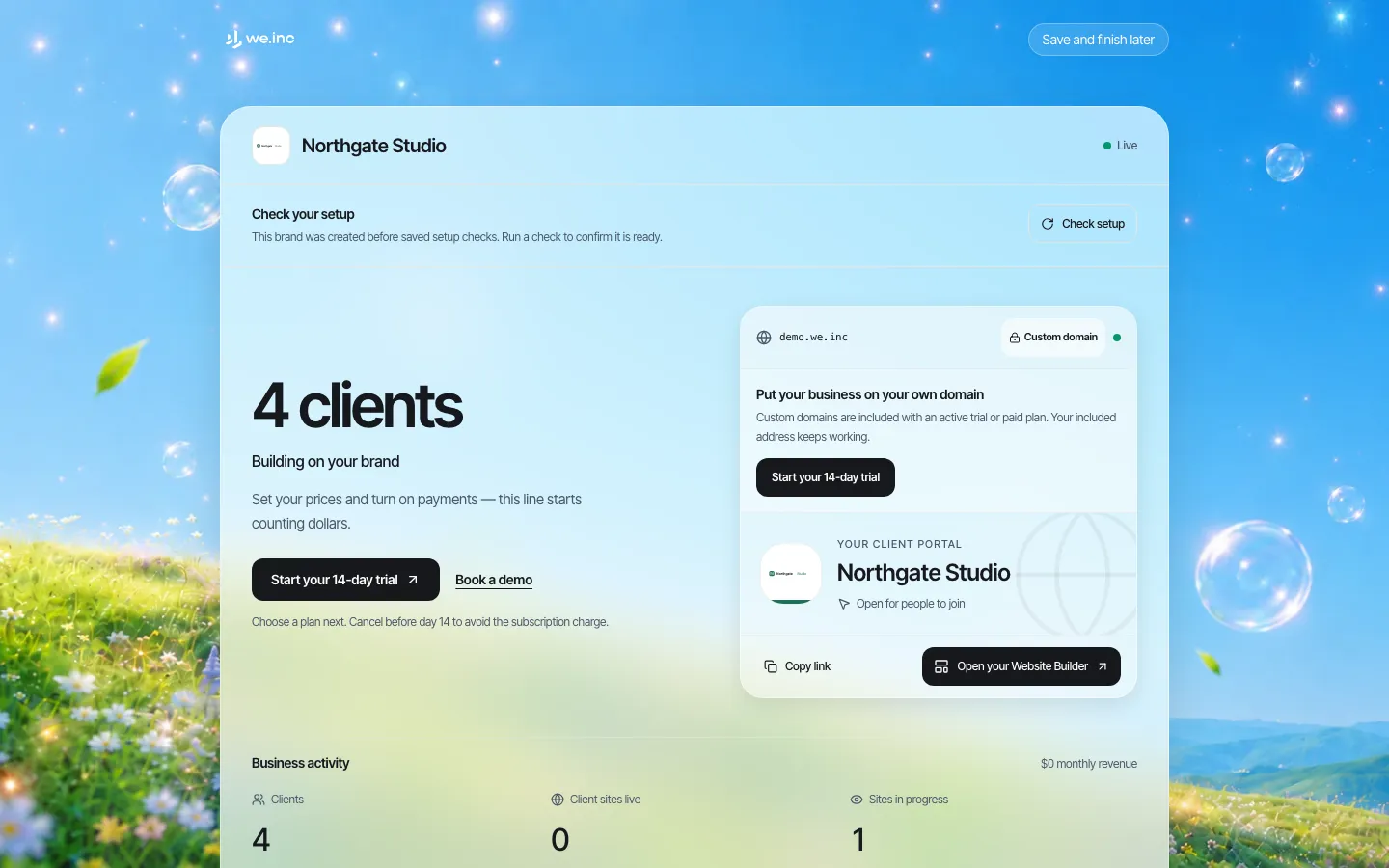
To see the client-side setup, book a demo.
Sources
Last checked 2026-10-25.
- ICANN, 2013 Registrar Accreditation Agreement (section 3.12 on resellers).
- ICANN, Transfer Policy (AuthInfo codes, 60-day transfer restrictions).
- Google Search Central Blog, Google's handling of new top level domains (keywords in an extension give no ranking advantage).
This guide is general information, not legal or financial advice.
Frequently asked questions
Is domain reselling profitable for a web agency?
Usually only slightly, once staff time for renewals, failed payments, transfers and DNS questions is counted. It works best as part of a bundled monthly plan rather than as a separate profit line.
Do I need ICANN accreditation to resell domains?
No. Resellers sell through an accredited registrar's reseller programme. Under ICANN's agreement the registrar stays responsible, and resellers may not claim ICANN accreditation without permission.
Should client domains be registered in the agency's name?
No. Register them with the client as registrant, in an account they can reach, and take delegated access yourself. It avoids disputes when a client leaves.
Which domain extension is best for SEO?
For search, content matters far more than the extension. Choose for people: .com where available, a country extension for single-country businesses, and check renewal prices on industry extensions.
How fast can a client move their domain away?
They need the AuthInfo code from the registrar, and a registrar may refuse a transfer within 60 days of registration or a previous transfer under ICANN's Transfer Policy.
More in Guides
- Should an Agency Switch from WordPress to a No-Code Website Builder? | How-to Guide
- Should an Agency Let Clients Edit Their Own Website? Access Levels, Rules and a Policy You Can Copy | How-to Guide
- Sitemap.xml and robots.txt Examples
- Small Business SEO: A Plain-English Guide and Checklist (2026) | How-to Guide
- Soft 404: When a Page Says Not Found but the Server Says OK
- Single Page Application SEO: A Practical Guide
- SPF, DKIM and DMARC: The Three Records Behind Trusted Email
- SQL Joins Explained with Live Examples
Related guides and tools
Start building
- how to make a website
- AI website builder
- free website builder
- website templates
- website builders by industry
Product
Who It's For
- For Agencies
- For Freelancers
- For Hosting Providers
- For SaaS Platforms
- For Startups
- For Financial Services
- For Healthcare
Features
Resources
- Blog
- Help Center
- Free Business Tools
- Free UI Components
- Website Templates
- Template Collections
- Website Examples
- Guides
- Comparisons
- Alternatives
- Best Lists
- Reviews
- Pricing Guides
- Use Cases
- Glossary & Guides
- Integrations
- Developers
- Benchmark
- Windows App