
The website builder made for art galleries.
An art gallery website should put the current exhibition first, give each represented artist a page with images and a CV, and make visiting and inquiring simple. We.inc's AI builds those pages from a description of your gallery. AI building and edits begin on Starter at $20 a month.
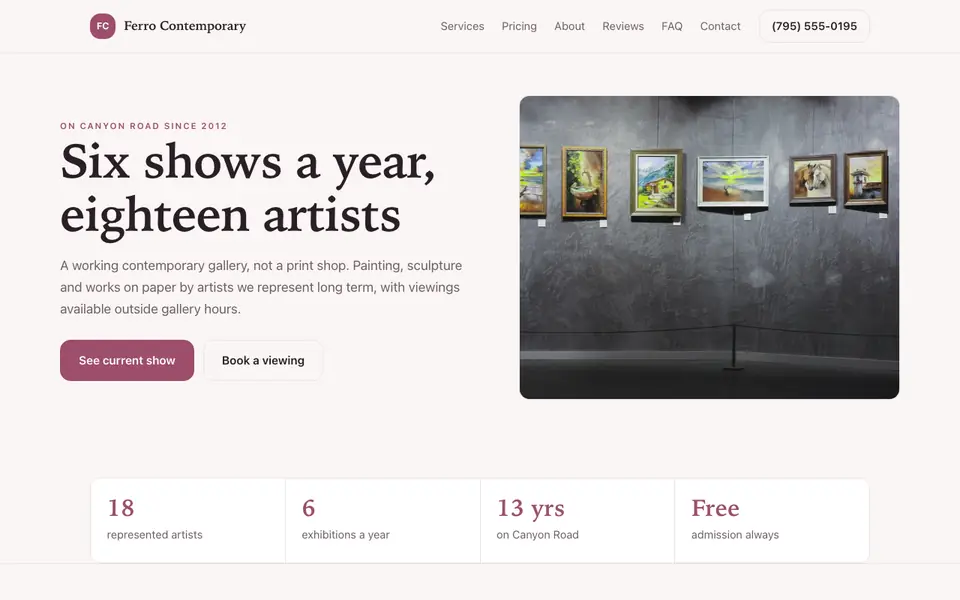
An art gallery website should let the work breathe: current exhibitions, represented artists, and clear visiting details. Describe your gallery and we.inc builds it.
Pages every art gallery website needs
- Home: The current show with a strong install image, dates, and hours. Visitors want to know what is on and when.
- Exhibitions: Current, upcoming, and past shows with press releases and install views. Past shows build a record collectors and critics check.
- Artists: A page per represented artist with selected works, bio, and CV. It is how curators and buyers research.
- Available Works: Title, medium, dimensions, and an inquiry button per piece. Many galleries list 'price on request' and handle sales personally.
- Visit: Address, hours, accessibility, and opening reception dates.
- Contact & Inquiries: A form for purchase, press, and submission inquiries, plus your submission policy.
Try this prompt
A website for Halcyon Projects, a contemporary gallery in Santa Fe, New Mexico. Pages for our current exhibition and past shows, six represented artists each with works and a CV, an available works page with inquiry buttons, visiting hours, and an artist submission policy. Minimal, white-space-heavy design with black type.
What collectors find on the Ferro Contemporary example
Ferro Contemporary is a fictional Santa Fe gallery our AI generated from one sentence. A gallery site has to feel serious to collectors while still welcoming walk-in visitors, and the example balances the two.
The current show comes first
See current show is the main button, with the opening reception date beside it. People plan gallery visits around openings, so the exhibition page is the one most worth keeping up to date.
Private viewings outside opening hours
Collectors can book time to see work from the racks, including pieces not on the walls. Serious buyers prefer a quiet appointment, and offering it online removes a step.
Provenance and a certificate with originals
Original paintings are sold with provenance and a certificate from the artist. Buyers spending real money look for that paperwork before they ask about anything else.
Payment plans and advisory
An interest-free plan where work ships once paid, and an advisory service for choosing and hanging pieces, are both listed. They make a first purchase feel possible for newer collectors.
Ferro Contemporary
This is Ferro Contemporary, an art gallery business we described to the AI in a sentence. See the Ferro Contemporary example site.
Start from this design
Three designs that suit an art gallery website.
- Cream & Burgundy Interior Designer
- Full-Bleed Wedding Photography
- Black Motion Reel Portfolio
An art gallery website designed around your actual services and prices, not a stock layout. Describe the business and the AI writes and builds every page.
Perfect for:
- Fine art galleries
- Contemporary art
- Pop-up galleries
Let images carry the page
Use large, color-accurate images with generous white space and minimal text over the art. Credit the photographer and include title, year, medium, and dimensions under each work.
Publish a submission policy
Say whether you accept artist submissions, how, and when. It saves your inbox from unsolicited portfolios and sets expectations kindly.
Keep past exhibitions online
An archive of past shows with press text shows the program's depth. Ask the AI to move each show into the archive when it closes.
What we.inc does not handle
The AI can build a print or edition shop with checkout through your own Stripe account, but there is no inventory or consignment tracking, and no collector portal. Many galleries still sell originals by inquiry and use Artlogic or an Artsy listing for inventory and reach.
What it costs
A gallery site mostly needs images and text, so costs are low. On We.Inc you can build your site free, with no card and no trial needed to start. Starter at $20 a month adds AI for writing exhibition and artist pages, and your own domain, around $10 to $20 a year, needs a paid plan.
Building your site is free, no card needed. Paid plans from $20 a month. Compare plans
Frequently asked questions
Should a gallery show prices online?
It depends on your program. Many galleries use 'price on request' and an inquiry button to start a conversation; others list prices for editions and smaller works. Either works on we.inc.
Can I sell art directly through the site?
Yes, for works you want to sell online, such as prints and editions: the AI can build product pages with checkout through your own Stripe account. For originals, many galleries prefer an inquiry form and a personal conversation.
How do I keep the site current between shows?
On a paid plan you ask the AI to add the new exhibition and move the old one to the archive. It takes a couple of messages.
What does a gallery website cost with we.inc?
New We.Inc accounts can build a site free, with no card needed to start. AI building and editing is $20 a month on Starter.
Can each artist get their own page?
Yes. The AI can build a page per artist with selected works, a bio, and a CV.
Related industries and website guides
- musician website builder
- wedding planner website builder
- portfolio website builder
- newsletter website builder
- artist website builder
- author website builder
- art galleries website examples
- how to make a website
Related website builders: Creative & Entertainment
- musician website builder
- wedding planner website builder
- portfolio website builder
- newsletter website builder
- artist website builder
- author website builder
Before you start
Product
Who It's For
- For Agencies
- For Freelancers
- For Hosting Providers
- For SaaS Platforms
- For Startups
- For Financial Services
- For Healthcare
Features
Resources
- Blog
- Help Center
- Free Business Tools
- Free UI Components
- Website Templates
- Template Collections
- Website Examples
- Guides
- Comparisons
- Alternatives
- Best Lists
- Reviews
- Pricing Guides
- Use Cases
- Glossary & Guides
- Integrations
- Developers
- Benchmark
- Windows App