A member website programme your chamber can actually run
Chambers are always looking for benefits members will use and for revenue that is not dues. A website programme can be both, or it can become a support desk that eats a membership coordinator's week. This page is about building one that stays manageable: what to offer, how to price it to members, what the chamber controls, and where We.Inc fits.
TL;DR
- Members get their own website in a portal with the chamber's name and colours. They build it from a description and edit by clicking or chatting.
- Bundle it into a dues tier or bill members through the chamber's own Stripe account. You set the prices.
- Per-member switches (publish, store, blog, forms, own domain) and optional approval before a member's site goes live.
- We do not run your member directory, events or CRM. Book a demo to see the member side and the chamber side.
Why chambers try this, and why some programmes fail
Small members often have a weak site or none. A chamber that can say "your membership includes a proper website" has a benefit that is concrete, visible and easy to explain at a networking breakfast. Programmes fail for predictable reasons:
- The chamber became the web designer. Staff ended up writing every member's copy.
- Nobody owned support. Members called the front desk with domain questions.
- The sites were hostages. Members who left lost their site, and told everyone.
- The offer was vague. "Free website" meant different things to different members.
A builder that lets members do most of the work themselves fixes the first problem. The other three are policy, and this page covers them too.
What members see
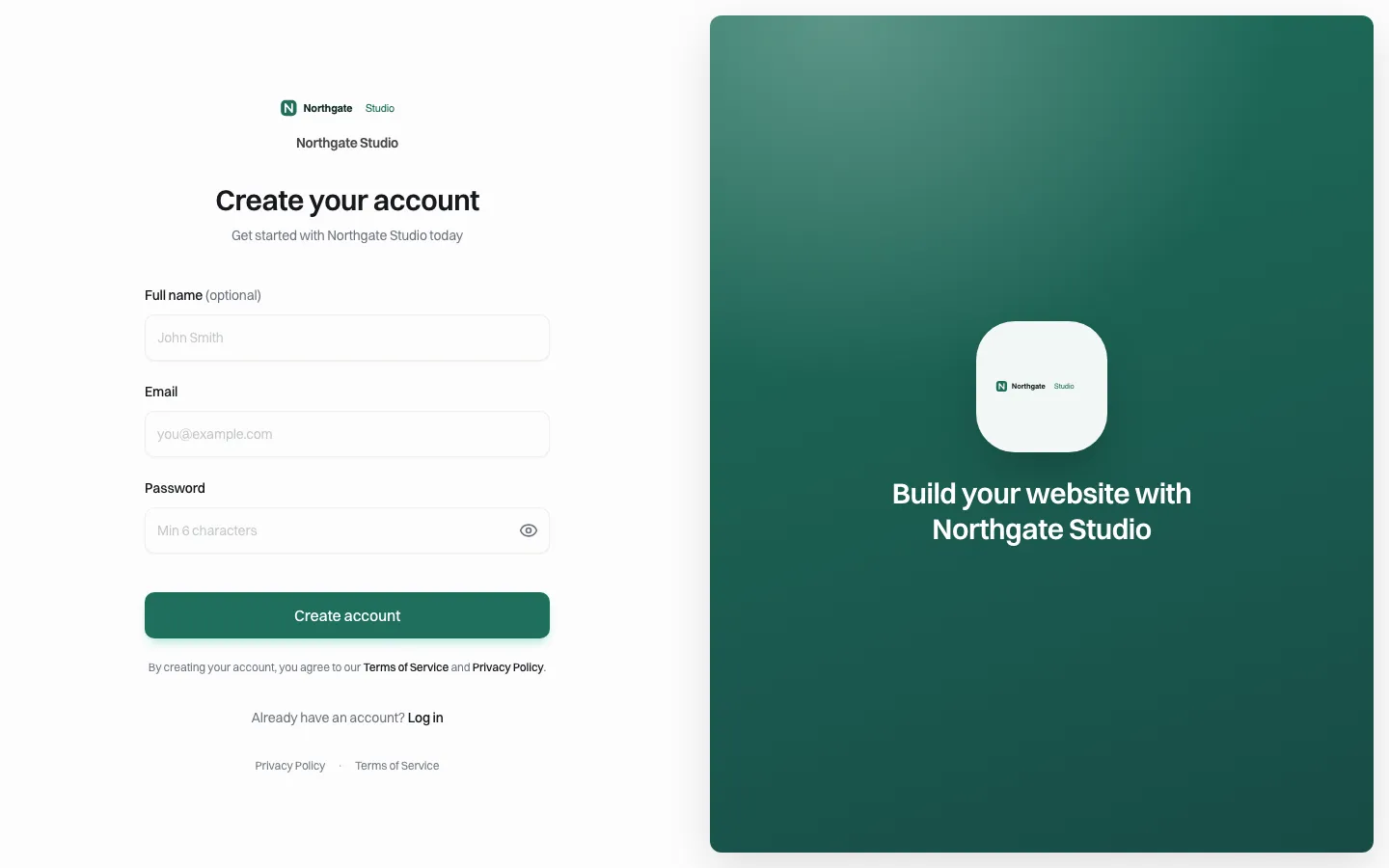
*Members sign up on the chamber's own portal, with the chamber's name and colours.*
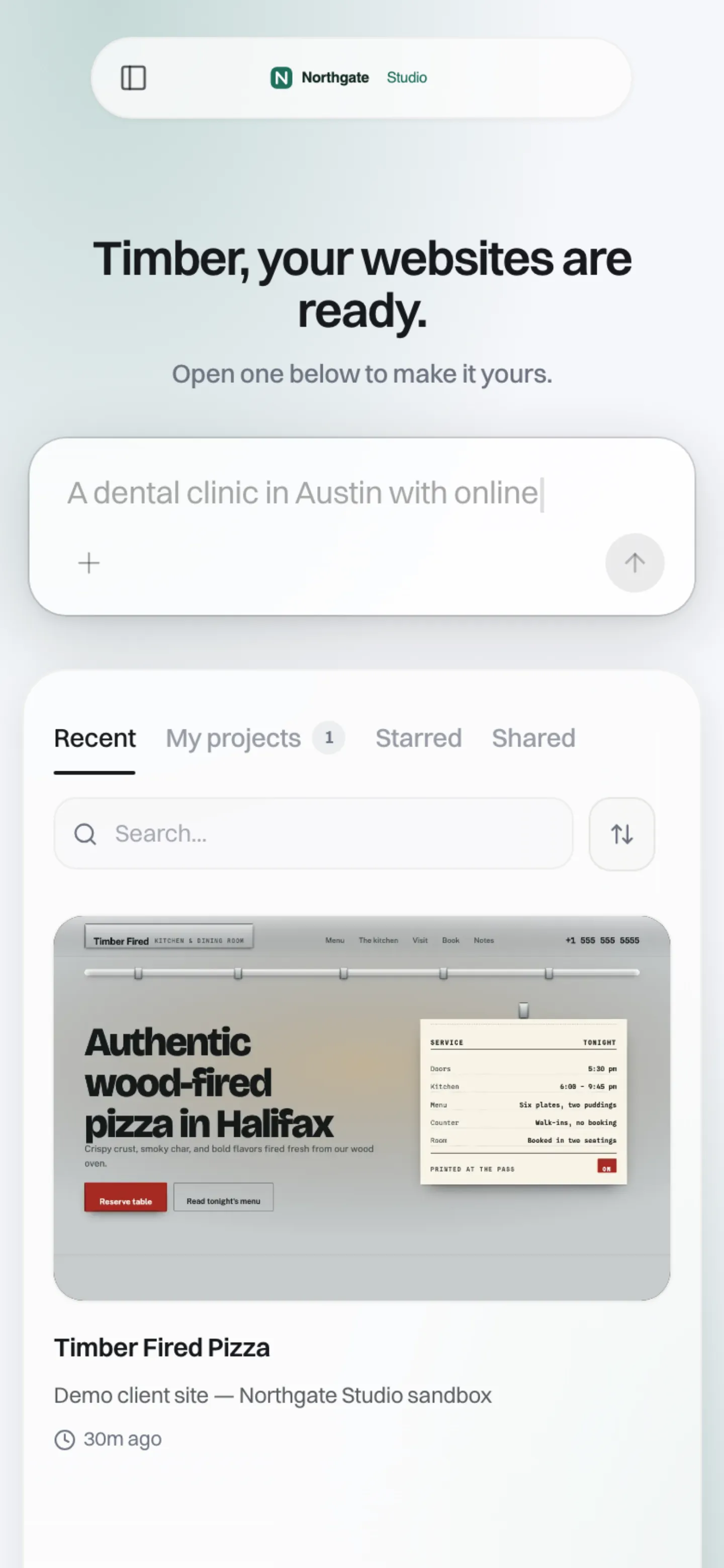
*The member's home, on a phone. They describe the business, and the AI builds a first version.*
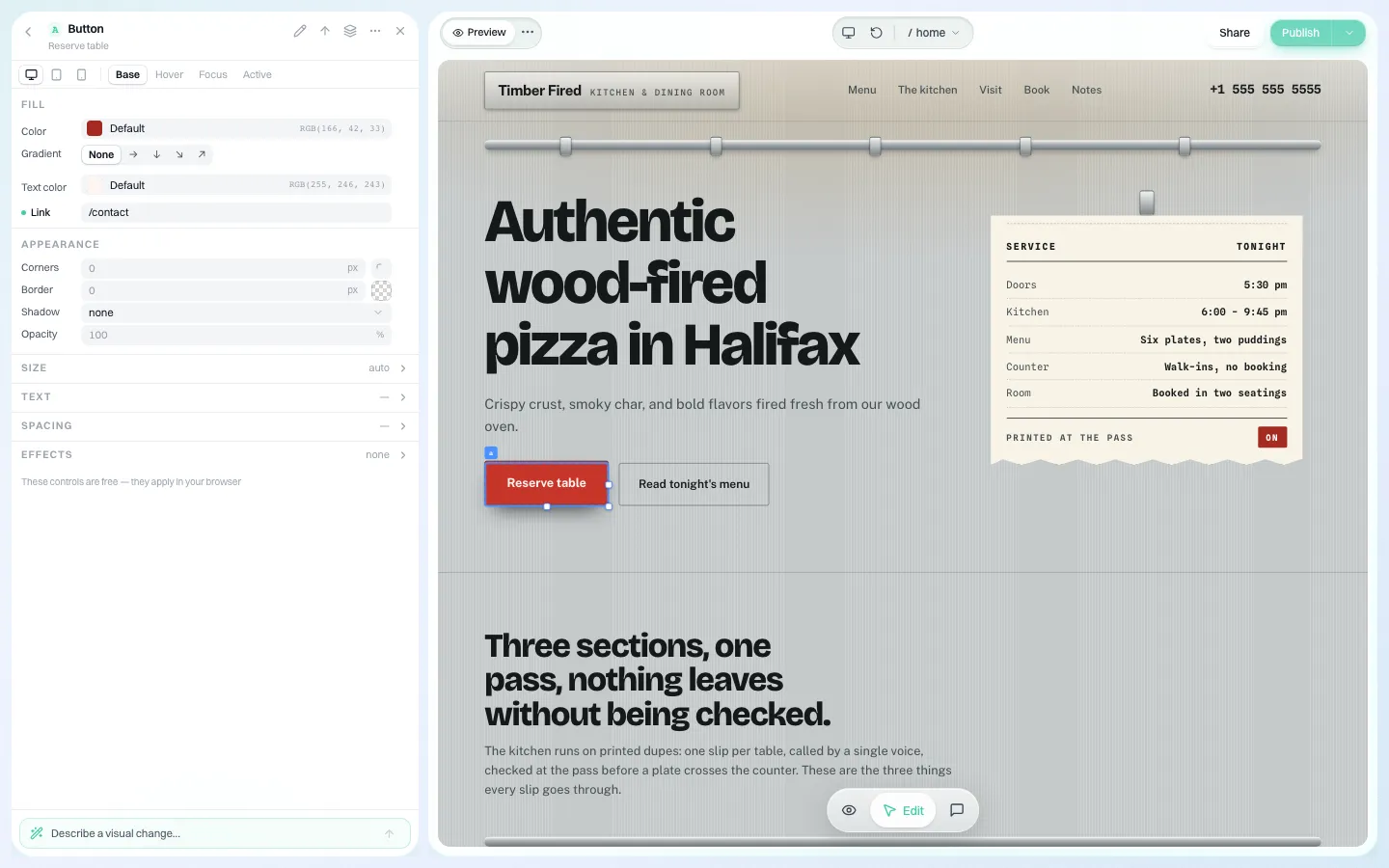
*Members change details by clicking: here a button's colour and shape.*
A plumber, a florist or a law office describes what they do, the AI builds a first version, and they fix it by clicking or by asking in plain language. The chamber's staff are not in that loop unless the member asks for help.
What the chamber controls
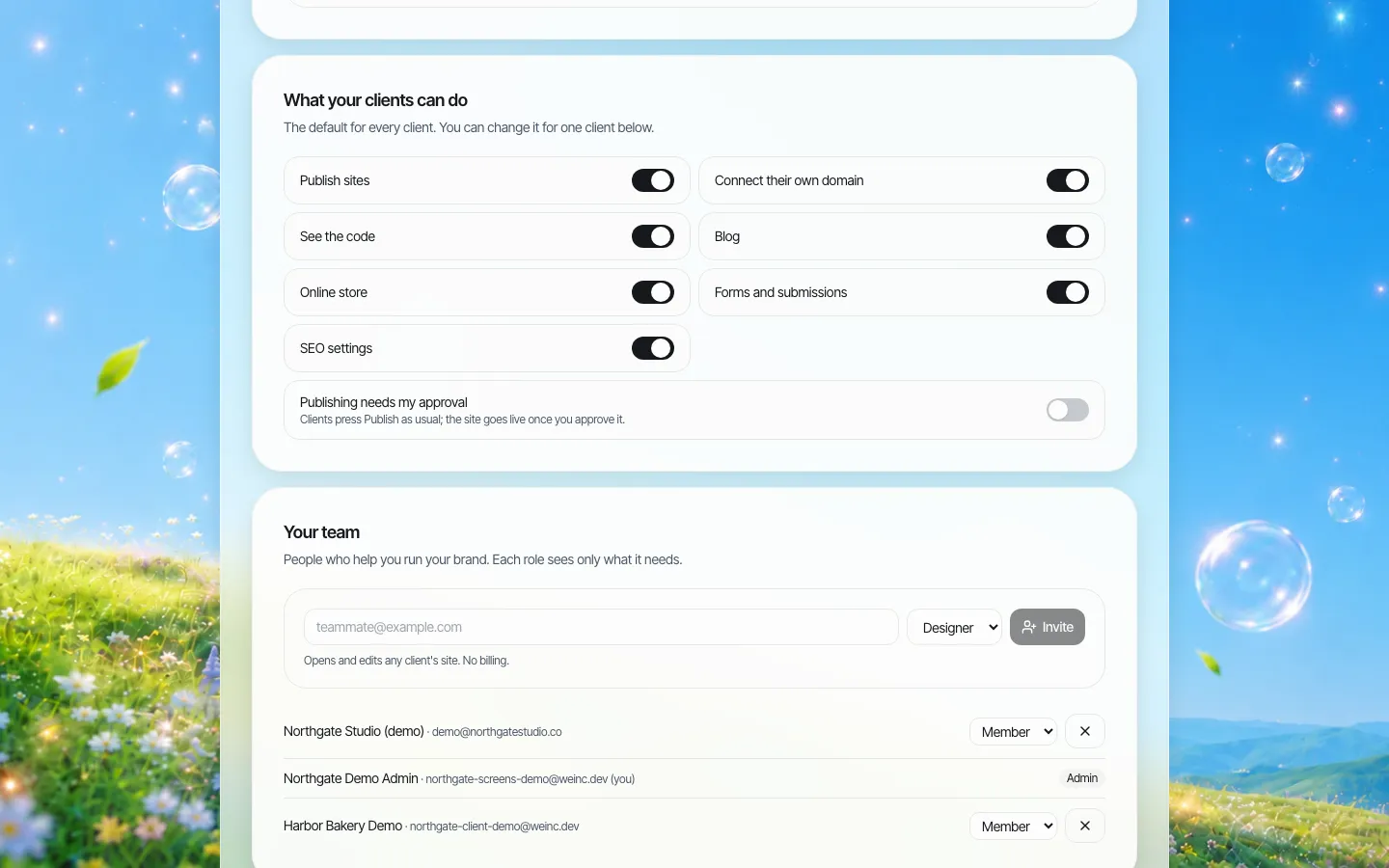
*Defaults for every member. The chamber decides what is on for everyone, and changes it member by member.*
Sensible defaults for a chamber:
- Publishing: on, without approval. It is the member's site and their business. Approval mainly helps where the chamber's name is at risk, such as a member site that sits on a chamber subdomain.
- Own domain: on. Members should use their own domain. It is better for them and keeps their site theirs.
- Online store and blog: on. Retail and hospitality members want them.
- See the code: off by default, on for members who ask; it rarely matters to them but should never be refused to someone leaving.
Pricing the programme to members
You set the prices; We.Inc does not show members our prices. There are three common models, each with a trade-off:
| Model | How it works | Watch for |
|---|---|---|
| Included in a dues tier | A website is part of the mid or top membership tier | Members who downgrade lose the site; plan how that works |
| Add-on subscription | Members pay the chamber monthly or yearly for the site | Billing admin, and members comparing your price with consumer builders |
| Launch fee plus subscription | A one-off setup fee for help getting started, then a small recurring fee | Only works if you really provide setup help |
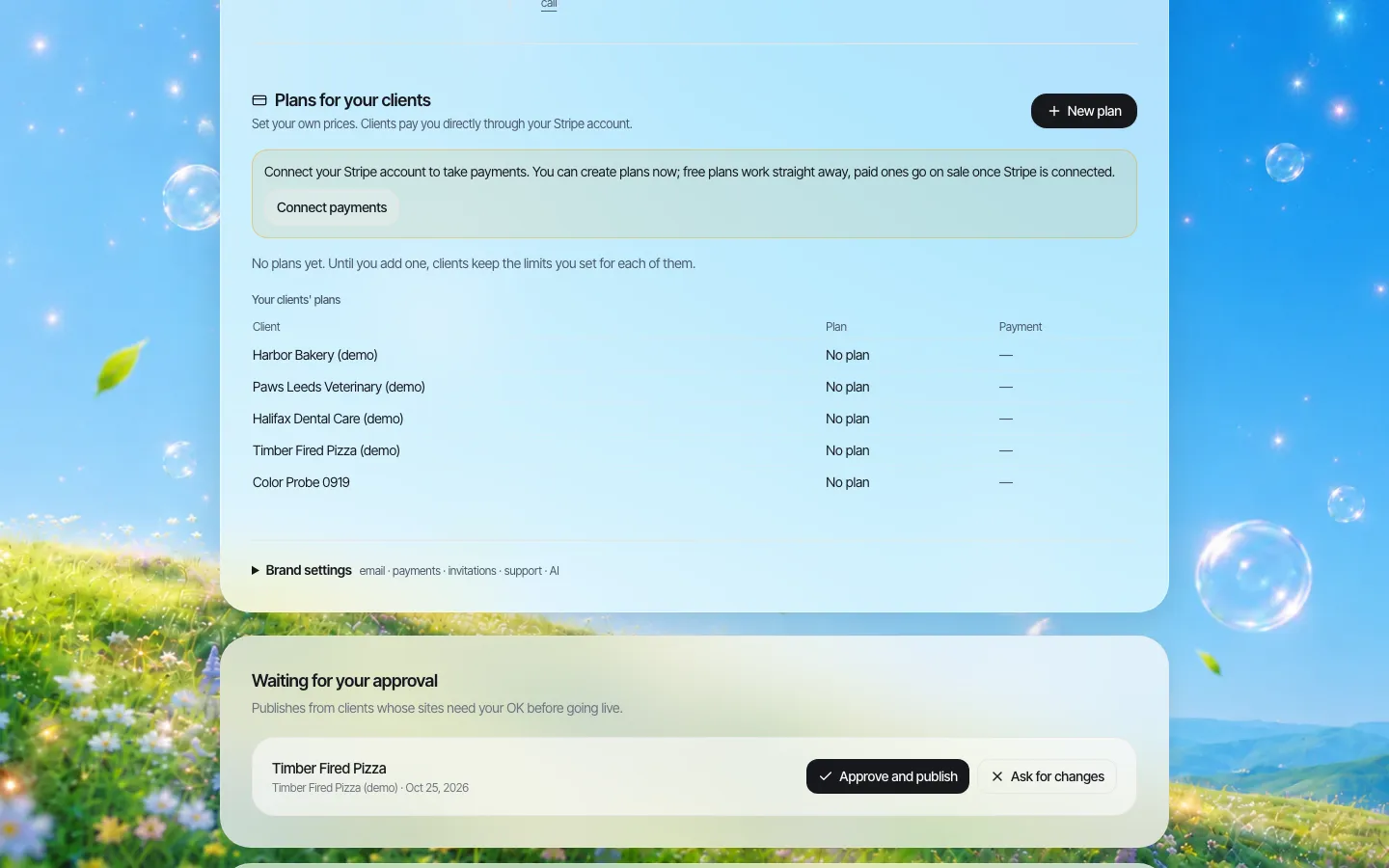
*Plans you create for members, paid into the chamber's own Stripe account. Shown with no prices set.*
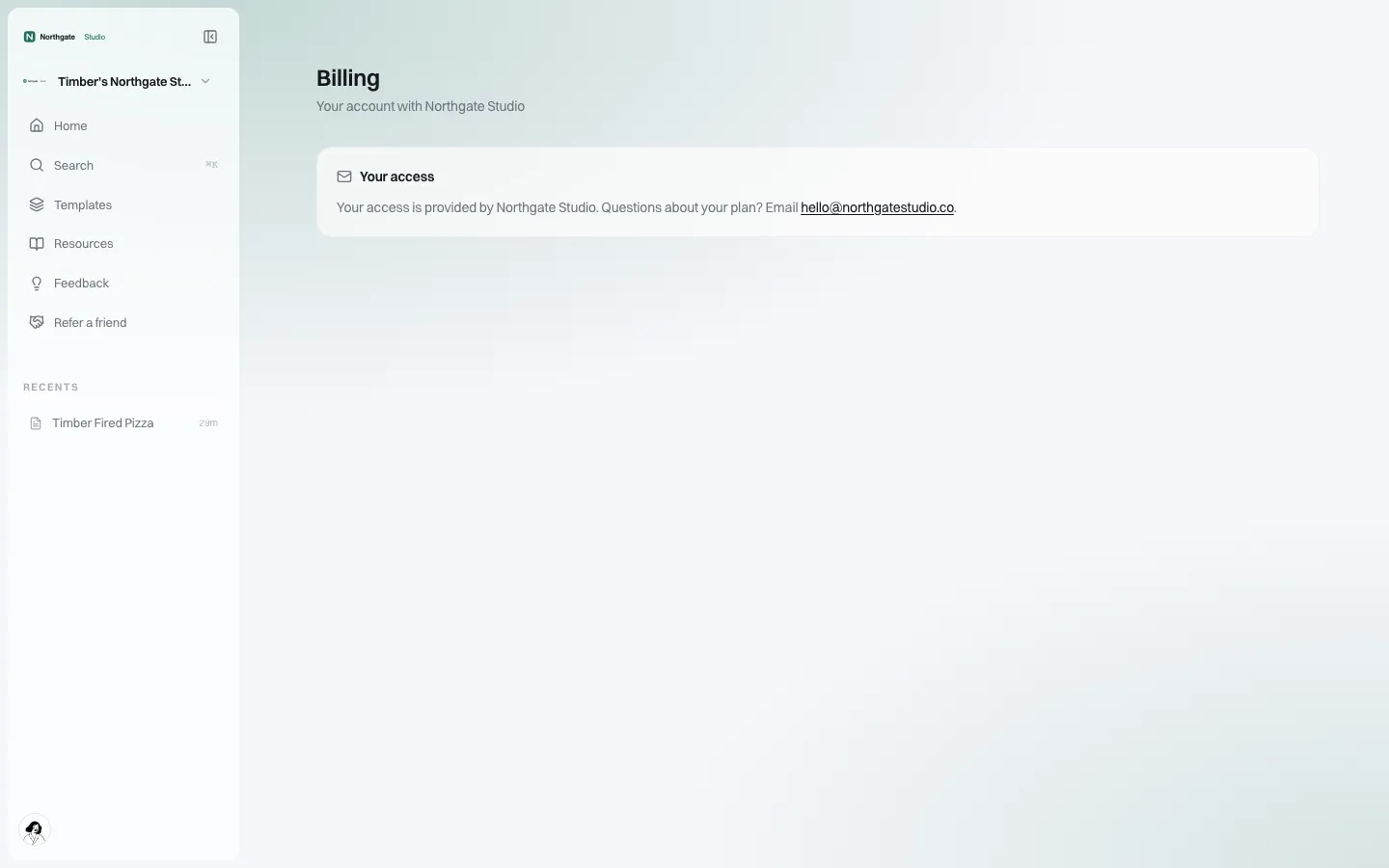
*What a member sees under billing: their access comes from the chamber.*
Chambers are usually organised as business leagues under section 501(c)(6), which the IRS describes as directing their efforts at "promoting the common economic interests of all commercial enterprises" in a community. Selling services to members can raise questions about unrelated business income, depending on how the programme is structured. Ask your accountant before you set prices. *This is general information, not tax or legal advice.*
Support without a support desk
Put the support line in writing before launch. The help page members see carries the chamber's own contact, so decide what that contact covers.
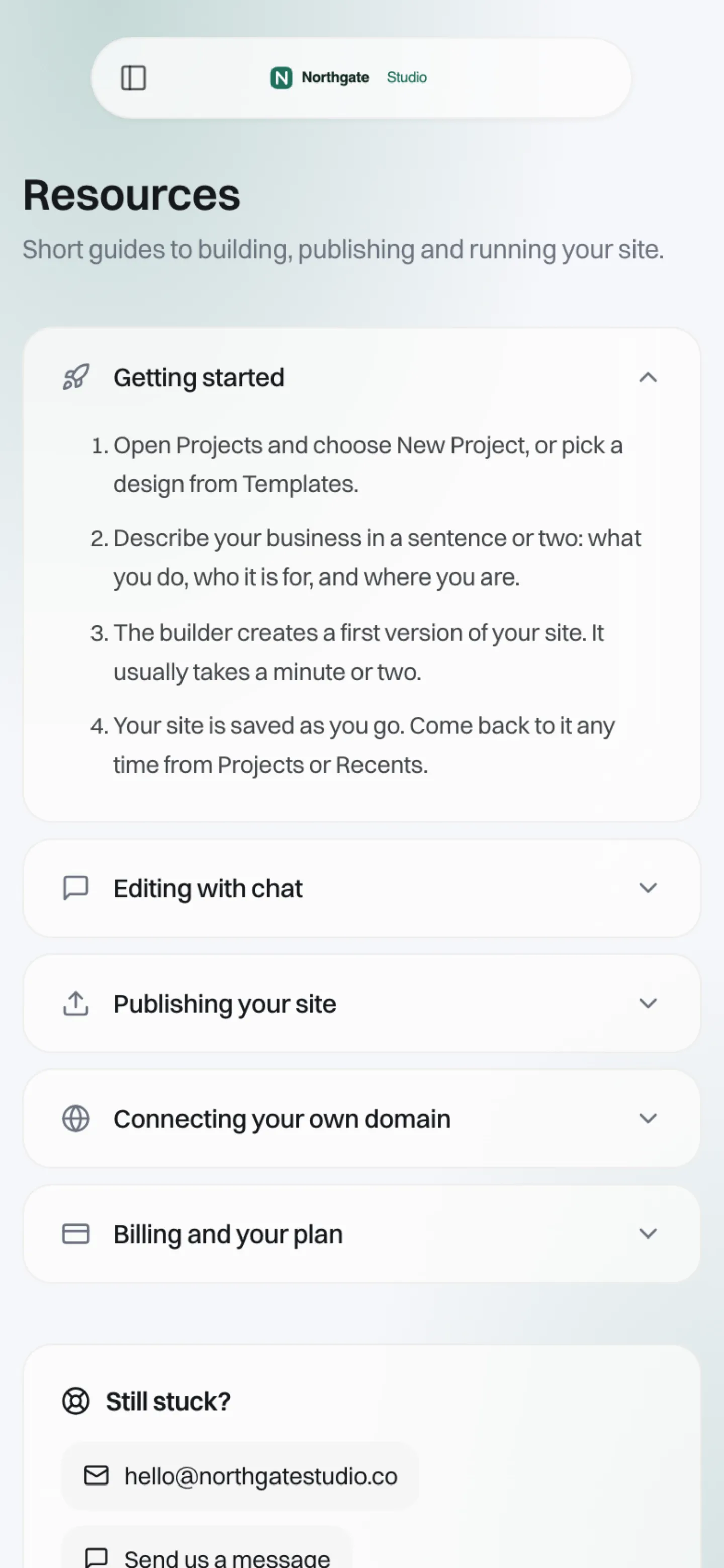
*The member help page, on a phone, with the chamber's support contact.*
A support policy members understand:
| Request | Who handles it |
|---|---|
| "How do I change my opening hours?" | Member, using the editor (point them to the help page) |
| "Can you look at my site before I launch?" | Chamber staff, once, at launch |
| "My domain stopped working" | Member's domain registrar first; chamber helps diagnose |
| "Write my whole site for me" | Not included, or a paid add-on |
Leaving the chamber
Decide now what happens when a member leaves. The platform lets every site's code be downloaded or synced to GitHub, and members can use their own domain, so a clean exit is possible. A fair policy: on non-renewal, the member gets a set period to export their site and move their domain, and the chamber helps once. Writing that down turns a likely complaint into a reason to trust the programme.
Launching with the first twenty members
Start small and pick the members on purpose. A launch that works:
| Week | Step |
|---|---|
| 1 | Set the chamber's brand, defaults and support policy. Write the one-paragraph offer: what is included, what is not, what happens on non-renewal |
| 2 | Invite five members who are keen and visible (a café, a trades business, a professional office, a retailer, a nonprofit member) |
| 3-4 | Each builds a site; staff review once at launch and note what members got stuck on |
| 5 | Fix the help page and defaults based on those notes |
| 6-8 | Invite fifteen more, then announce the programme with the first sites as real examples, with their owners' permission |
Count how many members publish within two weeks of signing up. If most stall, the offer needs more setup help, not more members.
The chamber's own sites
The same account can run the chamber's own small sites: an annual awards night, a young professionals group, a leadership programme, a "shop local" campaign. Treat each as a client owned by the staff member who runs it, with a review date in its notes.
What we do not replace
We.Inc does not run your member directory, event registration, dues invoicing system or association management software. Keep those, and link member sites to their directory listing. If your chamber also runs the local visitors bureau, see websites for tourism boards; for chambers in a regional economic partnership, see economic development organizations.
Book a demo and we will show the member's side and the chamber's side, using a member business of your choosing as the example.
Sources
Last checked 2026-10-25.
- IRS, Business leagues: business leagues and chambers of commerce under section 501(c)(6).
Book a demo. Pricing is tailored to your volume and setup, and you get your exact price on the call. 0% transaction fee.
Frequently asked questions
Can a chamber of commerce resell websites to members under its own brand?
Yes. Members sign up on your branded portal and build their own sites. You set the prices and they pay the chamber through your own Stripe account, or you include the site in a dues tier.
Do members see We.Inc branding or prices?
Members see the chamber's name, logo and colours on the sign-in page, dashboard and emails. They see only the plans and prices the chamber sets.
What happens to a member's website if they leave the chamber?
That is your policy to set. The platform lets a site's full code be downloaded or synced to GitHub and members can use their own domain, so a clean exit is possible.
Does it replace our member directory or event registration?
No. Keep your association management software for the directory, events and dues; member sites can link to it.
Keep reading
- Bill your clients under your own brand
- Chapter websites for associations
- Client permissions: what each site owner can do
- White label website builder: the We.Inc platform
- Manage many websites from one account
- Website vendor exit plan
More in White Label
- The cheapest white-label website builder, by cost per site
- A website for every congregation, under a shared identity
- A CivicPlus alternative for the sites a civic suite was never meant to run
- Showing clients their numbers without exporting a single spreadsheet
- Client Dashboard | White Label
- Answer the same ten client questions once, in your own words
- The first email a client gets from your platform should look like it came from you
- The first week decides whether a client builds or churns
Product
Who It's For
- For Agencies
- For Freelancers
- For Hosting Providers
- For SaaS Platforms
- For Startups
- For Financial Services
- For Healthcare
Features
Resources
- Blog
- Help Center
- Free Business Tools
- Free UI Components
- Website Templates
- Template Collections
- Website Examples
- Guides
- Comparisons
- Alternatives
- Best Lists
- Reviews
- Pricing Guides
- Use Cases
- Glossary & Guides
- Integrations
- Developers
- Benchmark
- Windows App