Your sellers will make a website either way. Make it one you can see.
Independent sellers are the brand to their customers. If the company does not give them a good site, they build one, and the words on it become the company’s problem. Regulators have been clear that a direct sales company answers for what its sellers say. This page is about giving sellers real personal sites that they want to use, while keeping income claims, product claims and brand use in a review step you control.
TL;DR
- The FTC says a direct sales company is responsible for making sure its participants do not make deceptive statements, and that there is no safe harbor.
- Income and lifestyle claims are the biggest risk: an earnings claim should reflect what a typical participant earns.
- In We.Inc each seller is a client account under your brand, with switches for publishing, domains, blog, store and forms, and approval before a seller’s site goes live.
- We.Inc does not connect to your back office, commission engine or replicated-site URLs. Book a demo to see how a seller site would work next to them.
The replicated site problem
Most direct sales companies already offer a replicated site: the same company page with the seller's name and photo swapped in, and an order link that credits the seller. It is safe and compliant, and sellers rarely share it because it does not sound like them. So they go elsewhere. They start a site on a free builder, write their own "my story" page, and add the line that got them into the business: what they earned last month.
That gap, between a replicated page nobody shares and a personal site nobody reviews, is the space this page is about. A seller site that sounds like the seller, under the company brand, behind a review step, closes it.
What the FTC has said about seller claims
In April 2024 FTC staff published *Business Guidance Concerning Multi-Level Marketing*. A few points from it shape any seller website program:
- The company answers for its sellers. The guidance says the company "is responsible for ensuring that its participants do not make deceptive or unfair statements", and that there is "no safe harbor or exception" to that principle.
- Earnings claims must be typical. "Any earnings claim should reflect what the typical person to whom the representation is directed" can expect, and a claim must have a reasonable basis.
- Expenses count. It is deceptive to promote what a company may pay participants without also disclosing the typical expenses.
- Lifestyle claims are earnings claims. Pictures of cars, trips and quitting a job are implied earnings claims, and deceptive if participants generally do not achieve those results.
- Part-time framing is risky. Claims about making money while working only a limited number of hours are called out as deceptive.
Product claims bring their own rules, especially for supplements, skincare and weight-loss products, and endorsement rules apply to testimonials. Your compliance team will already have a policy; the website program is how you enforce it at seller scale.
A claims checklist for seller sites
Hand this to sellers and reviewers. Adjust it to your own policies and product categories.
| Topic | Allowed on a seller site | Needs review | Not allowed |
|---|---|---|---|
| Income | "I share these products and earn commission on sales" | Any link to the company's income disclosure statement | Monthly figures, rank income, "replace your salary" |
| Lifestyle | Real photos of the seller with customers and products | Photos from company incentive trips | Cars, cash, mansions, "fire your boss" |
| Products | The company's approved product descriptions | Personal results with a product | Disease, cure or treatment claims |
| Testimonials | Real customers, named with permission | Before-and-after images | Invented or paid reviews presented as unpaid |
| Brand | Company logo in the fixed site design | Seller-made graphics with the logo | Altered logos, "official site" wording |
How it maps in We.Inc
| Your company | In We.Inc |
|---|---|
| The company and its field compliance team | The brand account and its team |
| A seller, consultant or distributor | A client account with their own site |
| A field compliance reviewer | A team member who approves publishing |
| A leader who coaches a downline | No separate role: leaders do not get access to other sellers' accounts |
That last row matters. We.Inc does not model a genealogy or downline tree. Every seller account sits directly under the company brand. If you want leaders to manage their team's sites, that is not something We.Inc does today.
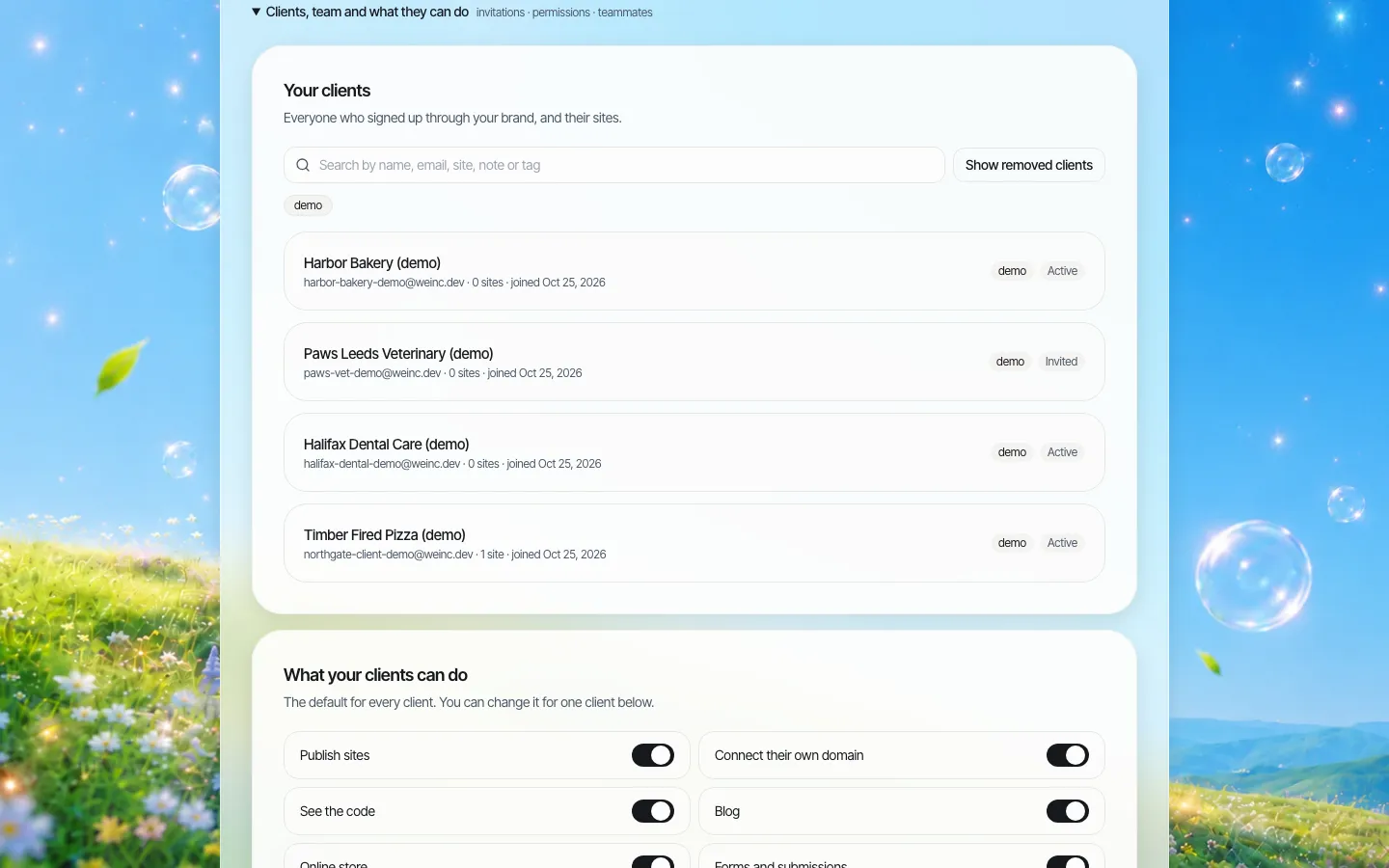
*The seller register. Tag sellers by market, rank or onboarding month and search by tag.*
Review without slowing sellers down
The review step is a single step. When a seller with approval on presses Publish, the request goes to your queue, and a reviewer approves it or asks for changes. A field of thousands of sellers can produce a long queue, so plan for it:
- Approve people, not every page, once you can. New sellers publish through approval; sellers with a clean record for a few months can publish directly.
- Keep the risky parts out of reach. Turn the blog off until a seller has completed claims training. Turn the store off if orders must go through your replicated checkout.
- Lock the company parts. The logo, the income disclosure link and the "independent seller" statement belong in the fixed design.
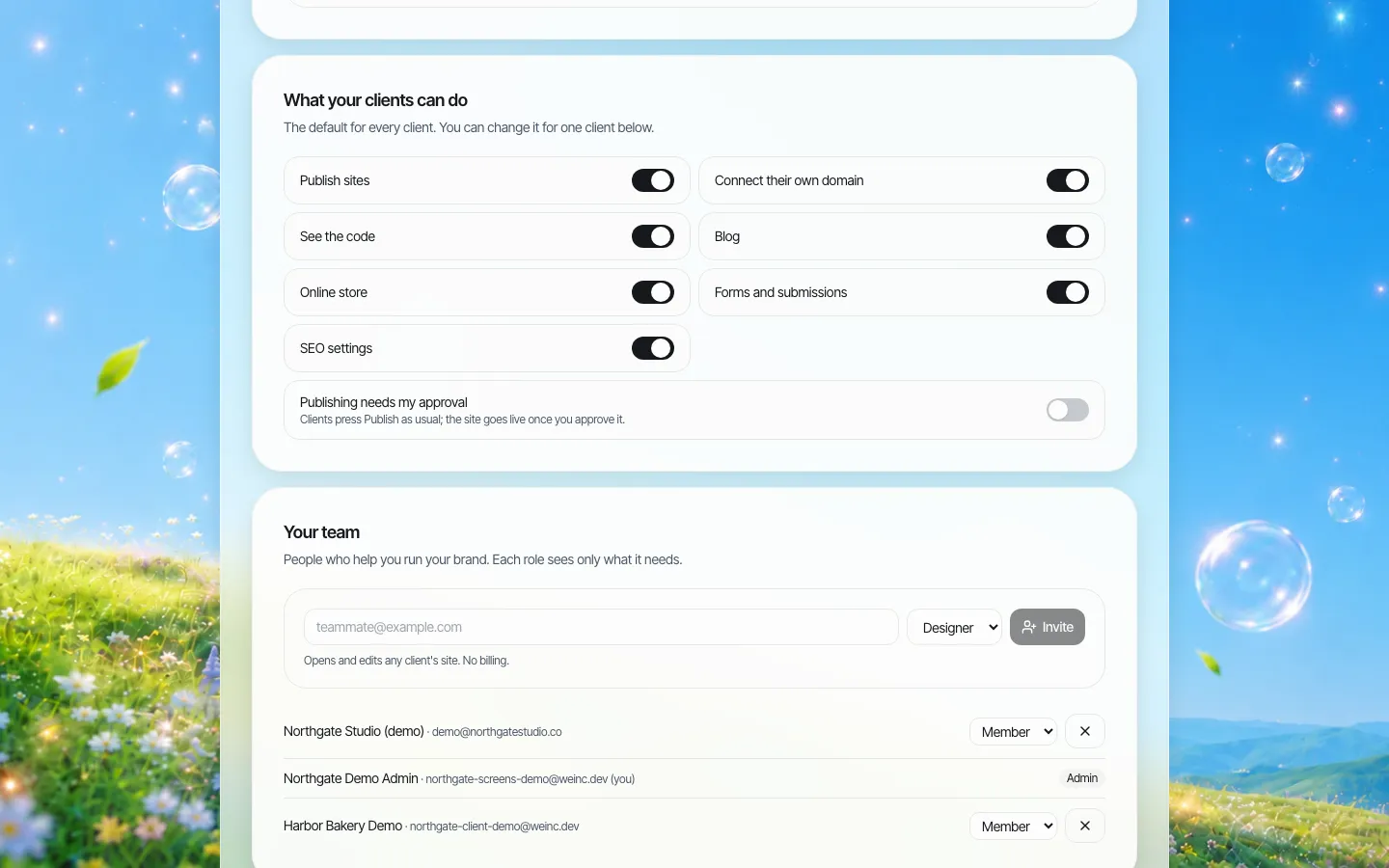
*Company-wide defaults: every new seller starts here.*
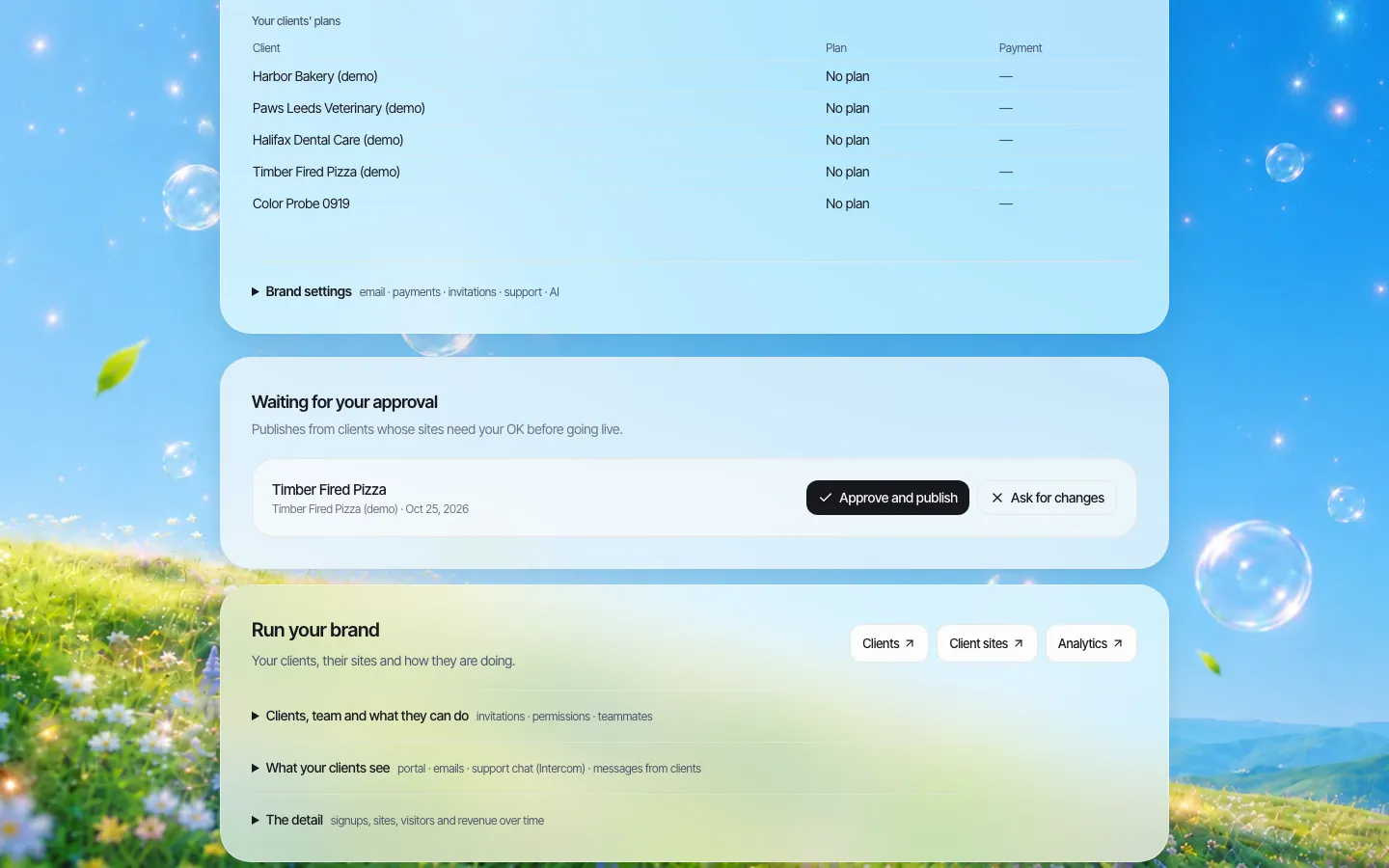
*The review queue. The request shown was staged for this screenshot.*
Ordering, commissions and your back office
Be clear with yourself about what the seller site is for. We.Inc is a website builder. It has no integration with direct sales back offices, commission engines or your replicated-site order links, and it does not track which seller a sale should be credited to. The working pattern:
- The seller site tells the seller's story, shows the products they love, and collects contact requests through a form.
- Every "shop" button links to the seller's replicated store or party link, which handles orders and credit.
- The company keeps product pages, pricing and the income disclosure on the corporate site.
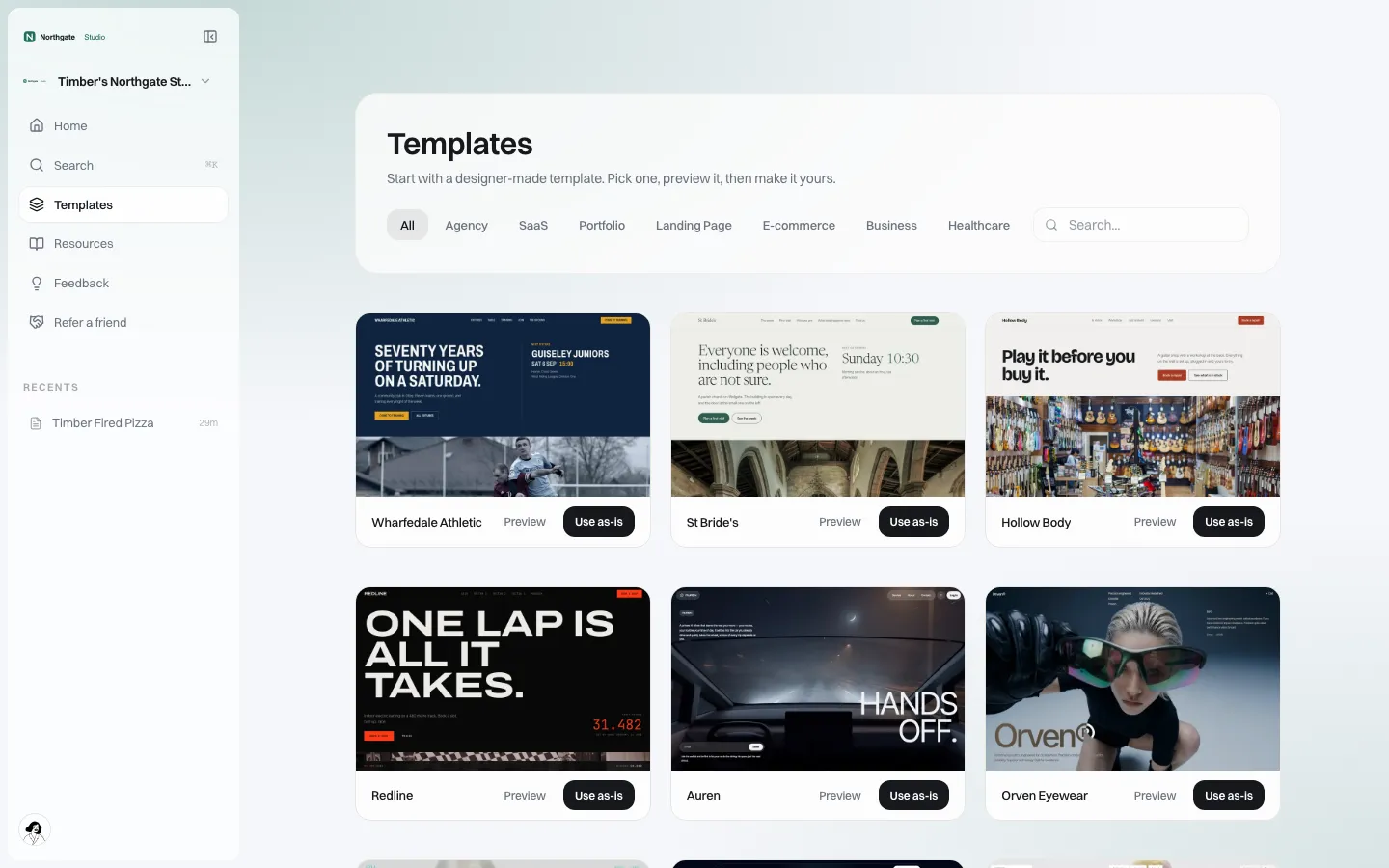
*Sellers start from templates under your brand rather than a blank page.*
When a seller leaves or is terminated
Seller churn is constant. Write the rules into the seller agreement before launch:
- The company's name, logo and approved product content leave with the company.
- The seller's own words and photos may go with them, if your agreement says so.
- On termination, pause the account the same day. A paused seller can no longer connect a domain, and you decide what the old site shows.
- Point the old site at a "find a seller" page so customers are not stranded.
A record of what happened helps when a dispute follows. We.Inc keeps an audit log of organisation actions, such as a seller's switches changing or an account being paused.
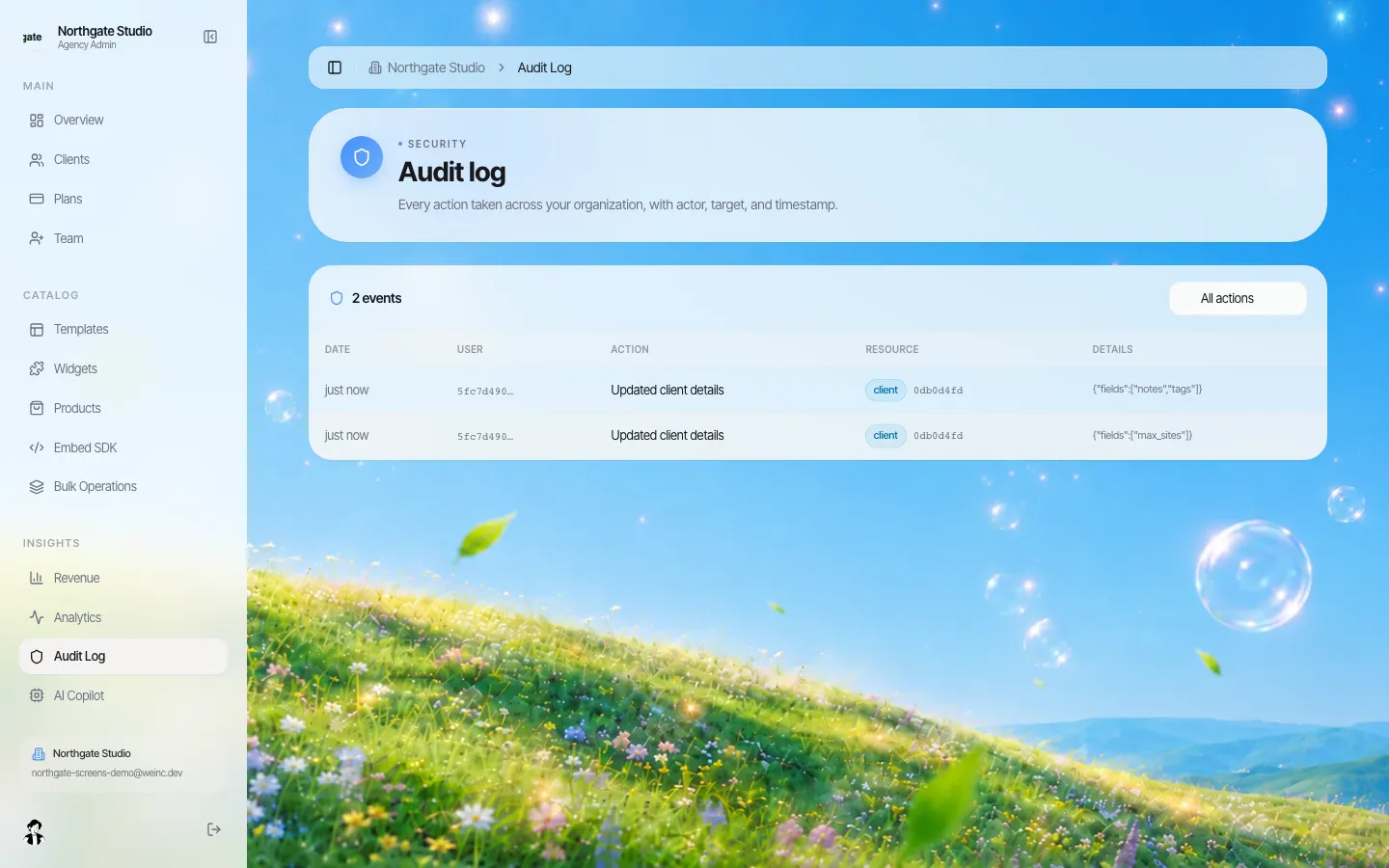
*Account-level actions are recorded. In this build the user column shows an ID rather than a name.*
Search: thousands of near-identical pages help nobody
A replicated site program is, by design, thousands of near-identical pages, and that is why most companies keep them out of search. If you give sellers personal sites, keep that discipline: no copied "about the company" sections, no shared product copy pasted onto each site. Google describes creating pages to rank for "specific, similar search queries" as doorway abuse. A seller site earns its place by being personal; if it is not, keep it out of search.
Is We.Inc the right fit?
A good fit for direct sales and party-plan companies that want sellers on personal, branded sites with a claims review step, next to the replicated store they already run.
Not the right fit if you need one system that combines seller sites with genealogy, commission tracking and replicated ordering. Direct sales back-office platforms do that; their site tools will connect to your compensation plan in ways We.Inc does not.
Book a demo and we will set up a sample seller under your brand with review switched on.
Sources
Last checked 2026-10-25. This page is general information, not legal advice.
- Federal Trade Commission, Business Guidance Concerning Multi-Level Marketing (April 2024).
- Google Search Central, Spam policies for Google web search: doorway abuse.
Book a demo. Pricing is tailored to your volume and setup, and you get your exact price on the call. 0% transaction fee.
Frequently asked questions
Can we review seller sites before they go live?
Yes. Turn on publishing approval for all sellers or chosen ones. It is a single-step approval before a seller’s site goes live.
Does We.Inc connect to our back office or commission system?
No. Link each seller site to their replicated store or party link, which keeps handling orders and commission credit.
Can team leaders manage their downline’s sites?
No. Every seller account sits directly under the company brand. There is no downline or genealogy structure in We.Inc.
Keep reading
- White label website builder: the We.Inc platform
- Client permissions: what each site owner can do
- Brand governance across many websites
- Manage many client websites from one account
- Audit log for a white-label website platform
- Website governance policy template
More in White Label
- Most domains you sell never become a website. That gap is the product.
- Drupal multisite alternative: keep Drupal for the flagship, rethink the long tail
- Duda white label pricing in 2026, and the AI alternative
- Websites for the projects, partners and small businesses an EDO serves
- Every event needs a website for about nine months
- A Finalsite alternative for districts that mainly need websites
- White Label for Freelancers
- White Label for Hosting Providers
We.Inc is an AI-powered website builder you can resell under your own brand. Launch a branded client dashboard, bill on Stripe Connect, and deliver AI-generated websites in minutes. White-label pricing is tailored to your volume and setup: book a 30-minute demo for a quote.
Product
- AI Website Builder: Describe a site in plain English; it's live in minutes
- White Label Platform: Your brand, your domain, your margin
- Enterprise: SSO, custom SLAs, and dedicated support
- Developer API: Embed site generation into your SaaS
Who It's For
- For Agencies: Resell under your brand
- For Freelancers: Your own branded builder
- For Hosting Providers: Add a builder to your stack
- For SaaS Platforms: Embed site creation via API
- For Startups
- For Financial Services
- For Healthcare
Features
- Drag & Drop Editor
- Built-in SEO Tools
- Custom Branding
- Client Dashboard
- Reseller Billing (Stripe Connect)
Resources
- Blog
- Help Center
- Free Business Tools
- Free UI Components
- Website Templates
- Template Collections
- Website Examples
- Guides
- Comparisons
- Alternatives
- Best Lists
- Reviews
- Pricing Guides
- Use Cases
- Glossary & Guides
- Integrations
- Developers
- Benchmark
- Windows App