Your listed businesses need websites. You already know who they are.
A directory or marketplace holds thousands of businesses that rely on it for customers, and many of them have no website of their own, or a poor one. Offering them a website under the platform's brand is a natural upsell: you already have their name, category, photos and contact details. But it needs to be done in a way that helps the businesses, and that does not fill your own domain with thin pages. This page covers both.
TL;DR
- Listed businesses want a presence they own; the platform wants recurring revenue and stickier listings. A branded website offer serves both.
- In We.Inc each listed business is a client account under your brand with its own site and domain, billed on your Stripe account.
- Webhooks feed signups, publishes and payments back into your platform, so your listing team sees who has a site.
- Put each business on its own domain, not thousands of pages on yours. Book a demo to plan the integration.
Why platforms add a website offer
Directories and marketplaces sell visibility: a listing, a featured placement, leads. That revenue is under pressure whenever a business decides the leads are not worth it. A website changes the relationship: it is something the business owns and uses every day, branded by you, and it gives them a reason to keep paying you even in a quiet month.
It also answers a request your support team probably hears already: "Can you help me with a website?"
The two ways to deliver it
| Approach | How it works | Best when |
|---|---|---|
| Branded portal | Businesses sign in on your branded page (your domain, logo and colours) and build there | You want to launch quickly without engineering work |
| Embedded in your product | The builder is embedded inside your own dashboard | The website should feel like a tab in your existing product |
Most platforms start with the branded portal and embed later. The embedded route is covered on our SaaS embedding page.
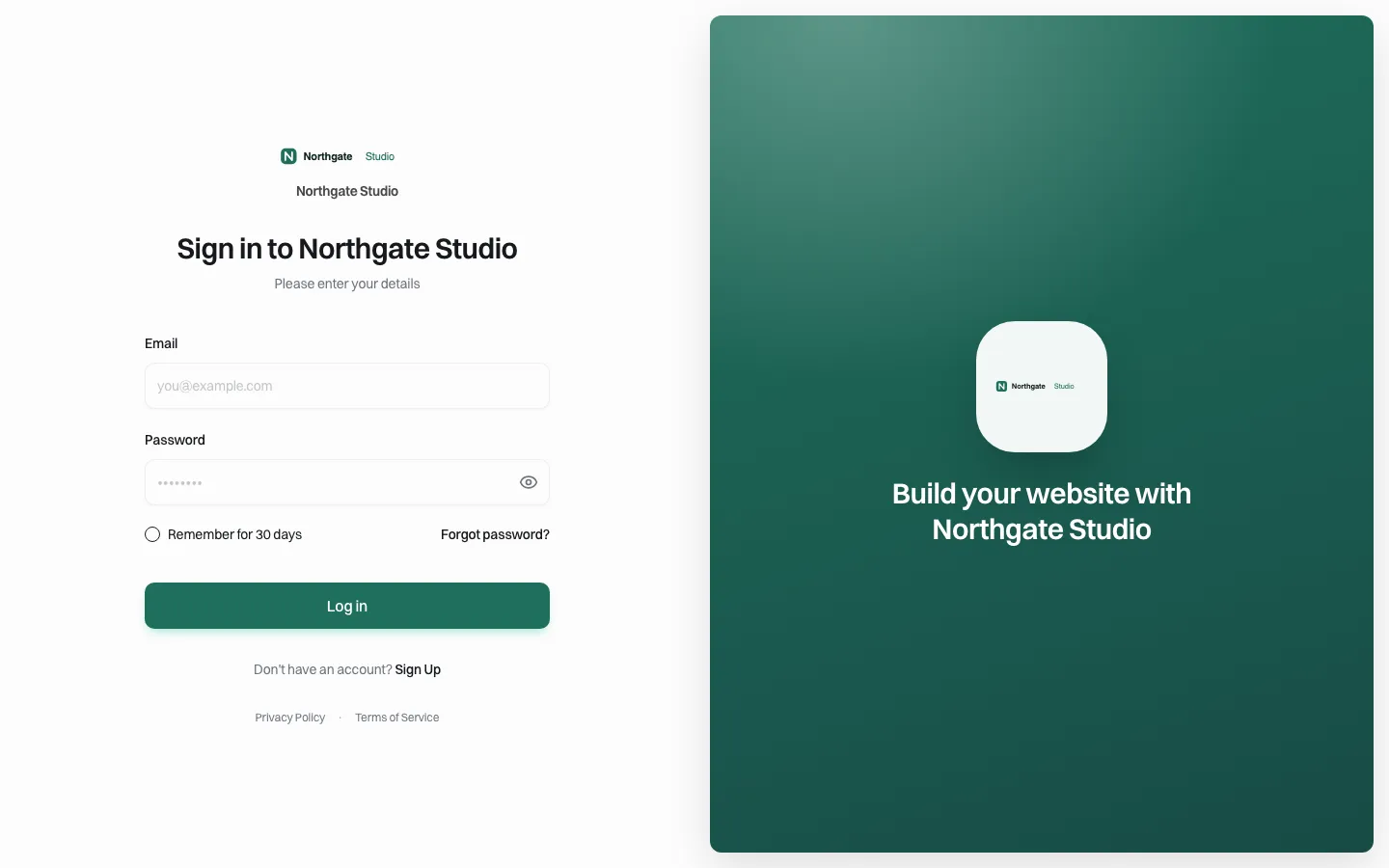
*The sign-in page under your platform's brand.*
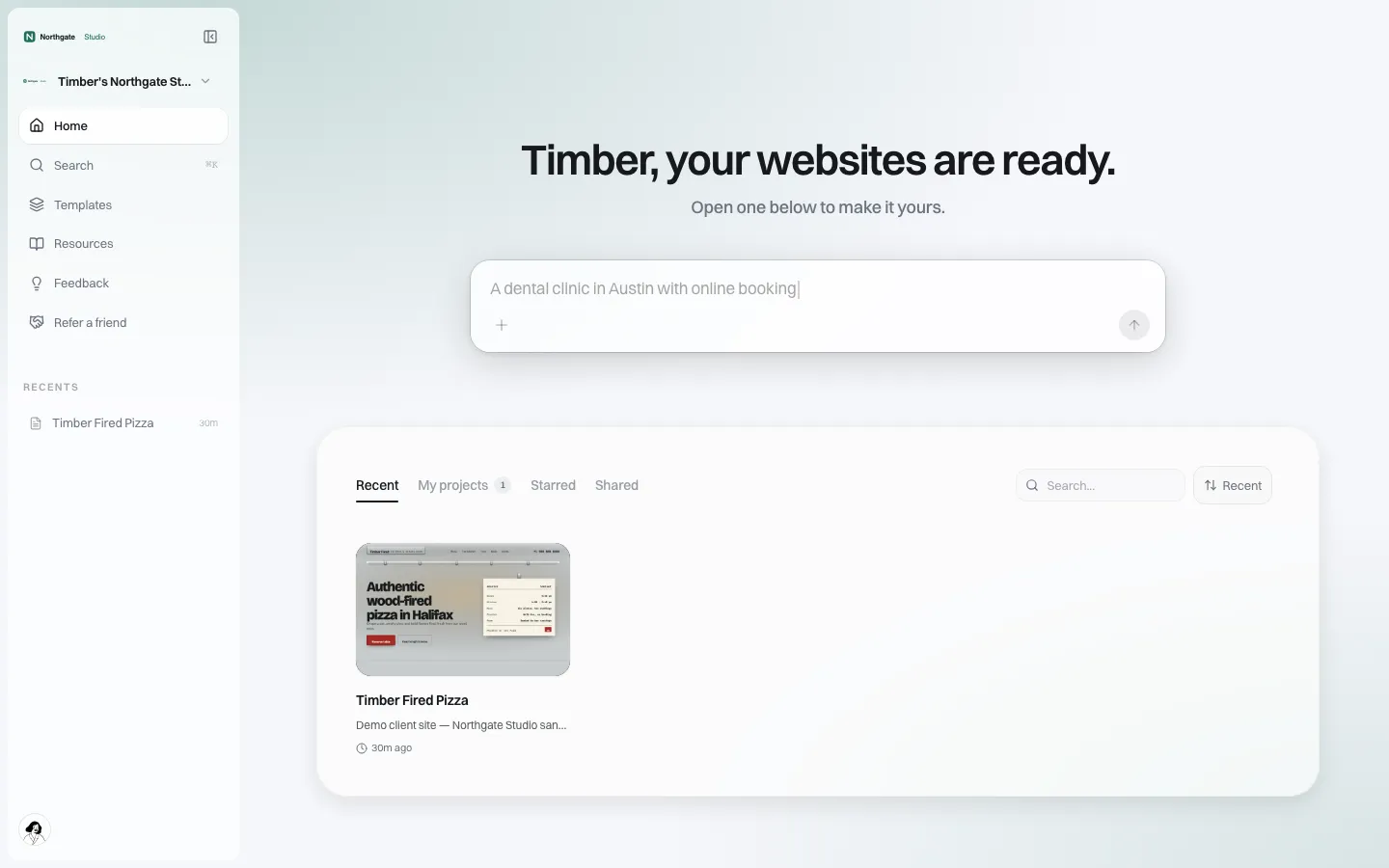
*A listed business's home screen on your address.*
Connecting it to the listing side
The work that makes this pay is the connection between the website offer and your listings. Brand webhooks send events to your systems (directly, or via Zapier or Make), including:
- a client signed up,
- a client created their first site,
- a client published a site,
- a client has not published seven days after joining,
- a client paid you,
- a client paused.
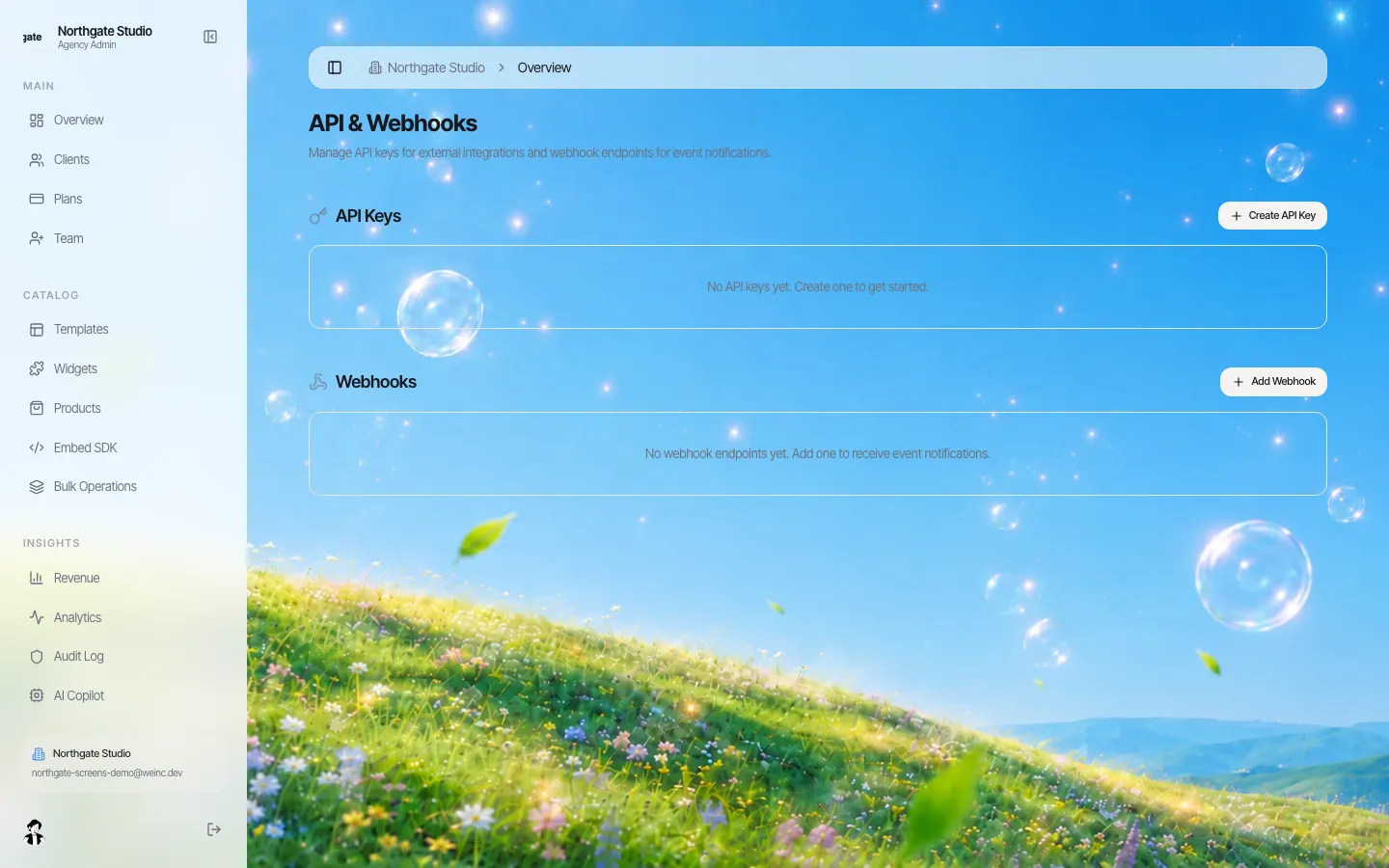
*Webhooks and API keys. Events such as "client published a site" can update the listing on your side.*
Practical uses: show a "visit website" link on the listing once the site is published; flag businesses that signed up but never published to your success team; tie payments to the listing's paid tier.
Billing: one relationship, your terms
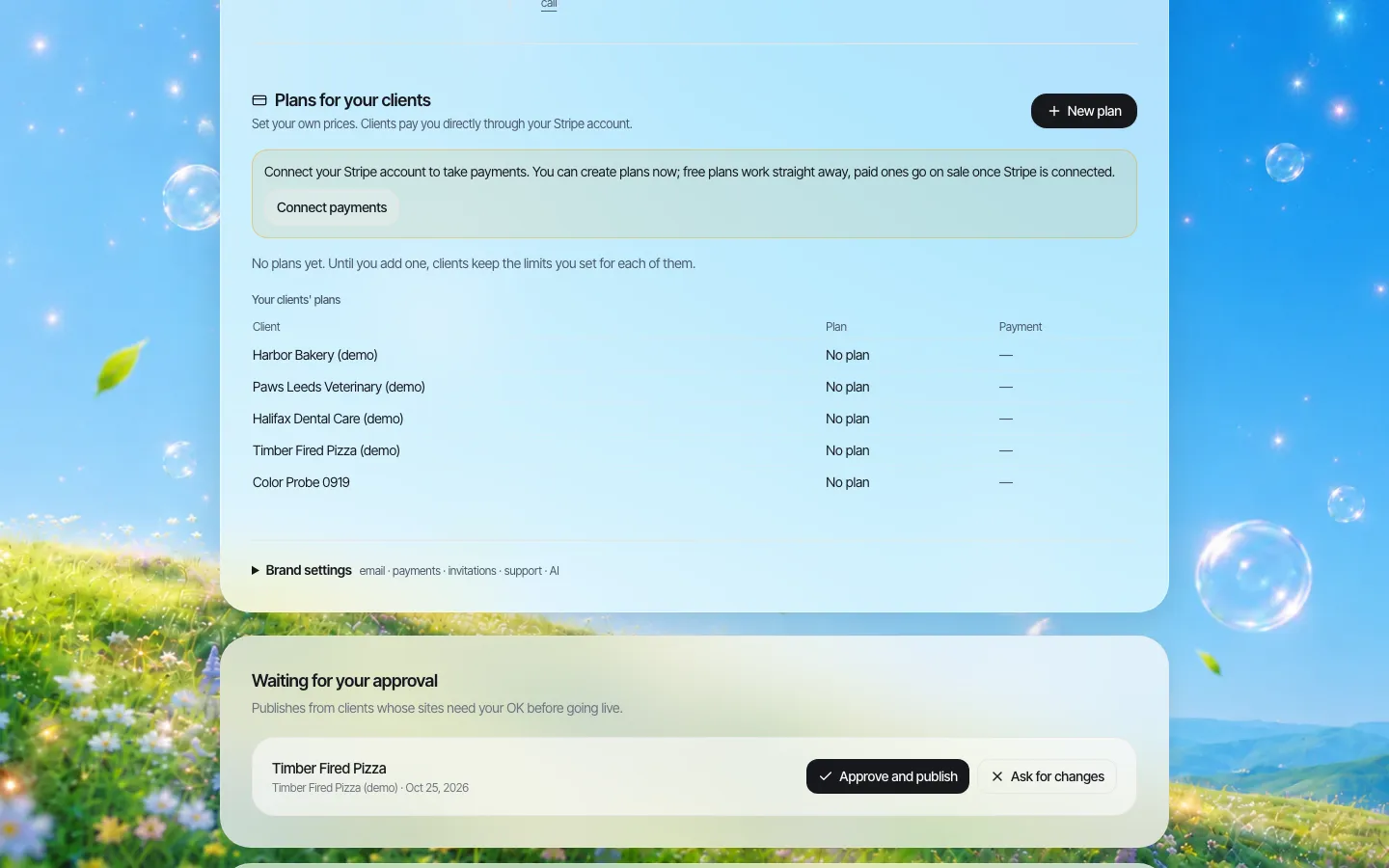
*Plans for listed businesses, billed on the platform's own payment account.*
You create the plans, decide what each includes, and bill on your own connected Stripe account. A plan sets a business's site limit and features. Many platforms tie the website to an existing paid listing tier rather than selling it separately, so the business sees one subscription.
Protect your own domain from thin pages
This is where directories get into trouble. It is tempting to generate a page or a mini-site for every listed business on the platform's domain, from the data you already hold. Google's spam policies describe exactly this risk: scaled content abuse (many pages generated mainly to manipulate rankings), doorway abuse (pages made to rank for many similar queries) and site reputation abuse (third-party content published on a host site mainly because of that host's ranking signals). A directory domain filled with thousands of auto-generated business pages can drag down the directory itself.
Safer rules:
- Each business gets its own domain (or a subdomain it controls), and the site is written by or with the business, not generated from listing fields alone.
- Nothing is published without the business. Create the account and a draft, then let the owner edit and publish.
- No auto-generated reviews or ratings. Reviews shown on a site must be real.
- Inactive sites come down. If a business leaves or never publishes, do not keep a placeholder live.
Rolling it out to a large listing base
| Phase | Who | What |
|---|---|---|
| Pilot | 20 to 50 engaged businesses in two categories | Invitations from your team; learn which templates and features they use |
| Defaults | Your product team | Set brand-wide switches (forms, store, blog, own domain) to what the pilot needed |
| Integrate | Your engineering team | Webhooks into your listing system; a link on each published listing |
| Offer | Your sales and success team | Add to a paid tier; follow up on "not published after seven days" |
| Scale | Everyone | Invite category by category, watching support load |
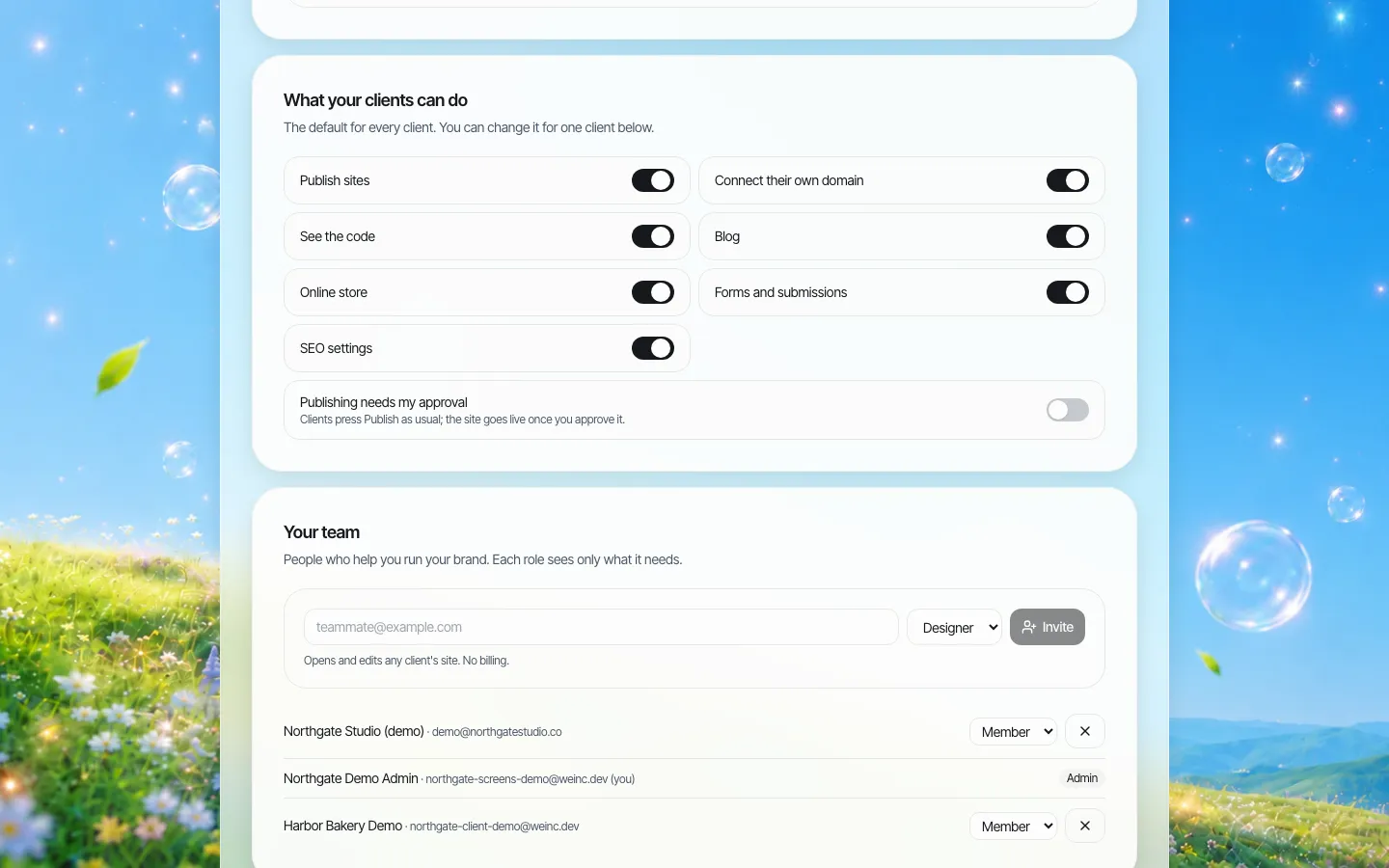
*Brand-wide defaults apply to every new business; you override them for individual accounts.*
Questions your product and legal teams will ask
- Who is the customer of the website, us or the business? Decide whether the business signs your terms only, and make the website a clause in them. Most platforms keep one contract.
- Who owns the content? The business should own its words and photos. Say so; it makes the offer easier to accept, and it matches the fact that each site's code can be downloaded.
- Who handles a takedown request about a business's site? Your support team receives it first because your brand is on the platform. Write the escalation path before launch.
- Do website signups count as platform users? Clients sign in on your branded page, so for most reporting they are; agree how analytics and marketing consent are handled.
- What happens when a listing is suspended? Pausing a client's account is one action, and a webhook tells your systems it happened, so you can keep the two in step.
None of these are technical blockers. They are the decisions that slow launches when they surface in week six instead of week one.
Where We.Inc fits, and where it does not
Good fit: directories, booking platforms and marketplaces whose listed businesses are small service and retail firms that need a simple site, and that want a branded offer with billing and events tied into the platform.
Better elsewhere: if what you need is a storefront that sells the business's products through your marketplace's own checkout and catalogue, that is part of your marketplace, not a separate website. We.Inc sites can include a simple online store, but they do not plug into your marketplace's catalogue or checkout.
We do not publish security certifications, uptime figures or customer counts. Every business's site can be downloaded or synced to GitHub, so businesses that leave your platform can take their site. Book a demo and bring your category list.
Sources
Last checked 2026-10-25.
- Google Search Central, Spam policies for Google web search: doorway abuse, scaled content abuse, site reputation abuse, thin affiliation.
Book a demo. Pricing is tailored to your volume and setup, and you get your exact price on the call. 0% transaction fee.
Frequently asked questions
Can we create sites for listed businesses automatically?
You can invite businesses and start them from templates, but we recommend each business edits and publishes its own site, on its own domain. Mass auto-generated pages on your domain risk Google's scaled content and site reputation policies.
Can website events update our listings?
Yes. Brand webhooks send events such as client signed up, site published, client paid you and client paused, directly or via Zapier or Make.
Can we bill businesses for websites ourselves?
Yes. Create plans and connect your own Stripe account. Many platforms tie the website to an existing paid listing tier.
Can the builder appear inside our own product?
There is an embed option for putting the builder inside your dashboard; see the SaaS embedding page and ask in the demo for the details that fit your product.
Keep reading
- White label website builder: the We.Inc platform
- Embed a website builder in your SaaS
- White-label reseller billing
- Manage many client websites from one account
- Websites for associations and chapters
More in White Label
- Every loan officer wants a website. Every one of them is an advertisement.
- Running fifty websites is a different job from running one
- Affiliate websites when every affiliate has its own board
- Your instructors want a website. Make sure it is yours, not a competitor’s
- Should a payments company give its merchants a website?
- Candidate websites for every customer on your campaign platform
- White-label website builder pricing
- You already made their logo, cards and sign. The website is the next thing they ask about.
We.Inc is an AI-powered website builder you can resell under your own brand. Launch a branded client dashboard, bill on Stripe Connect, and deliver AI-generated websites in minutes. White-label pricing is tailored to your volume and setup: book a 30-minute demo for a quote.
Product
- AI Website Builder: Describe a site in plain English; it's live in minutes
- White Label Platform: Your brand, your domain, your margin
- Enterprise: SSO, custom SLAs, and dedicated support
- Developer API: Embed site generation into your SaaS
Who It's For
- For Agencies: Resell under your brand
- For Freelancers: Your own branded builder
- For Hosting Providers: Add a builder to your stack
- For SaaS Platforms: Embed site creation via API
- For Startups
- For Financial Services
- For Healthcare
Features
- Drag & Drop Editor
- Built-in SEO Tools
- Custom Branding
- Client Dashboard
- Reseller Billing (Stripe Connect)
Resources
- Blog
- Help Center
- Free Business Tools
- Free UI Components
- Website Templates
- Template Collections
- Website Examples
- Guides
- Comparisons
- Alternatives
- Best Lists
- Reviews
- Pricing Guides
- Use Cases
- Glossary & Guides
- Integrations
- Developers
- Benchmark
- Windows App