A HubSpot CMS alternative for agencies whose clients are not on HubSpot
HubSpot Content Hub (the product formerly called CMS Hub) is a strong choice when the client's marketing, sales and service already run on HubSpot: the site, forms and CRM share one database. Many agencies are HubSpot partners for exactly that reason. The trouble starts when an agency tries to make HubSpot its default for every client, including small businesses that will never use the CRM. This page compares the two fairly, using HubSpot's own published tiers.
TL;DR
- HubSpot's pricing page today: Content Hub Free, Starter (per seat), Professional from $500/mo with 3 seats, Enterprise from $1,500/mo with 5 seats; 'Manage multiple sites' and 'content approvals' are listed under Enterprise.
- Each client normally has its own HubSpot account and subscription; the site is HubSpot-branded to the client as a HubSpot product.
- We.Inc puts every client inside one portal under your brand, AI-builds their site, and bills them through your own Stripe.
- Use HubSpot for clients who live in HubSpot. Use We.Inc for the many small-business clients who just need a website.
HubSpot's tiers, as published today
HubSpot's Content Hub page, checked today, lists four tiers. We quote HubSpot's figures only so you can see where features sit; check the page for the current offer before you decide.
| Content Hub tier | HubSpot's listed price | Features HubSpot highlights for the tier |
|---|---|---|
| Free | $0/month | Build landing pages, blog posts with AI, basic SEO tips |
| Starter | Per seat (the page shows a limited-time discount for new customers) | Remove HubSpot branding, add website pages, personalise content |
| Professional | Starts at $500/month, 3 seats included | Remix content, define brand voice, podcasts |
| Enterprise | Starts at $1,500/month, 5 seats included | Manage multiple sites, content approvals, customise your CMS |
Two things stand out for agencies. "Manage multiple sites" and "Set up content approvals" are listed under Enterprise. And the tiers are priced per client account: HubSpot is designed for one business running its own marketing, not for an agency running many small businesses under one roof.
HubSpot runs a Solutions Partner Program "designed for service firms, consultancies, and agencies". Its partner page, as we read it today, does not describe white-labelling or reselling the CMS under the agency's own brand.
Where HubSpot is the right answer
Be honest with the client:
- They use HubSpot CRM, marketing email or sales tools. A site on the same platform means forms, contacts and analytics line up without integration work.
- They have a marketing team that will run campaigns, personalisation and content from the CMS.
- They value the HubSpot ecosystem, including its partner directory and certifications for your agency.
For those clients, building on HubSpot is a service you can charge well for, and we would not suggest moving them.
Where it is a poor fit
Agencies tell us about a different client: a dentist, a bakery, a local trades firm. They want a good website, the ability to change their hours and photos, and a fair monthly price. They will never open a CRM. For that client:
- A per-account subscription is a cost they do not see value in.
- The product they sign in to is HubSpot's, not yours, so the relationship is partly HubSpot's.
- Multi-site management and approvals sit in the top tier, which is not designed for a five-page local site.
Multiply that by fifty clients and the agency has fifty separate accounts to run.
The one-portal model
In We.Inc, every client is an account inside your brand. They sign in on your domain, see your logo, get emails from your name and pay you.
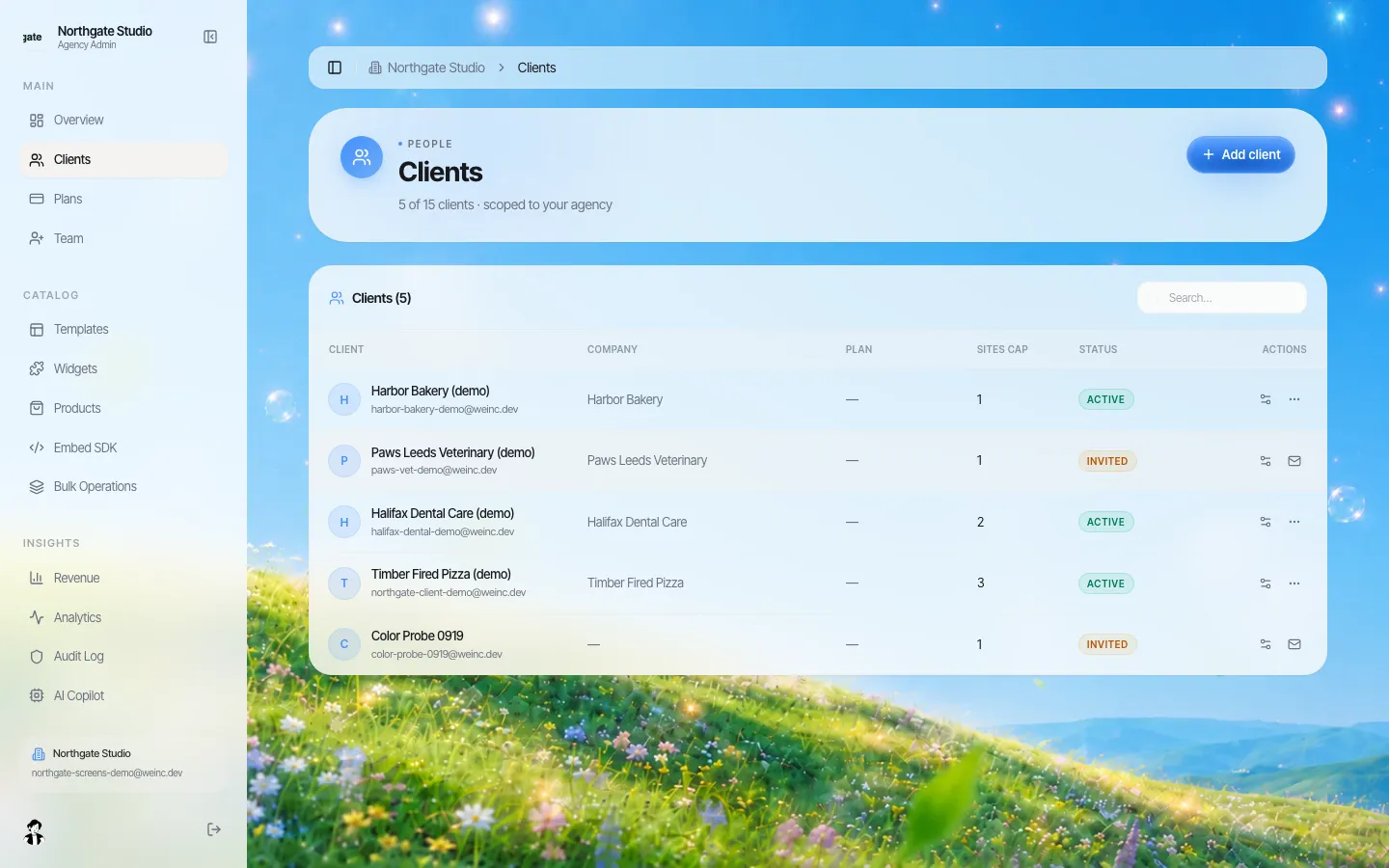
*Every client in one table: company, plan, how many sites each may have, and status.*
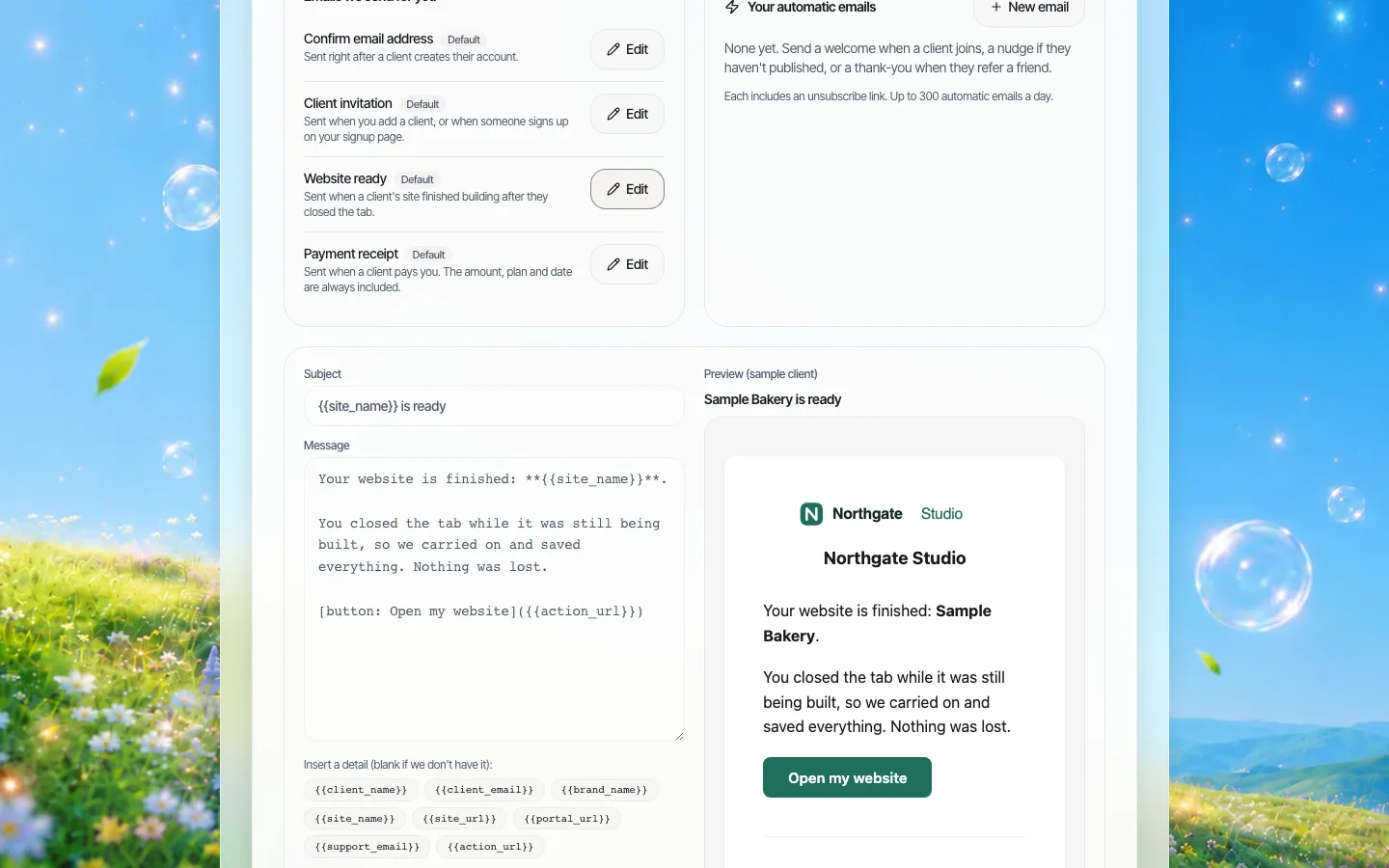
*System emails such as "Website ready" go out under your brand, with your logo and colours.*
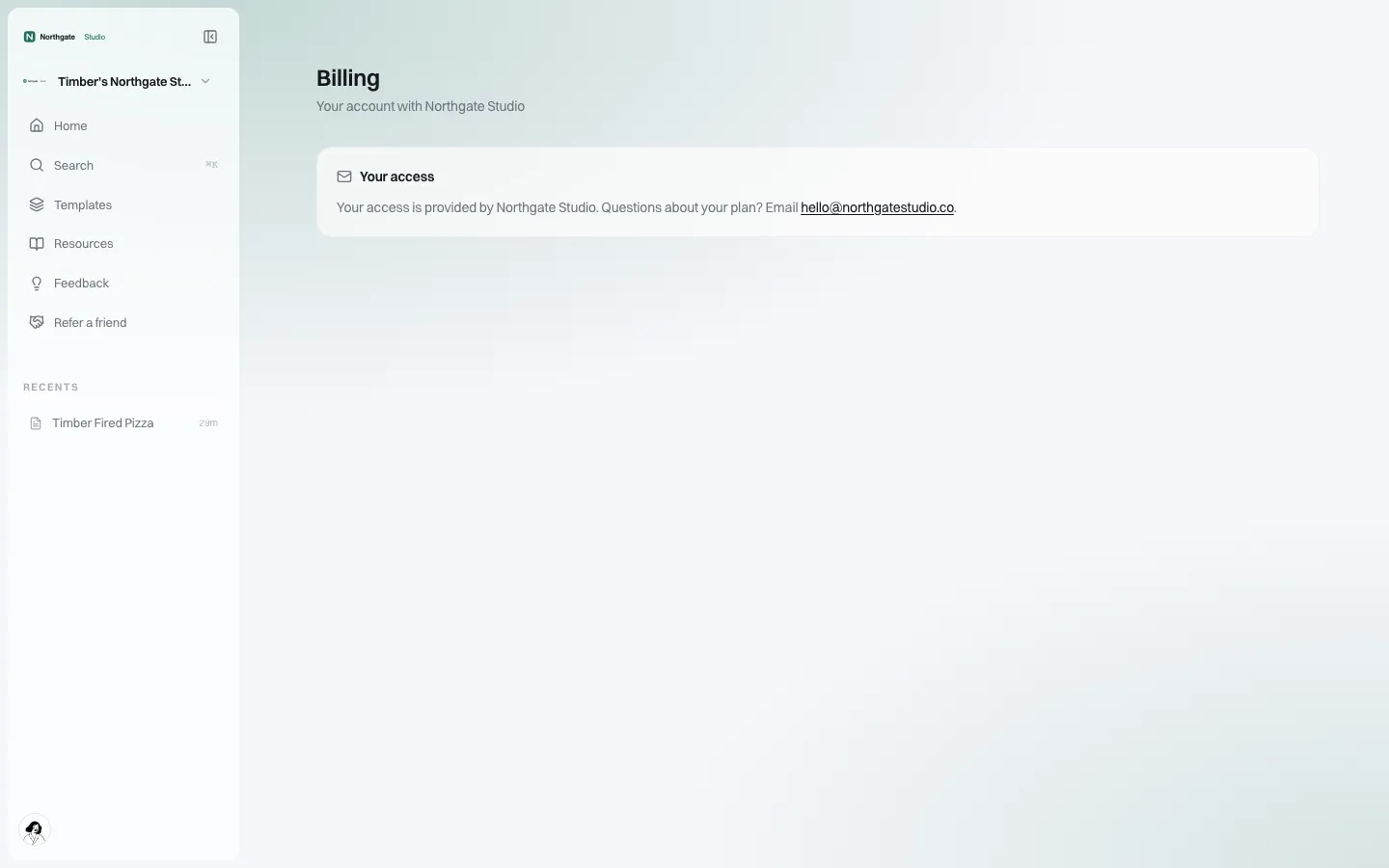
*The client's billing page names your agency, not us.*
Each client builds their site by describing it; the AI produces a first version and they edit visually. You set what each client may do and whether their changes need your approval before going live.
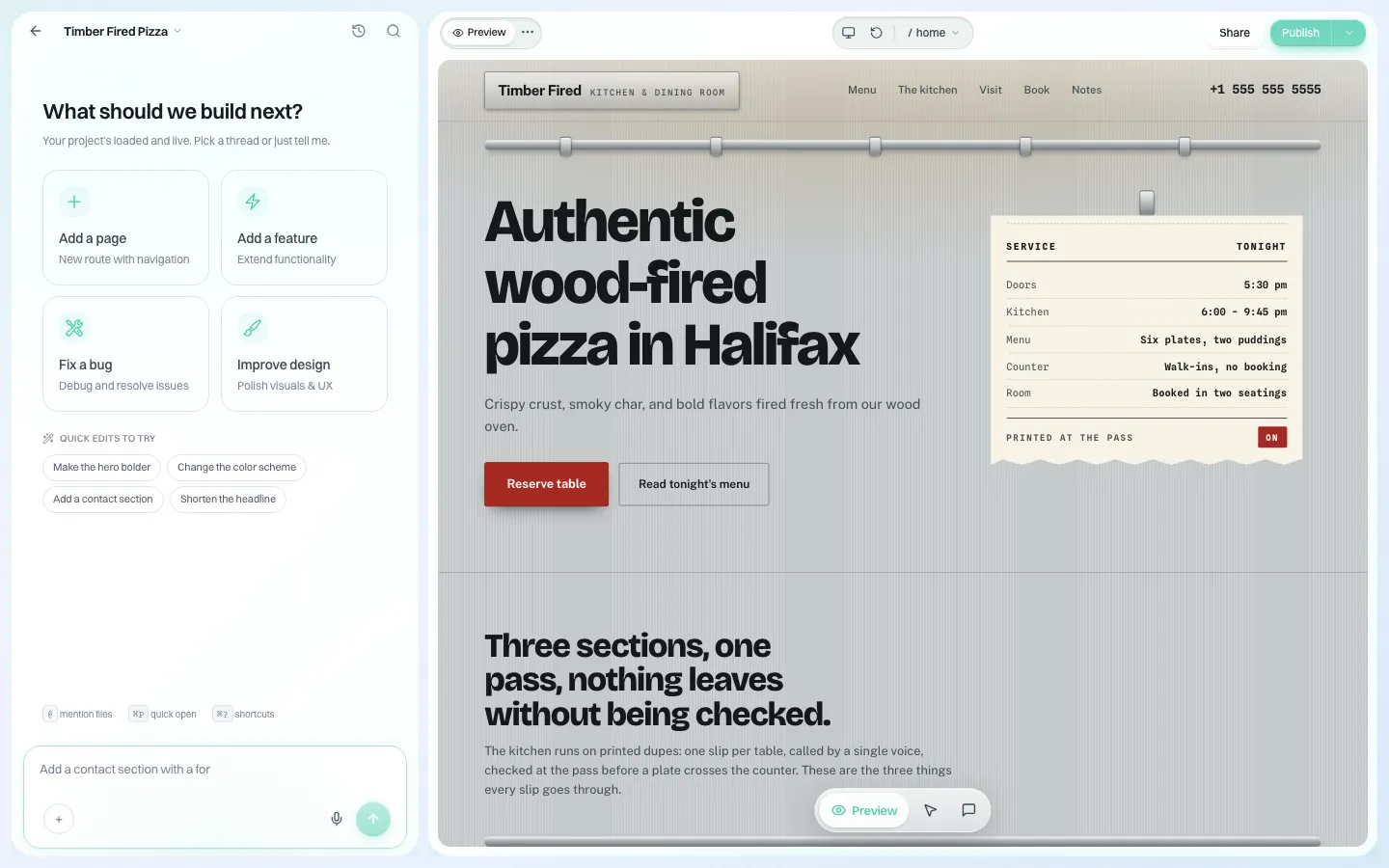
*A client's site open in the builder, inside your branded portal.*
Side by side for an agency
| Question | HubSpot Content Hub (from HubSpot's pages) | We.Inc |
|---|---|---|
| Who the platform is branded as | HubSpot, with HubSpot branding removable from Starter | Your agency: login, portal, domain, emails, billing |
| Account structure | One HubSpot account per client business | One brand account; clients are accounts under it |
| Multi-site management | Listed under Enterprise | Core: register, site limits, per-client switches |
| Content approvals | Listed under Enterprise | Single-step approval before a client's site goes live, per client |
| CRM and marketing automation | Yes, HubSpot's core strength | No CRM |
| Building a site | Templates, themes and the editor | AI builds from a description; visual editing |
| Who bills the client | HubSpot bills the subscriber | You, through your own Stripe |
| Getting the code out | Ask HubSpot about export | Download ZIP or sync to GitHub |
The real cost of running clients as separate accounts
The subscription is the visible cost. The hidden cost of one account per client is operational, and it is worth writing down before you pick a default platform:
- Logins. Your team needs access to every client account, and has to be removed from every one when they leave.
- Renewals. Each account renews on its own date, on the client's card or yours. Missed renewals become emergencies.
- Templates. A section you improve for one client has to be rebuilt in each other account.
- Reporting. Answering "how many client sites do we run, and which are live?" means opening each account.
- Ownership disputes. When a client leaves, whose account holds the site, the domain and the form data?
In a single brand account those questions have one answer each. Your team is added or removed once, with a role (owner, admin, member, or a fixed preset such as designer or support). Clients sit in one register with tags and notes. A client who leaves can take their site's code with them, which keeps the parting friendly.
None of this makes HubSpot the wrong tool for clients who use its CRM; it just means the per-account model is a cost to price in, not a free default.
Running a mixed client book
Most agencies end up with both:
- Tag clients by platform need. "Uses HubSpot CRM" goes on HubSpot. "Needs a website" goes on your own brand.
- Price the two differently. HubSpot builds are projects plus retainer; We.Inc sites can be a simple monthly plan you set yourself.
- Keep the brand consistent. Your portal, emails and invoices look the same for every We.Inc client.
- Move clients up when they grow. A We.Inc client who starts using HubSpot CRM can move to a HubSpot site later; the code export means nothing is trapped.
Our reseller billing page explains how client plans and Stripe work, and the agency page covers the rest of the workflow.
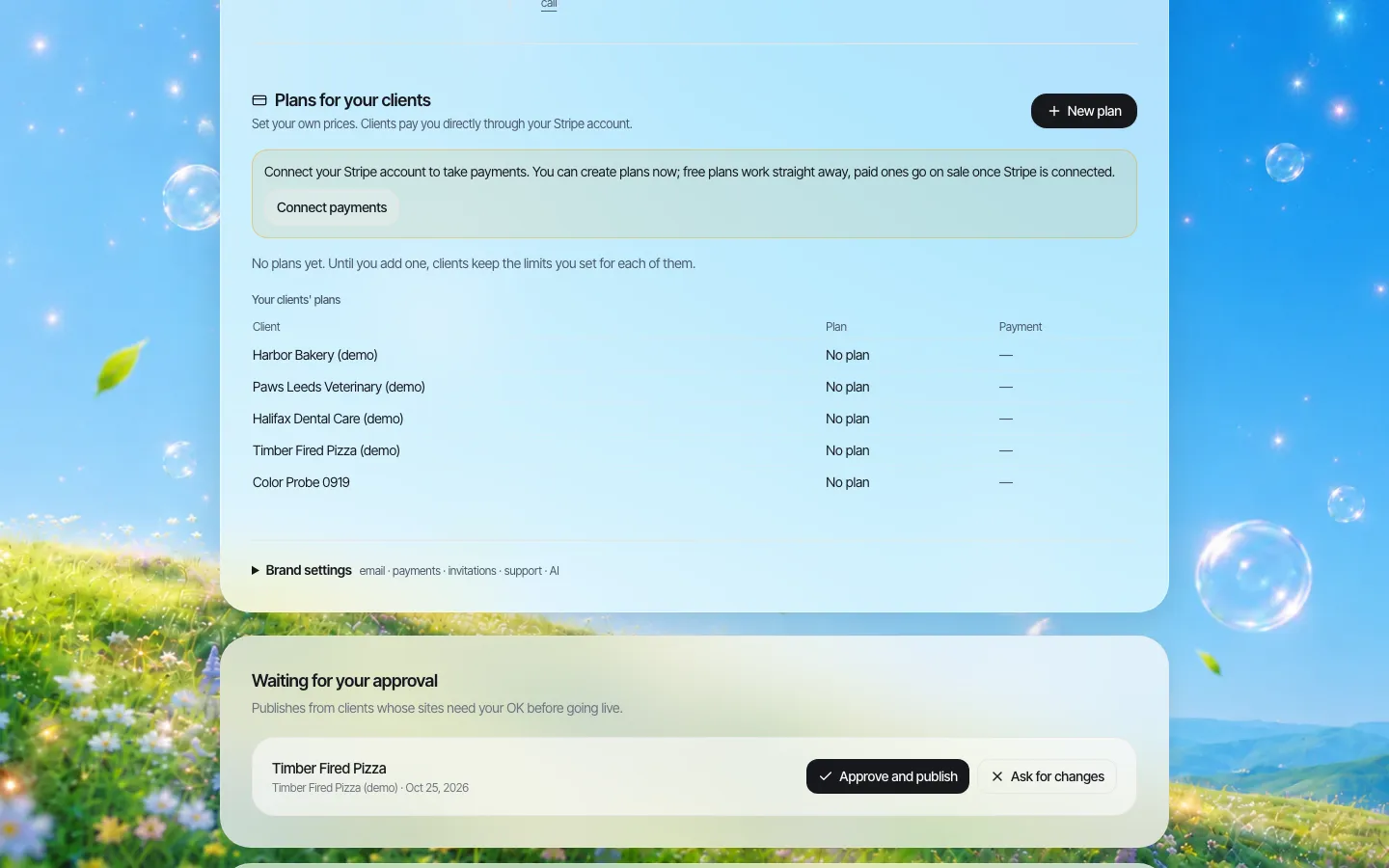
*You decide each client's plan and price; payments go to your Stripe account.*
Book a demo and bring your client list. We will split it into "HubSpot clients" and "website clients" with you.
Sources
Last checked 2026-10-25.
- HubSpot, Content Hub: tiers, listed prices, seats and features per tier.
- HubSpot, Partners: Solutions Partner Program description.
Book a demo. Pricing is tailored to your volume and setup, and you get your exact price on the call. 0% transaction fee.
Frequently asked questions
Which HubSpot Content Hub tier includes managing multiple sites?
On HubSpot's Content Hub page, checked on 25 October 2026, 'Manage multiple sites' and 'Set up content approvals' are listed under Enterprise, which starts at $1,500 a month with 5 seats.
Can I white-label HubSpot CMS for my clients?
HubSpot's Starter tier lets a subscriber remove HubSpot branding from their content. HubSpot's partner page, as we read it, does not describe reselling the CMS under your own brand. Ask HubSpot for the current terms.
Does We.Inc have a CRM?
No. We keep a list of clients with notes and tags, but there is no sales CRM or marketing automation. Clients who need that are often better on HubSpot.
How is We.Inc white label priced?
It is quoted on a demo, based on how many client sites you plan to run.
Keep reading
- White-label website builder for agencies
- Bill clients through your own Stripe
- Resell websites under your own brand
- Duda white label alternative
- GoHighLevel website builder alternative
- White label website builder: the We.Inc platform
More in White Label
- A website for every member agency, without becoming their web designer
- Attorney advertising rules apply to every page. Review has to scale with the sites.
- Your ad reps already sit with every business in town. Sell them a website.
- Your marketing tool is only as good as the website it points to
- Your listed businesses need websites. You already know who they are.
- Every loan officer wants a website. Every one of them is an advertisement.
- Running fifty websites is a different job from running one
- Affiliate websites when every affiliate has its own board
We.Inc is an AI-powered website builder you can resell under your own brand. Launch a branded client dashboard, bill on Stripe Connect, and deliver AI-generated websites in minutes. White-label pricing is tailored to your volume and setup: book a 30-minute demo for a quote.
Product
- AI Website Builder: Describe a site in plain English; it's live in minutes
- White Label Platform: Your brand, your domain, your margin
- Enterprise: SSO, custom SLAs, and dedicated support
- Developer API: Embed site generation into your SaaS
Who It's For
- For Agencies: Resell under your brand
- For Freelancers: Your own branded builder
- For Hosting Providers: Add a builder to your stack
- For SaaS Platforms: Embed site creation via API
- For Startups
- For Financial Services
- For Healthcare
Features
- Drag & Drop Editor
- Built-in SEO Tools
- Custom Branding
- Client Dashboard
- Reseller Billing (Stripe Connect)
Resources
- Blog
- Help Center
- Free Business Tools
- Free UI Components
- Website Templates
- Template Collections
- Website Examples
- Guides
- Comparisons
- Alternatives
- Best Lists
- Reviews
- Pricing Guides
- Use Cases
- Glossary & Guides
- Integrations
- Developers
- Benchmark
- Windows App