A website for every member agency, without becoming their web designer
Aggregators, clusters, captive programs and carrier agent programs all run into the same request: "can you give us a website?" Saying yes is easy once. Saying yes three hundred times, keeping every site reviewed and knowing what happens when an agency leaves, is the hard part. This page walks through that operation.
TL;DR
- Decide the ownership model first: who owns the domain and the content when a member agency leaves your network.
- In We.Inc each member agency is a client account under your network brand, with its own sites and a set of switches you control.
- Advertising review fits the single-step approval: the agency edits, your marketing or compliance reviewer approves, the site goes live.
- There is no carrier quoting or rating engine inside the site builder. Link to the quoting tools your agencies already use.
Three network shapes, three different answers to "whose site is it?"
Before choosing any platform, settle who owns what. The answer changes with the kind of network you run.
| Network type | Who usually owns the agency's brand | What should happen to the site when they leave |
|---|---|---|
| Independent agency cluster or aggregator | The member agency | They take their domain and content with them |
| Captive or exclusive agent program | The carrier or program | The site comes down; the agent's personal domain, if any, is released |
| Franchise-style agency brand | The franchisor | The site is reassigned to the next owner of the territory |
Write the answer into the membership agreement. A network that never decided ends up arguing about a domain at the worst possible moment, while a book of business is moving.
We.Inc supports all three. For members who take their site with them, every site's code can be downloaded as a ZIP or synced to GitHub, so "you can take it" is a real promise. For programs that keep the site, pausing or removing the client account keeps control with you, and removed clients stay findable in your register.
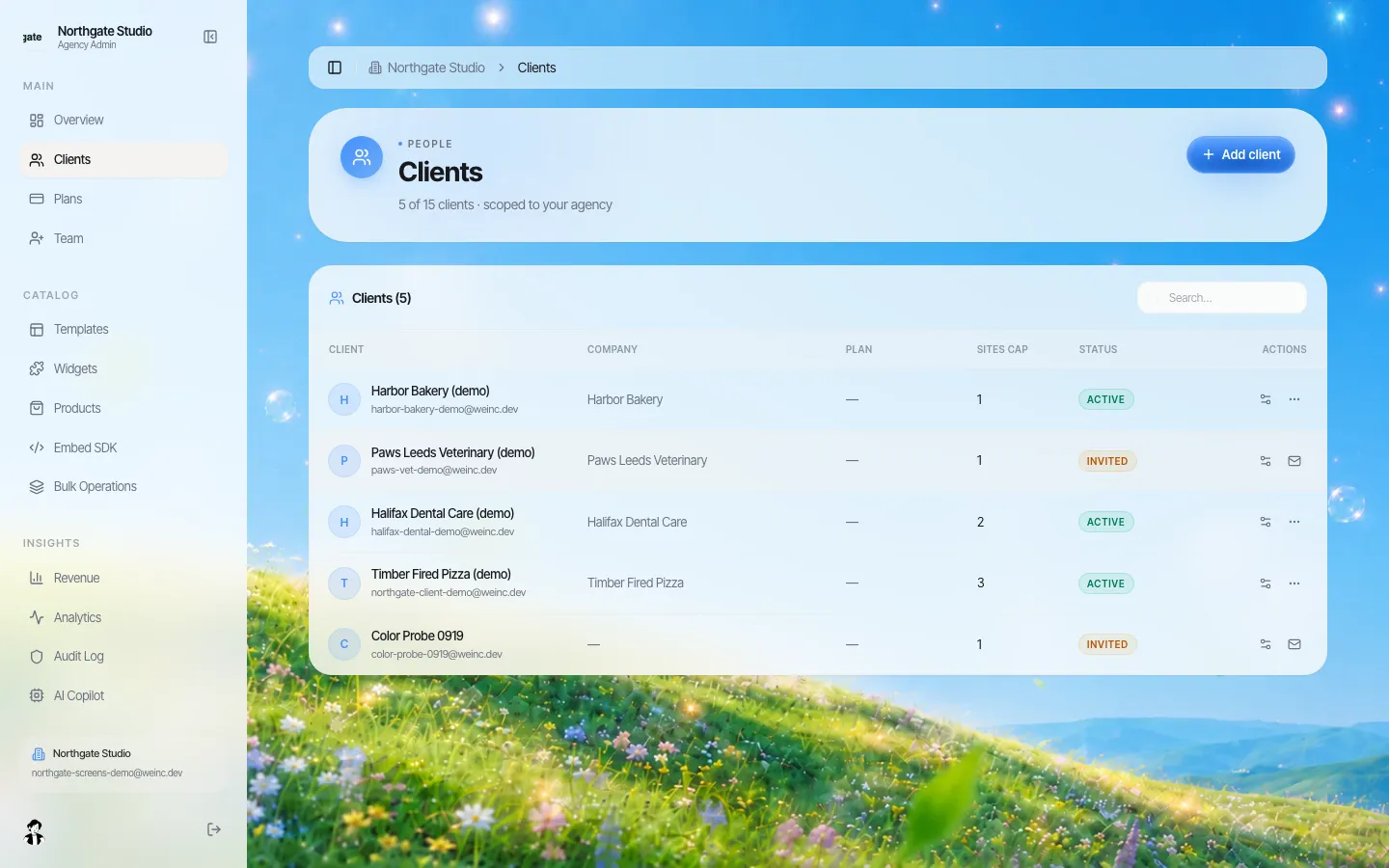
*Your member register. Each row is a member agency with its plan, how many sites it may have, and its status.*
Review before publishing, without a backlog
Insurance advertising is regulated, and the rules vary by state and by line of business. Most networks already have someone who reviews ads; the question is how website changes reach that person.
We.Inc has one approval step. You can switch it on for the whole network and off for the agencies you trust, or the reverse. When an agency with approval on presses Publish, the request lands in a queue for your team, who approve and publish it or ask for changes.
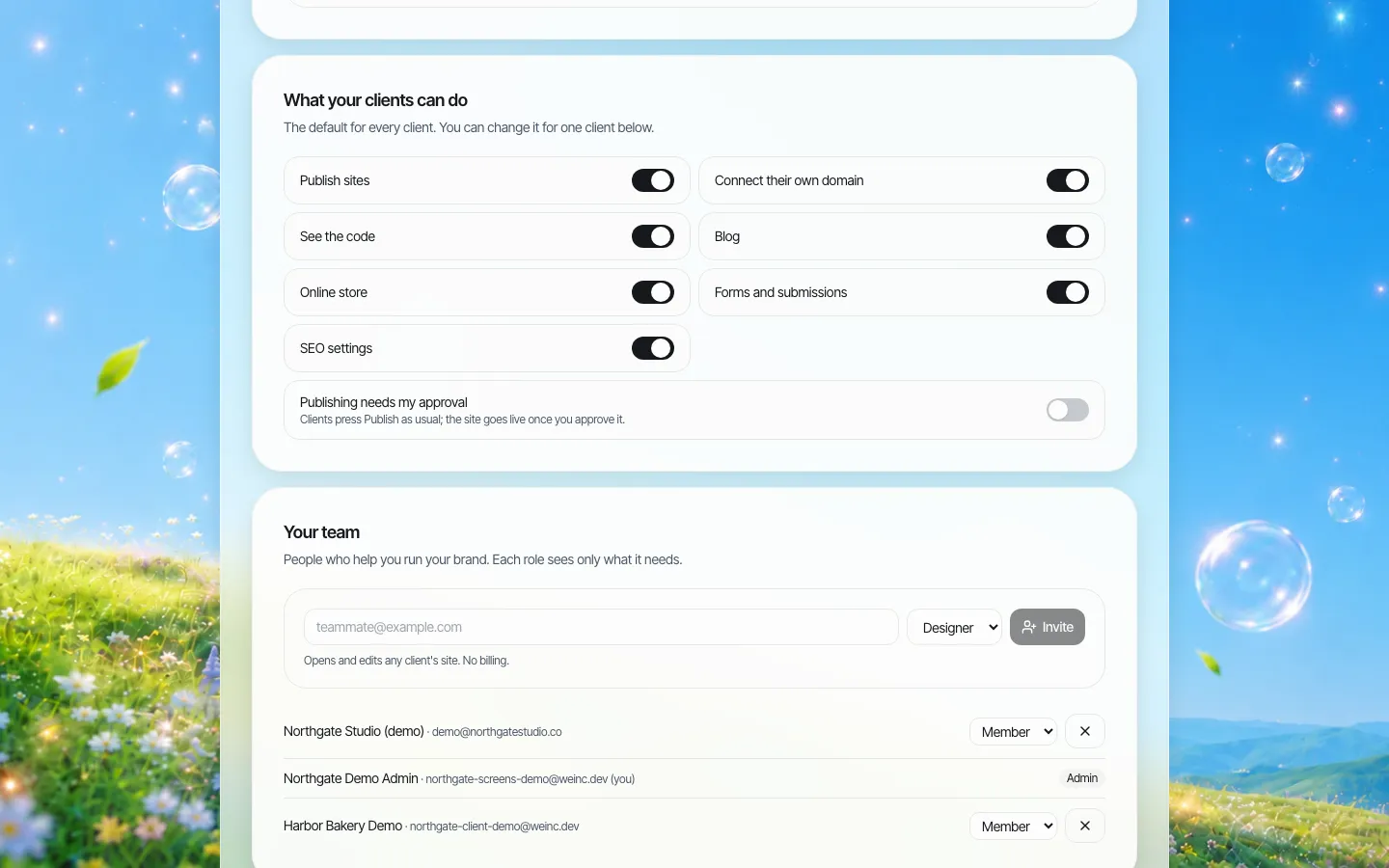
*Network-wide defaults. Every new member agency starts with these until you change them for that agency.*
A practical review checklist for agency sites, worth copying into your compliance manual:
| Check | Why it matters |
|---|---|
| Agency legal name and licence details appear where your state requires | Many states set disclosure rules for producer advertising |
| Carrier names and logos are used only as each carrier allows | Carrier appointment agreements often control logo use |
| No "lowest price" or "guaranteed savings" claims without support | Unsupported savings claims are a common complaint |
| Testimonials are real and attributed with permission | Invented reviews are both a regulatory and a search risk |
| Quote forms ask only what the callback needs | Keep driver's licence numbers and health details out of a simple contact form |
| Every page has a named human contact | Members of the public want to know who will call them back |
This checklist is a starting point, not legal advice. Your state department of insurance and your carriers set the actual rules.
Give agents the edits they make every week
Agencies change their websites for small reasons: a new producer joins, a Saturday closure, a seasonal note about hurricane prep or open enrollment. If each of those needs a ticket to your marketing team, the sites go stale.
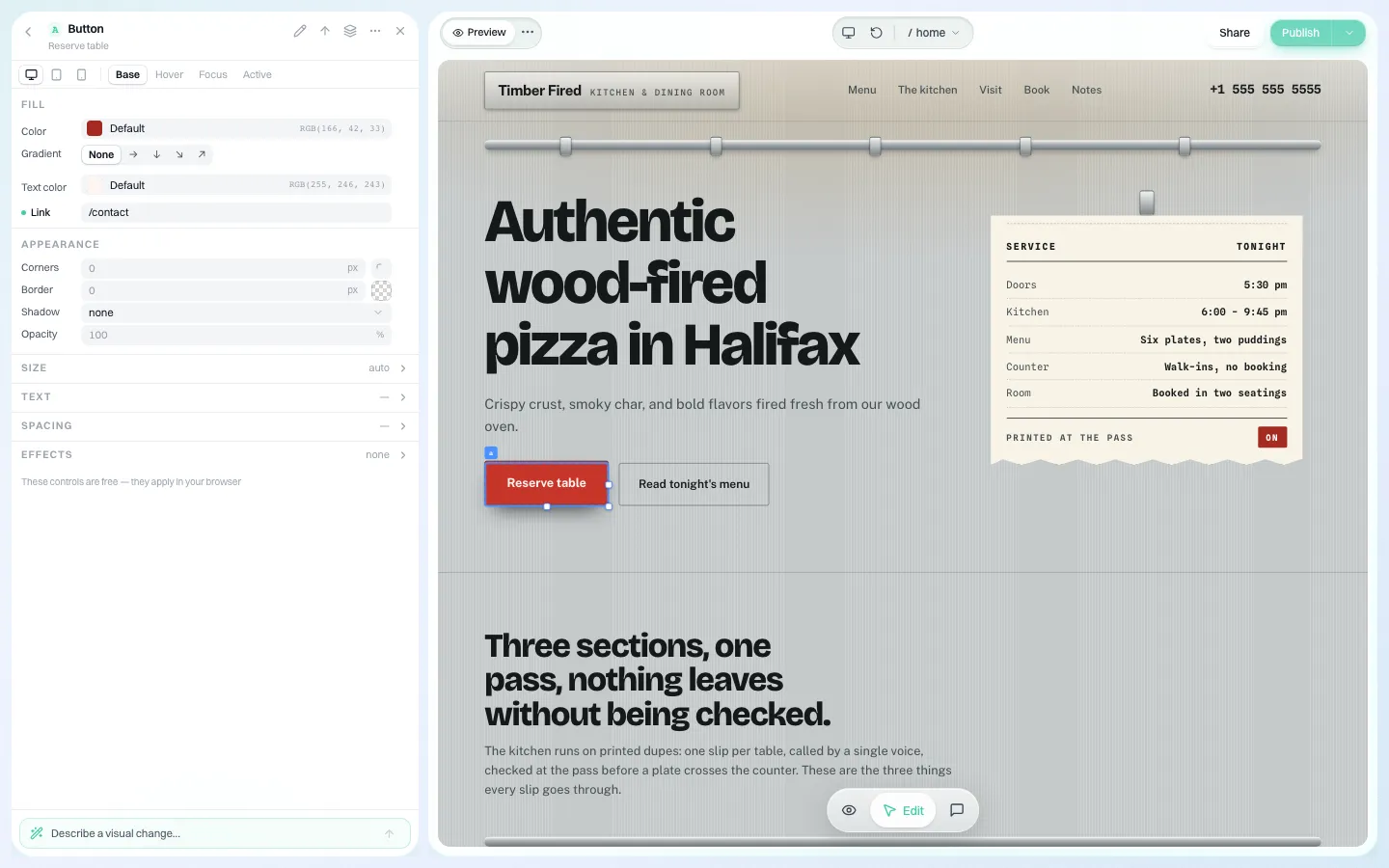
*The visual editor. Agency staff can change text, images and buttons directly; your reviewer sees the result before it goes live if approval is on.*
Decide per agency whether it can run a blog, forms, or its own SEO settings. A cluster with experienced members might allow all of it; a captive program might keep SEO central and give agents only content edits.
Producer onboarding and offboarding
Agency staff change often. Each member agency signs in on a page that carries your network's brand, not ours, and you can choose the logo, colours and login layout.
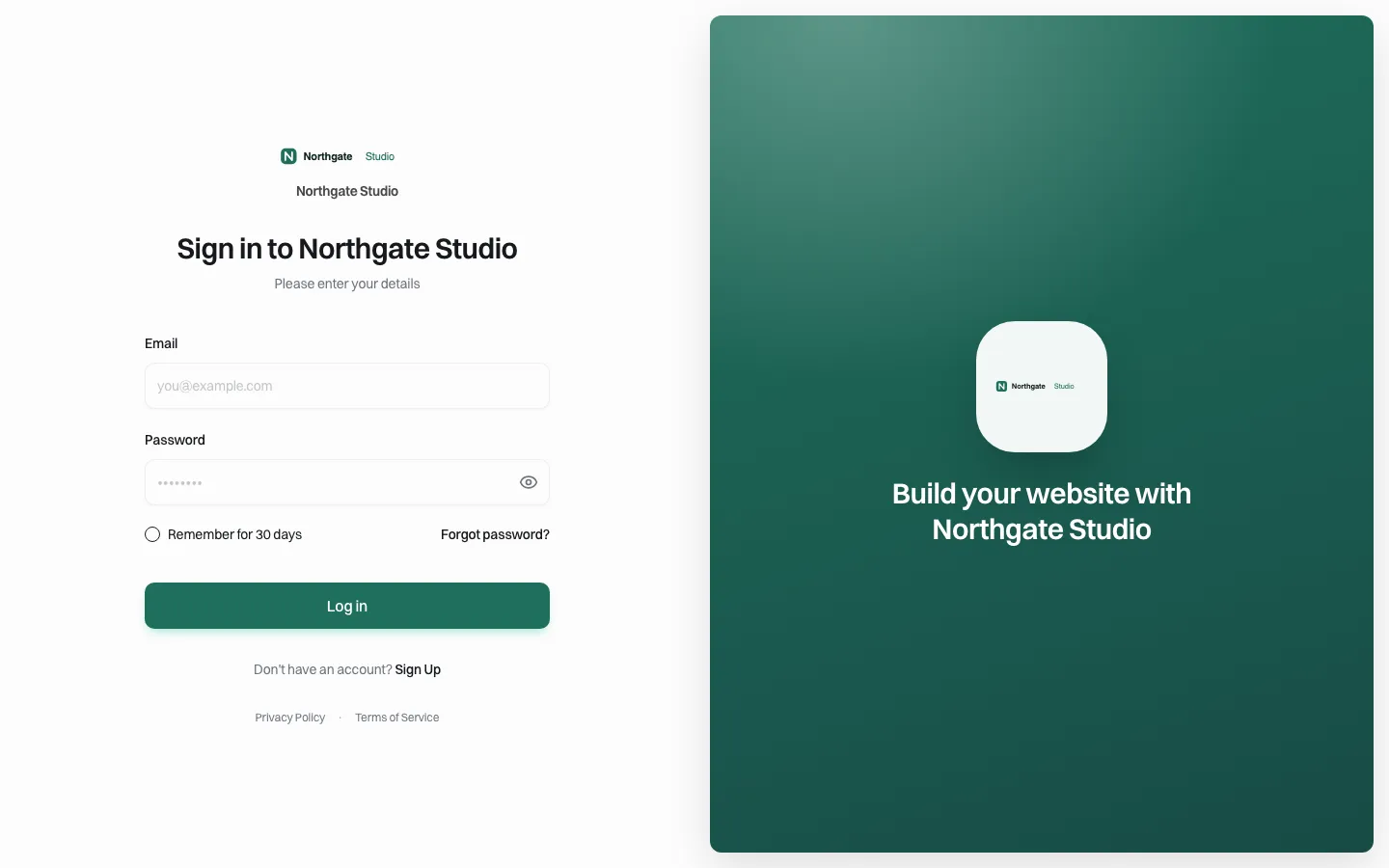
*Members sign in on your brand. Most will never know which platform runs it.*
When an agency leaves, your own records matter as much as the software. The audit log records account-level actions, such as a client being paused or removed or its switches changing, and owners and admins can filter it by action. It does not record every edit to a paragraph.
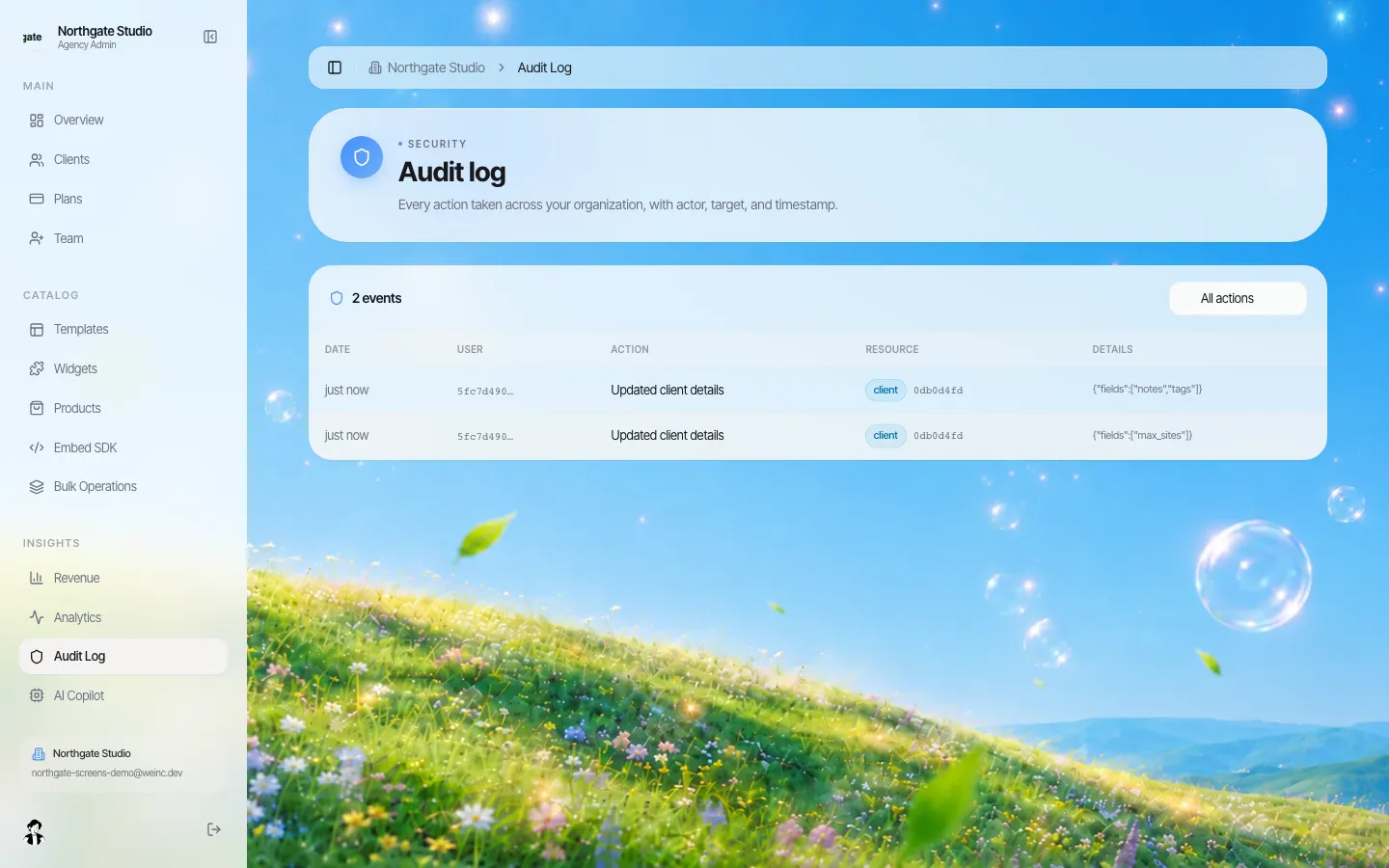
*The audit log. Use it to answer "who gave this agency its own domain?" months later.*
A rollout plan for a network of 100 to 500 agencies
- Pick ten pilot agencies of different sizes and lines: personal lines, commercial, life and health, one brand new agency.
- Write your defaults from what the pilot taught you: approval on or off, which features each tier gets.
- Build a small set of starting designs for your network. Each agency then adds its own team, story and local content.
- Invite in waves of 25. Watch how many publish within a week; the platform can send a webhook when a client "hasn't published 7 days after joining", which you can route to the person who chases them.
- Retire the old sites only after the new one is live and the domain points at it.
Do not build three hundred sites with the same body text and a different agency name. Google's spam policies treat many pages "generated for the primary purpose of manipulating search rankings" as scaled content abuse. A shared design is fine; each agency should tell its own story.
Billing your members, or not
Some networks include the website in membership; others charge for it. If you charge, We.Inc lets you set your own client plans and collect payment through your own connected Stripe account, so the invoice comes from you. The reseller billing page explains how that works. We do not publish our own prices for white-label; we quote them in the demo.
Questions to put to any website vendor, including us
Networks that have run a member website program before tend to ask the same things the second time round. Use these in any evaluation:
| Question | Why it matters for an agency network | Our answer |
|---|---|---|
| Can a member leave with their site? | Independent members will ask before they join | Yes: code download or GitHub sync |
| Can you lock the program brand while letting agencies edit content? | Brand and compliance stay central | Brand settings are yours; agencies edit within the switches you set |
| Is review per agency or all-or-nothing? | New members need more review than veterans | Per agency, with a network default |
| Who supports the agency's staff? | Your team cannot answer every "how do I" | Help pages show your support address; agree the split in the demo |
| What do you not do? | Avoids a surprise in month three | No quoting engine, no agency management integration, no certifications claimed |
| What happens to the data if we leave you? | Your exit matters as much as theirs | Every site can be exported; see our vendor exit guide |
If a vendor cannot answer the last two plainly, treat that as the answer.
Where We.Inc fits, and where it does not
Good fit: a network that wants every member agency to have a credible, reviewed, easy-to-update site under the network's control, without hiring a web team.
Not a fit: if you need comparative rating, policy servicing or a client document portal inside the website. Those belong in your agency management system or quoting platform; link to them from the site. We do not claim integrations with any specific agency management system.
Book a demo and we will set up a sample member agency with your review rules switched on.
Sources
Last checked 2026-10-25. This page is general information, not legal advice.
- Google Search Central, Spam policies for Google web search: scaled content abuse.
Book a demo. Pricing is tailored to your volume and setup, and you get your exact price on the call. 0% transaction fee.
Frequently asked questions
Can a member agency take its website when it leaves?
If your agreement allows it, yes. Every site’s code can be downloaded as a ZIP or synced to GitHub, and the agency keeps its own domain.
Can our compliance team review changes before they go live?
Yes. Switch on approval before publishing for the whole network or for chosen agencies. It is a single approval step by your team.
Does the website include insurance quoting?
No. There is no rating or quoting engine in the site builder. Link to the quoting tool your agencies already use.
Keep reading
- White label website builder: the We.Inc platform
- White-label websites for franchisors
- Client permissions: what each site owner can do
- Audit log for a white-label website platform
- White-label reseller billing
- Website governance policy template
More in White Label
- Attorney advertising rules apply to every page. Review has to scale with the sites.
- Your ad reps already sit with every business in town. Sell them a website.
- Your marketing tool is only as good as the website it points to
- Your listed businesses need websites. You already know who they are.
- Every loan officer wants a website. Every one of them is an advertisement.
- Running fifty websites is a different job from running one
- Affiliate websites when every affiliate has its own board
- Your instructors want a website. Make sure it is yours, not a competitor’s
We.Inc is an AI-powered website builder you can resell under your own brand. Launch a branded client dashboard, bill on Stripe Connect, and deliver AI-generated websites in minutes. White-label pricing is tailored to your volume and setup: book a 30-minute demo for a quote.
Product
- AI Website Builder: Describe a site in plain English; it's live in minutes
- White Label Platform: Your brand, your domain, your margin
- Enterprise: SSO, custom SLAs, and dedicated support
- Developer API: Embed site generation into your SaaS
Who It's For
- For Agencies: Resell under your brand
- For Freelancers: Your own branded builder
- For Hosting Providers: Add a builder to your stack
- For SaaS Platforms: Embed site creation via API
- For Startups
- For Financial Services
- For Healthcare
Features
- Drag & Drop Editor
- Built-in SEO Tools
- Custom Branding
- Client Dashboard
- Reseller Billing (Stripe Connect)
Resources
- Blog
- Help Center
- Free Business Tools
- Free UI Components
- Website Templates
- Template Collections
- Website Examples
- Guides
- Comparisons
- Alternatives
- Best Lists
- Reviews
- Pricing Guides
- Use Cases
- Glossary & Guides
- Integrations
- Developers
- Benchmark
- Windows App