Your marketing tool is only as good as the website it points to
Email platforms send traffic to a website. SEO tools measure a website. Review tools put stars on a website. When the customer's site is slow, out of date or missing, your product looks like it does not work, and that shows up as churn. This page is for marketing software teams thinking about giving customers a website under their own brand, and what that does and does not fix.
TL;DR
- For many small-business customers the website is the weakest link in the funnel your product sits in.
- A white-label builder lets you offer that site under your name, with your sign-in, your domain and your emails, without building an editor.
- Webhook events (client created, site published and more) let your product react when a customer's site goes live.
- It suits vendors with many small customers. If your customers are enterprises with their own web teams, skip it.
The churn conversation nobody has
Ask your customer success team why small accounts cancel. A familiar set of answers comes back: "not seeing results", "didn't have time to set it up", "our web person left". Look at those accounts and a pattern shows: the email went out, but the link went to a three-year-old page. The SEO report flagged twenty problems on a site the customer cannot edit. The review widget had nowhere to live.
Your product did its job. The website did not. And the customer cancels the tool they can cancel.
Three ways vendors respond
| Option | What it costs you | What the customer gets | Good fit when |
|---|---|---|---|
| Partner referral: send customers to a web agency or builder | Little; maybe a referral fee | A site, in someone else's product, with another login | You have few small customers, or they already have sites |
| Build your own landing-page or site feature | A product team, permanently | Exactly what you design, tightly integrated | Sites are core to your product and you have the engineers |
| White-label a builder under your brand | A partnership and setup work | A full multi-page site, in your name, on your portal | You have many small customers and want sites without a new team |
None of these is always right. A white-label builder is a middle path: more than a referral, far less than building your own.
What "under your brand" means in practice
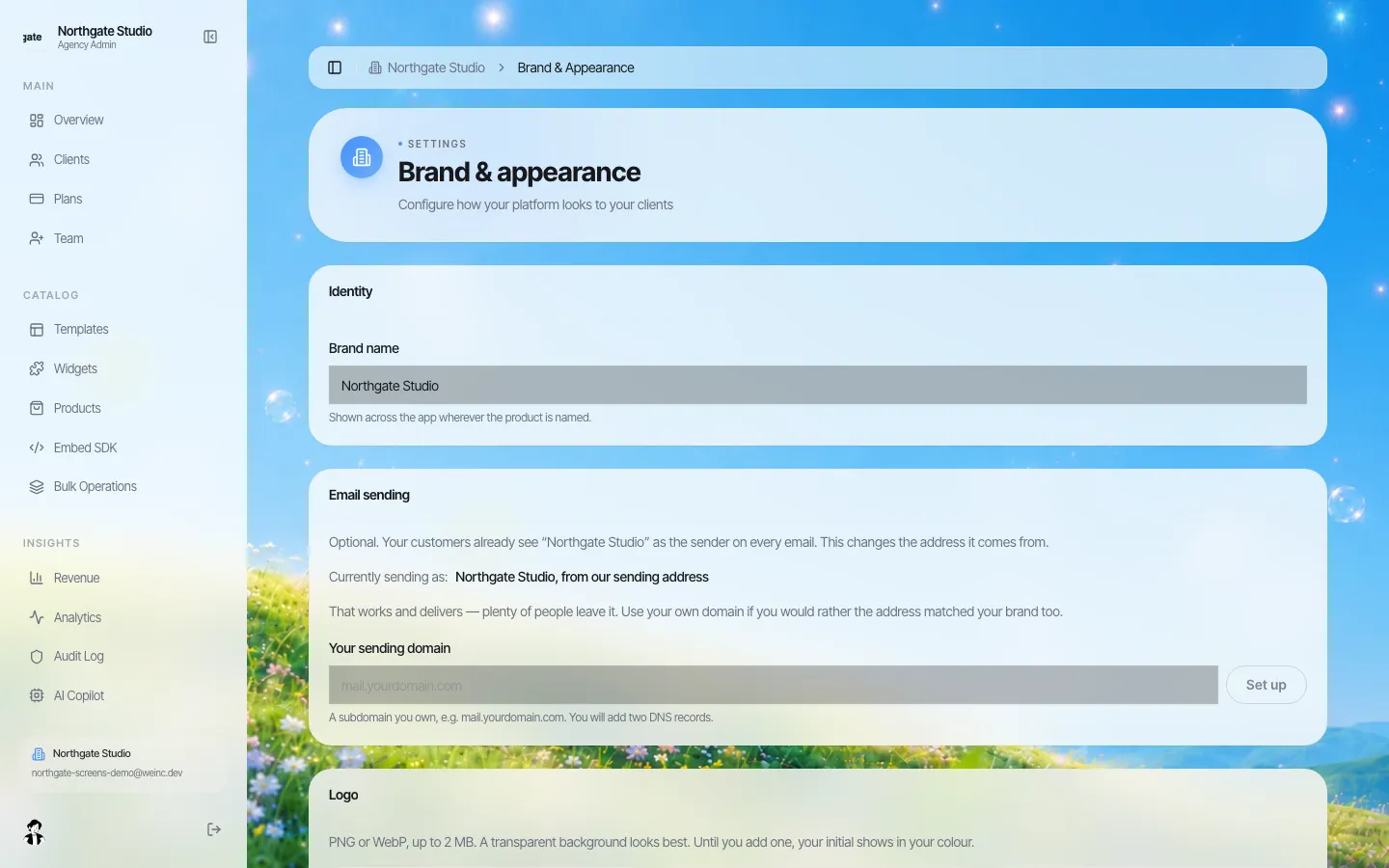
*Brand settings: your name, logos, favicon, colours, fonts and button styles. This is our demo brand.*
Your customer signs in on your web address, sees your logo and colours, gets emails from you, and asks your support team for help. The brand settings cover:
- Sign-in and sign-up pages in your design.
- The client dashboard and help pages, which show your support contact, not ours.
- System emails (invitations, "your website is ready", receipts) in your layout and, once you set it up, from your own sending address. See branded client emails.
- Custom domains for your portal and, if you allow it, for each customer's site.
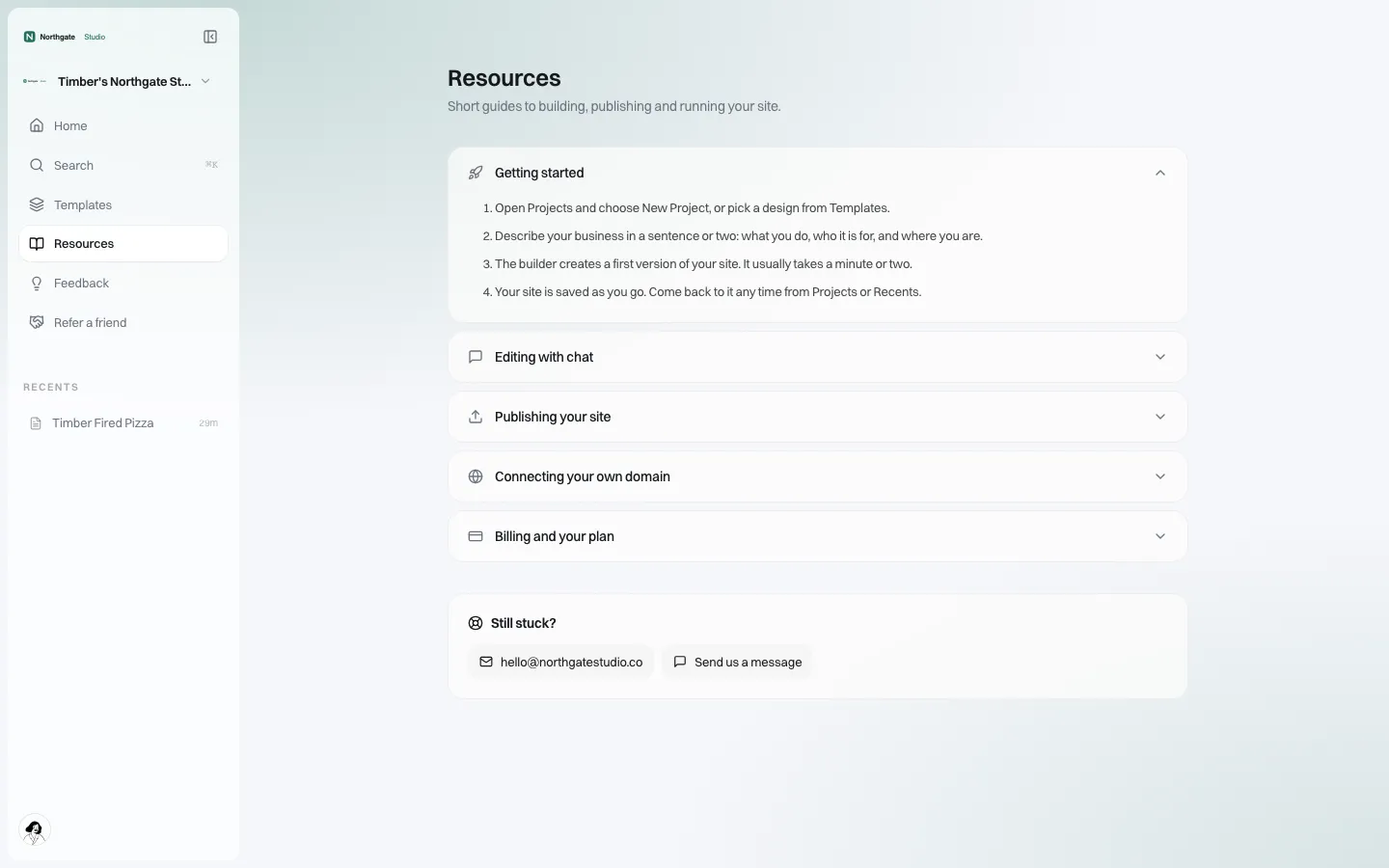
*The help page your customer sees, with your support address.*
Integration: making the site part of your product
The real value for a marketing vendor is not the site on its own; it is what your product can do once it knows the site exists.
Webhooks
We.Inc sends webhook events to an endpoint you control. Events in the code today include a client being created, invited, updated, paused, resumed, removed or restored; plans being created, updated, archived or deleted; a site being published; and a publish request being approved or rejected. There is a test button and a delivery log.
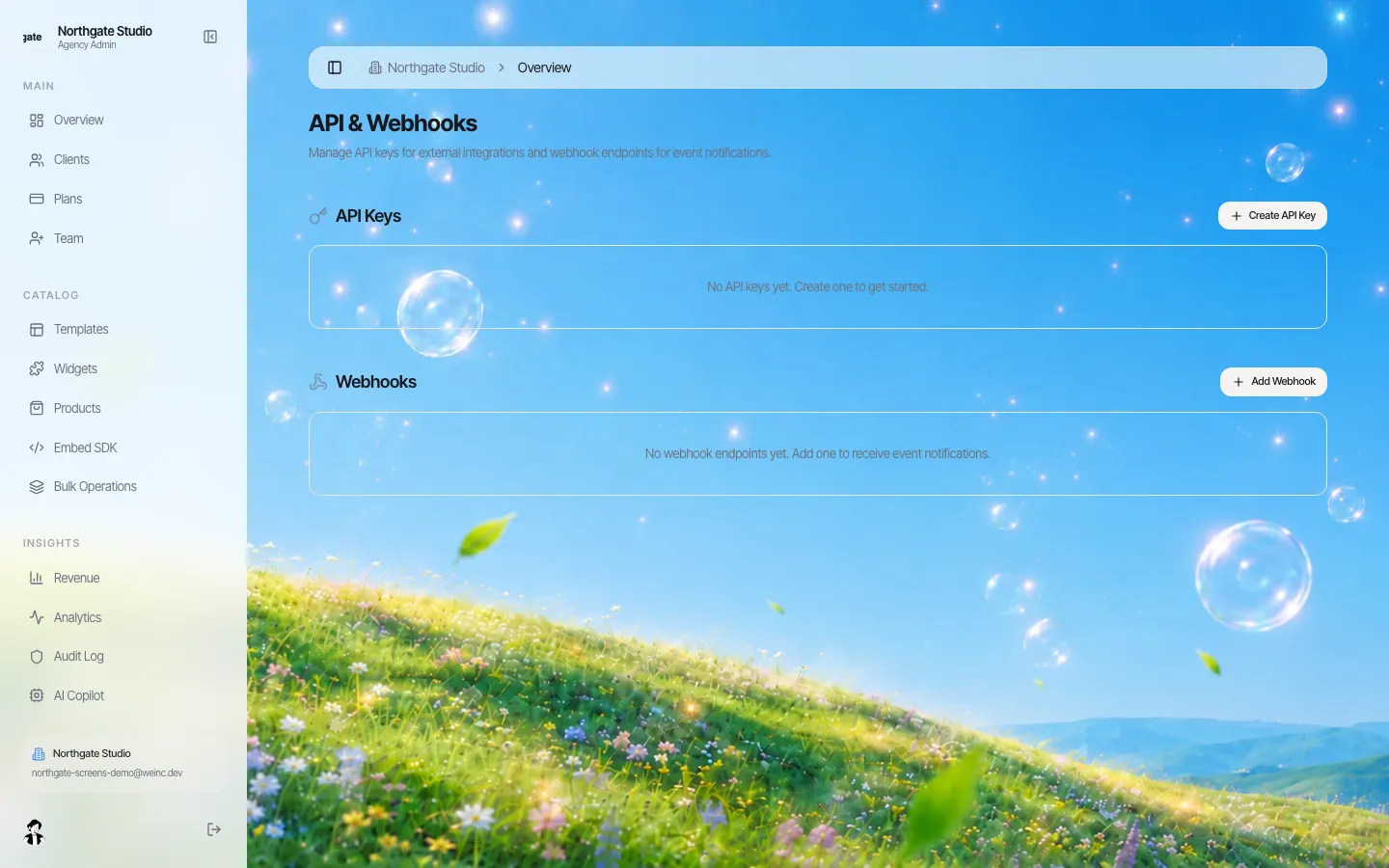
*API keys and webhooks on the brand side.*
Ideas that use only those events:
- When site.published arrives, start your SEO tool's first crawl of the new site, or turn on the "add a review widget" task in your onboarding checklist.
- When client.created arrives, create the matching account in your product, so the customer never fills in two sign-up forms.
- When client.paused arrives, flag the account for your success team.
We do not send a webhook for every form submission today. If your product needs leads from the site, ask on the demo how your form or widget fits.
Embedding inside your app
If you would rather customers never leave your product, the builder can be embedded. The embed settings let you list the web addresses allowed to host it, set theme colours and fonts, switch features such as the code view or deploy on or off, choose which templates appear and cap projects per user. The details are on our embedding page.
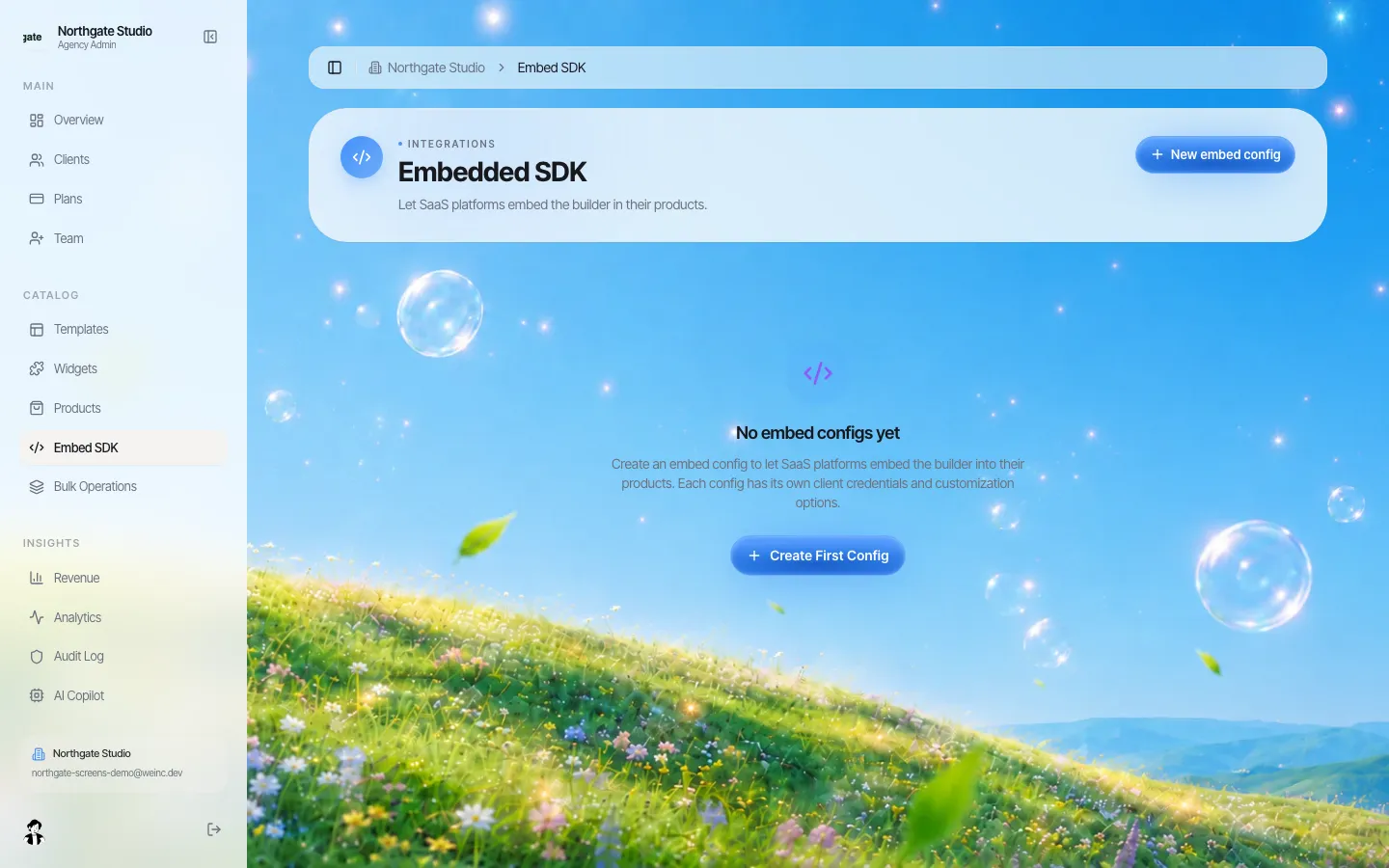
*The embed settings screen (empty in the demo).*
Reporting that supports your story
Marketing software lives or dies on "is it working?". We.Inc can send each customer a monthly report email under your brand with last month's visitors, top pages and the change on the month before. It is off until you switch it on. You also get an insights view across all your customers: sign-ups, sites and visits.
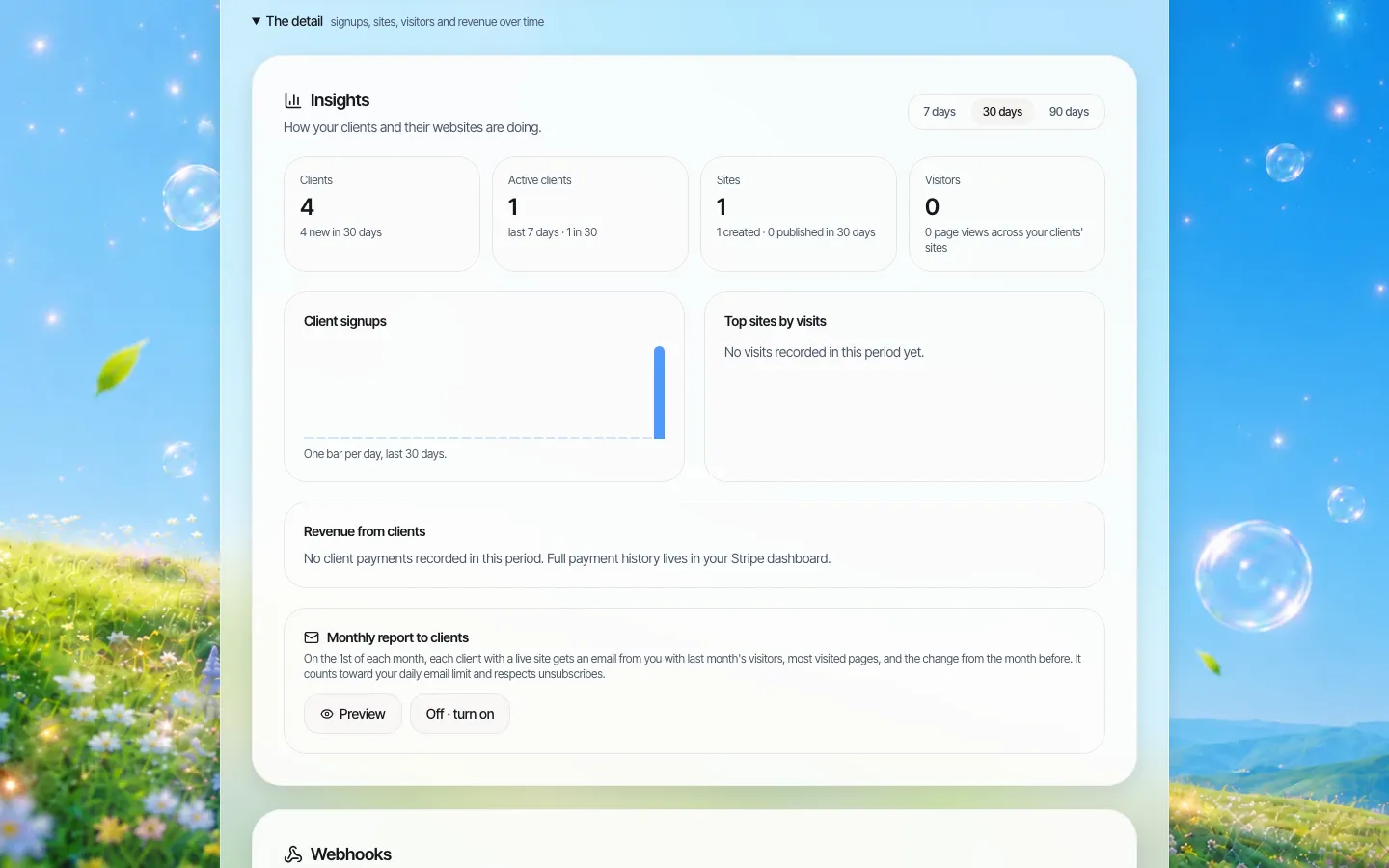
*Insights across the brand. The demo has very little data.*
See client analytics for detail.
Guard-rails for customer content
Two risks come with putting websites in the hands of many small businesses under your name.
Fake or misleading reviews. In the US, the FTC's rule on consumer reviews and testimonials (16 CFR Part 465) took effect on 21 October 2024 and bans practices such as fake reviews and testimonials. If you sell review software, your customers' sites are where those reviews appear. Make the rule part of your onboarding.
Thin pages at scale. Google's spam policies describe scaled content abuse as "when many pages are generated for the primary purpose of manipulating search rankings", and doorway abuse as pages "created to rank for specific, similar search queries". An SEO tool that encourages customers to spin out a page per town works against them. Tell customers to write pages only they could write.
Per-client switches help you set the default: who can publish, whether they can edit SEO settings, whether they can add a blog, and whether publishing waits for your approval. See client permissions.
A pilot that tells you whether it reduces churn
- Pick 30 to 50 small customers with no site or a site they cannot edit.
- Offer each a site under your brand, set up on an onboarding call.
- Wire site.published into your product so the success team knows which accounts went live.
- After 90 days compare product usage and cancellations against a matched group that was not offered a site.
- Decide on the numbers, not on how good the sites look.
When this is not for you
If most of your revenue comes from mid-market or enterprise accounts with their own web teams and content systems, a website builder will not matter to them. If your product already has a page builder customers like, extending it may beat adding a second editor. We would rather say so on a call than sell you something you will not use.
Sources
- US Federal Trade Commission, "The Consumer Reviews and Testimonials Rule: Questions and Answers" and the final rule notice for 16 CFR Part 465 (effective 21 October 2024). ftc.gov
- Google Search Central, "Spam policies for Google web search": scaled content abuse and doorway abuse definitions. developers.google.com/search/docs/essentials/spam-policies
Last checked 2026-10-25. Not legal advice.
Book a demo to see your brand on the client portal.
Book a demo. Pricing is tailored to your volume and setup, and you get your exact price on the call. 0% transaction fee.
Frequently asked questions
Can our product react when a customer publishes a site?
Yes. We.Inc sends a site.published webhook event to your endpoint, alongside events for clients being created, invited, paused or removed and for publish approvals.
Do form submissions on customer sites reach our product?
There is no webhook for each form submission today. Ask on the demo how your own form or widget can sit on the site instead.
Will our customers see the We.Inc name?
The sign-in, dashboard, help pages and system emails carry your brand. The support contact shown is yours.
Can we embed the builder in our app instead of a separate portal?
Yes. The embed settings control allowed host addresses, theme, which features are shown, which templates appear and project limits per user.
Keep reading
- White label website builder: the We.Inc platform
- White label website builder for SaaS platforms
- Embedding a website builder in your product
- Branded client emails
- Client analytics and monthly reports
- Client permissions: what each site owner can do
More in White Label
- Your listed businesses need websites. You already know who they are.
- Every loan officer wants a website. Every one of them is an advertisement.
- Running fifty websites is a different job from running one
- Affiliate websites when every affiliate has its own board
- Your instructors want a website. Make sure it is yours, not a competitor’s
- Should a payments company give its merchants a website?
- Candidate websites for every customer on your campaign platform
- White-label website builder pricing
We.Inc is an AI-powered website builder you can resell under your own brand. Launch a branded client dashboard, bill on Stripe Connect, and deliver AI-generated websites in minutes. White-label pricing is tailored to your volume and setup: book a 30-minute demo for a quote.
Product
- AI Website Builder: Describe a site in plain English; it's live in minutes
- White Label Platform: Your brand, your domain, your margin
- Enterprise: SSO, custom SLAs, and dedicated support
- Developer API: Embed site generation into your SaaS
Who It's For
- For Agencies: Resell under your brand
- For Freelancers: Your own branded builder
- For Hosting Providers: Add a builder to your stack
- For SaaS Platforms: Embed site creation via API
- For Startups
- For Financial Services
- For Healthcare
Features
- Drag & Drop Editor
- Built-in SEO Tools
- Custom Branding
- Client Dashboard
- Reseller Billing (Stripe Connect)
Resources
- Blog
- Help Center
- Free Business Tools
- Free UI Components
- Website Templates
- Template Collections
- Website Examples
- Guides
- Comparisons
- Alternatives
- Best Lists
- Reviews
- Pricing Guides
- Use Cases
- Glossary & Guides
- Integrations
- Developers
- Benchmark
- Windows App