A website for every advisor, without losing the network's name
Independent travel advisors sell on trust: their name, their niche, the trips they have taken themselves. Host agencies and networks want each advisor to have a real website for that reason, but they also carry the registration numbers, supplier relationships and disclosures that every one of those sites must get right. Here is how to give advisors freedom without giving up the parts the network is answerable for.
TL;DR
- Advisor sites fail in two ways: they never launch, or they launch with missing disclosures and copied supplier text.
- Each advisor gets a client account under your network brand, with an AI site builder they describe in plain words and switches you control.
- Agree up front who owns the domain and content when an advisor moves to another host. The site code can be downloaded either way.
- We.Inc does not do bookings, CRM or commissions. It runs the advisors' websites. Book a demo with three of your advisors in mind.
Why most advisor websites never get finished
Ask any host agency how many of its advisors have a website they are proud of. The usual answer is "fewer than you would think", and the reasons repeat:
- Time. Advisors are paid on bookings, not on page copy. A website that takes a weekend to build is a website that never gets built.
- Templates that all look the same. If the network's tool gives every advisor the same supplier-heavy page, advisors would rather use a social profile.
- Fear of getting compliance wrong. Advisors are not sure what the network requires on the site, so they avoid publishing.
- Ownership worries. Experienced advisors hesitate to invest in a site that the host owns and might keep if they leave.
A platform will not fix the first and last points by itself. Your onboarding and your advisor agreement do most of that work. What the platform can do is make the site quick to build in the advisor's own words, and let the network check the parts it is answerable for.
Settle ownership before the first site
Write this into the advisor agreement and the onboarding pack, in plain words. Advisors who know the answer invest more in their sites.
| Item | A common, fair split |
|---|---|
| The advisor's personal domain (for example janesmithtravel.com) | Registered in the advisor's name; it leaves with them |
| A subdomain or path on the network's domain | Owned by the network; it stays |
| Trip reports, photos and blog posts the advisor wrote | The advisor's work; the advisor can take a copy |
| Supplier images and descriptions | Licensed through the network or the supplier; check whether that licence follows the advisor |
| The network's logo, registration numbers and disclosures | Removed when the advisor leaves |
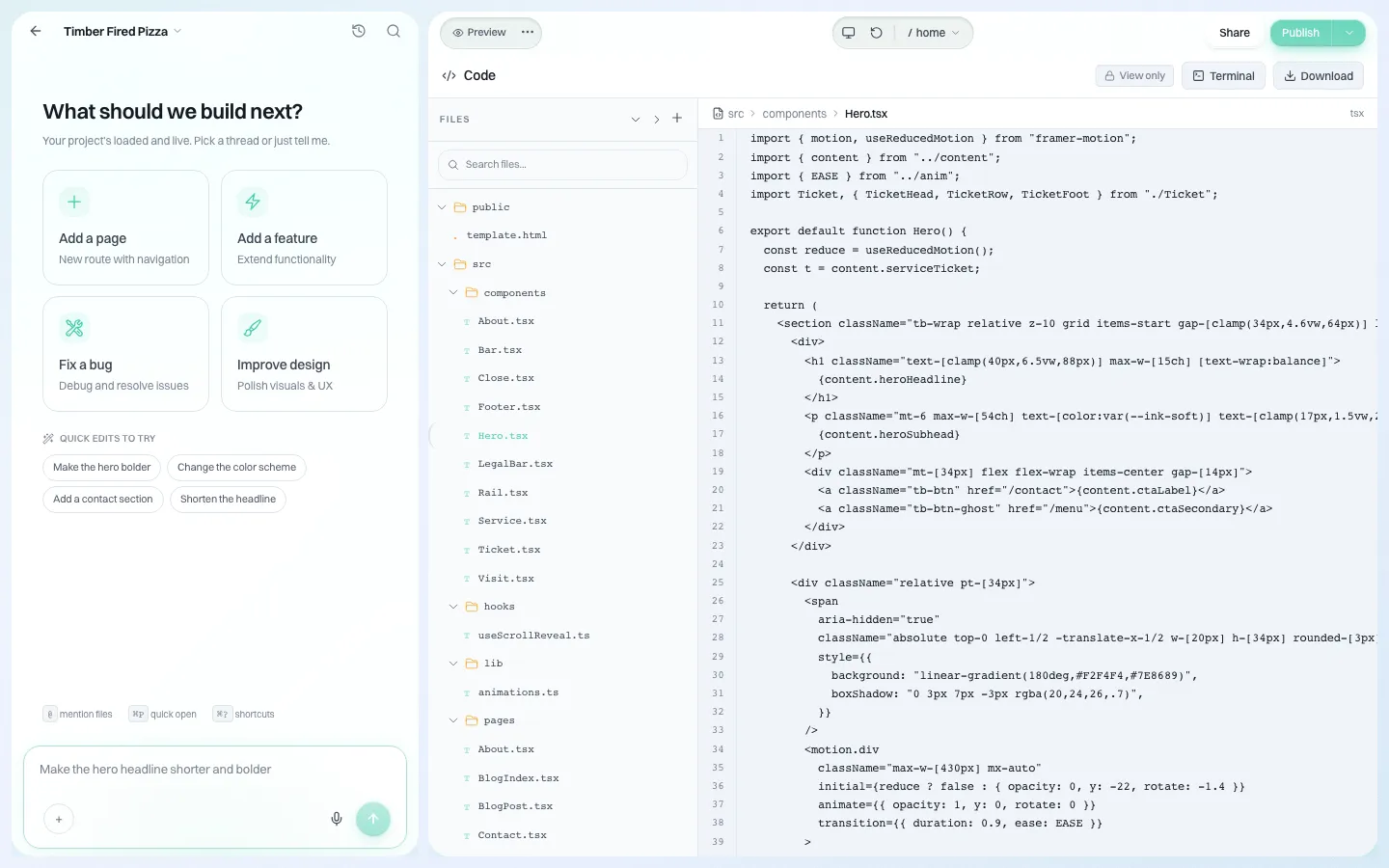
*Each site's code can be downloaded as a ZIP or exported to GitHub. Agreeing in advance that departing advisors get a copy of their own work removes the biggest reason they hold back.*
Whatever you decide, record it. The website vendor exit plan has clause wording you can borrow for the advisor side.
Disclosures the network should own
General information, not legal advice. Your counsel should confirm what each state and each country you sell into requires.
Seller-of-travel registration. Several US states run seller-of-travel programmes. California, for example, requires a registered seller of travel to display its registration number in advertising for air or sea transportation or travel services, and independent agents who advertise under the registrant's number are named in the registration. Many host agencies therefore have a standard disclosure line that must appear on every advisor site. Florida, Washington and Hawaii have their own programmes with their own rules; collect the list that applies to your network once, centrally.
Total price on lodging offers. The FTC Rule on Unfair or Deceptive Fees, in effect since May 12, 2025, covers short-term lodging. Advisors who publish "from" prices for hotels or rentals on their sites should show the total including mandatory fees. Package pricing that includes taxes and port charges is a separate question for your counsel; the safe habit is not to advertise a number you have not checked that day.
Supplier content. Cruise lines, tour operators and hotel brands license their images and descriptions under terms. Advisors often copy them from a supplier portal without checking. Two habits help: keep a shared folder of approved supplier assets, and ask advisors to write their own words about trips they have taken. The second is also better for search: an advisor page that repeats a cruise line's paragraph adds nothing that the cruise line's own page does not.
How the network keeps the required parts in place
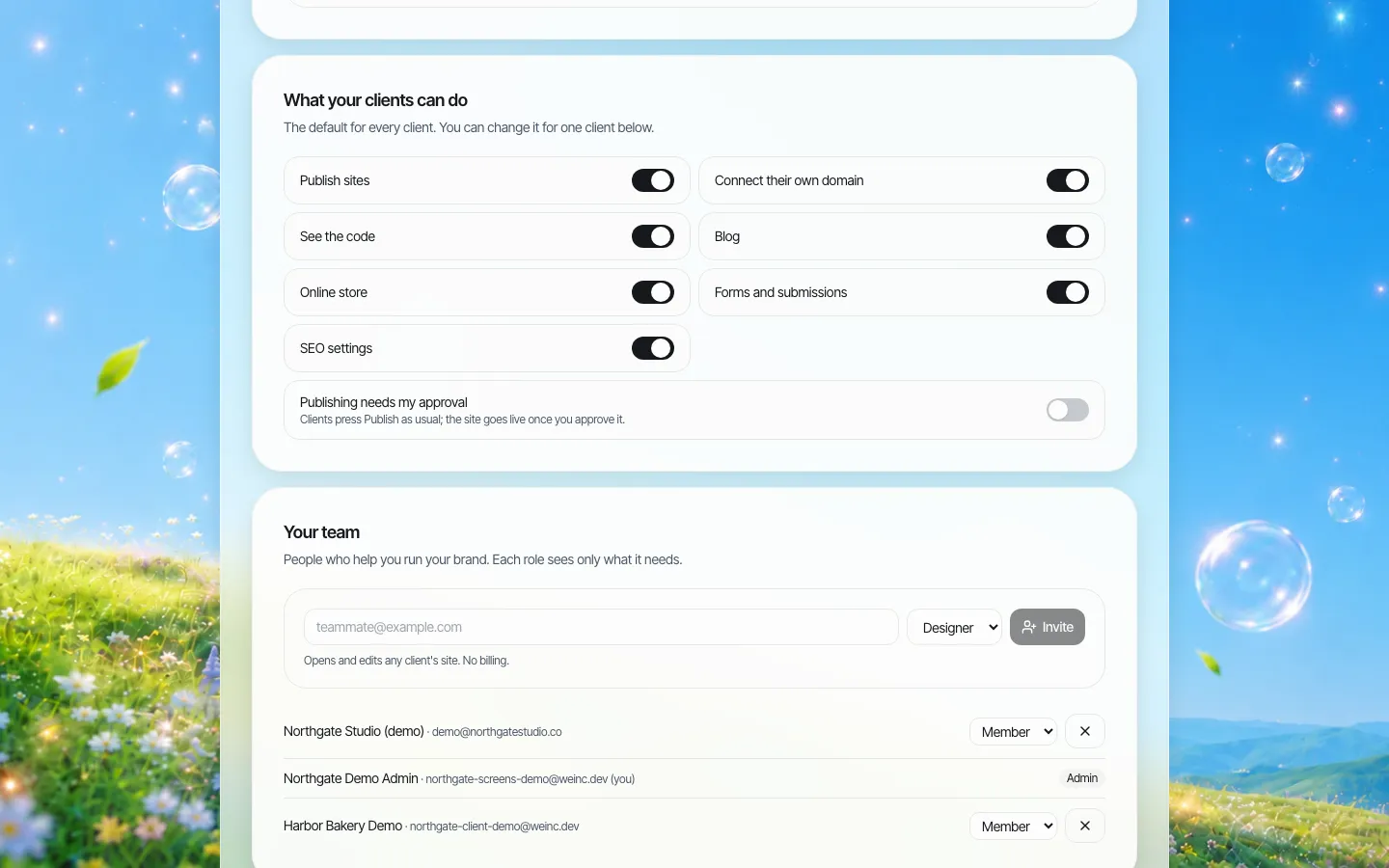
*Network-wide defaults. Every new advisor starts with these settings, and you can change them for one advisor at a time.*
In We.Inc your network runs the branded account; each advisor is a client account with their own site. For each advisor you choose whether they can publish, connect their own domain, see the code, run a blog, an online store, forms and SEO settings. You can also require approval before publishing, a single-step check before an advisor's site goes live.
A workable rollout uses approval for the first publish only:
- A new advisor builds their site and submits it.
- Someone in advisor support checks the registration line, the disclosure text, supplier images and any price claims.
- Approve, then switch approval off for that advisor so routine updates (a new trip report, a group departure) go straight out.
- Turn approval back on for an advisor whose site causes a complaint.
The client permissions page walks through how defaults and per-advisor overrides combine.
The advisor's side: describing a site, not designing one
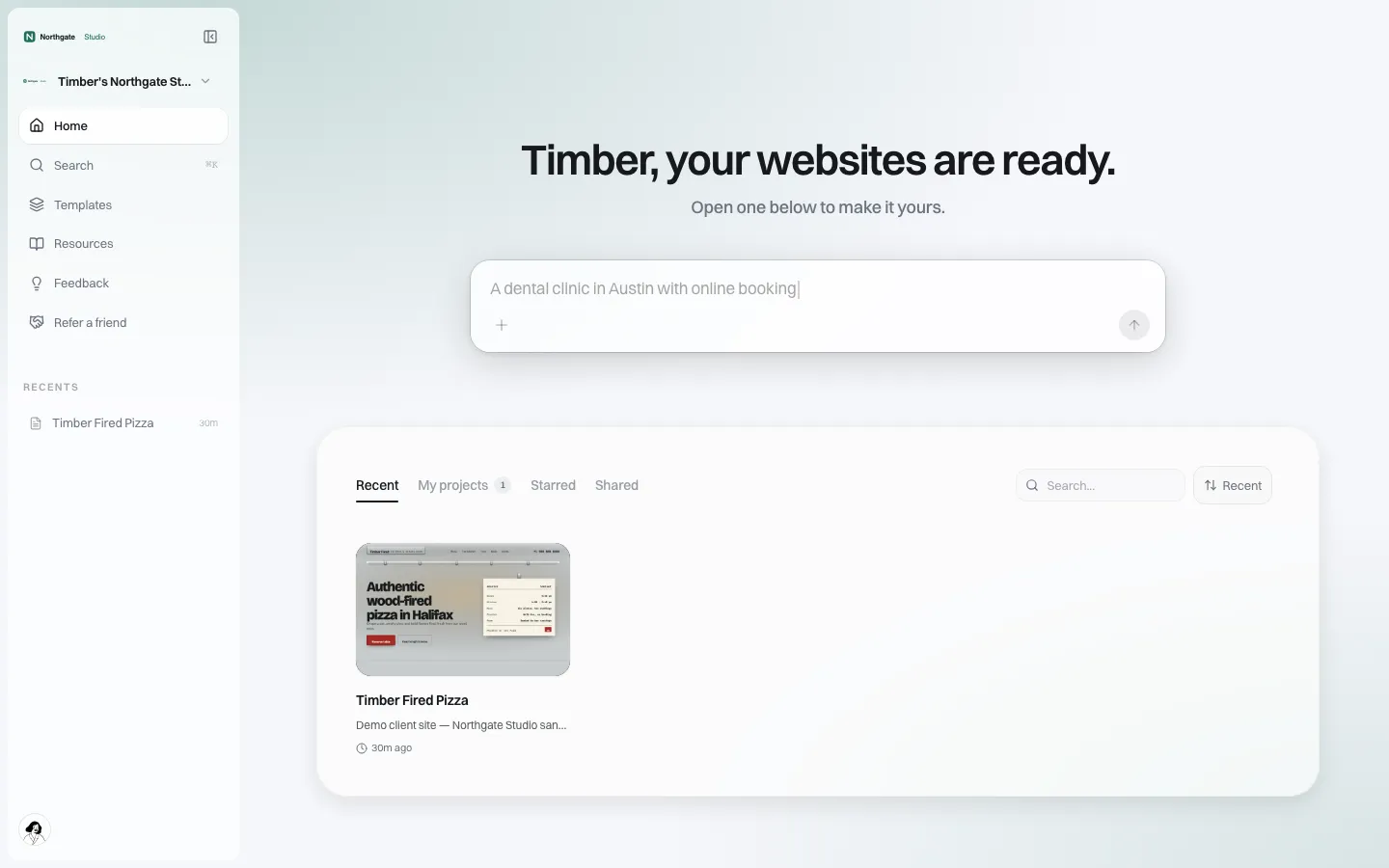
*What an advisor sees after signing in on your network's address: their sites and a box to describe what they want.*
Advisors build by describing what they sell: "I plan honeymoons in the Caribbean and small-ship cruises in the Mediterranean, I am based in Austin, and I want my trip reports front and centre." The AI builds a first version; the advisor then changes it in plain words or in a visual editor where they click a heading or button and edit it directly.
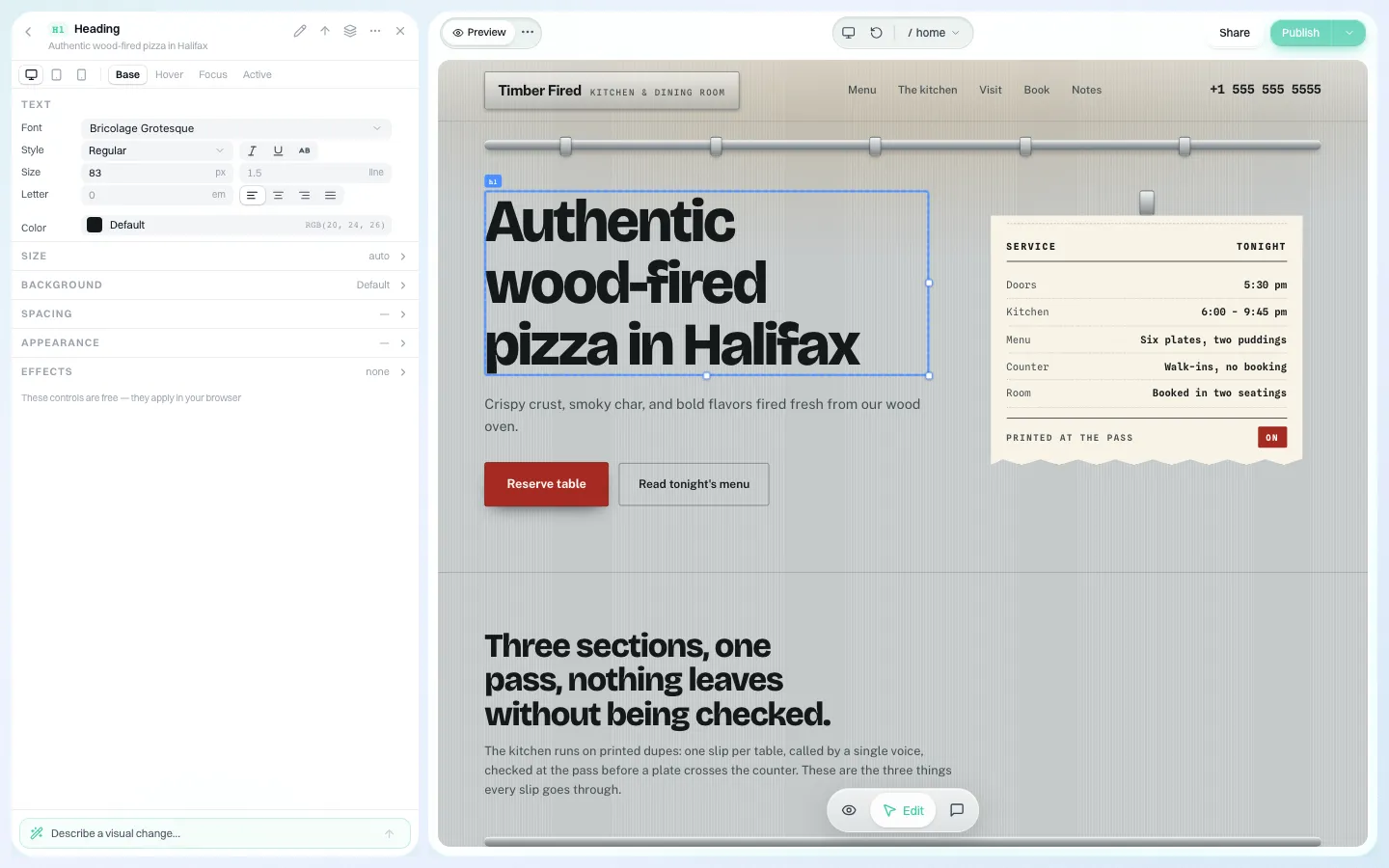
*The visual editor. Advisors who prefer clicking to describing can change text, fonts and colours directly.*
A few page ideas that work better than a generic "destinations" grid:
- A niche page per specialism (accessible travel, multigenerational trips, culinary tours) written from the advisor's own trips.
- Trip reports on the blog, with the advisor's photos. These are the pages that win searches for "travel advisor who has been to…".
- A clear enquiry form that asks the questions the advisor needs (dates, budget band, who is travelling). The forms switch controls whether an advisor can collect submissions.
- A "how I am paid" page. Clients increasingly ask, and advisors who explain fees and commissions plainly tend to win trust.
Rolling out to hundreds of advisors
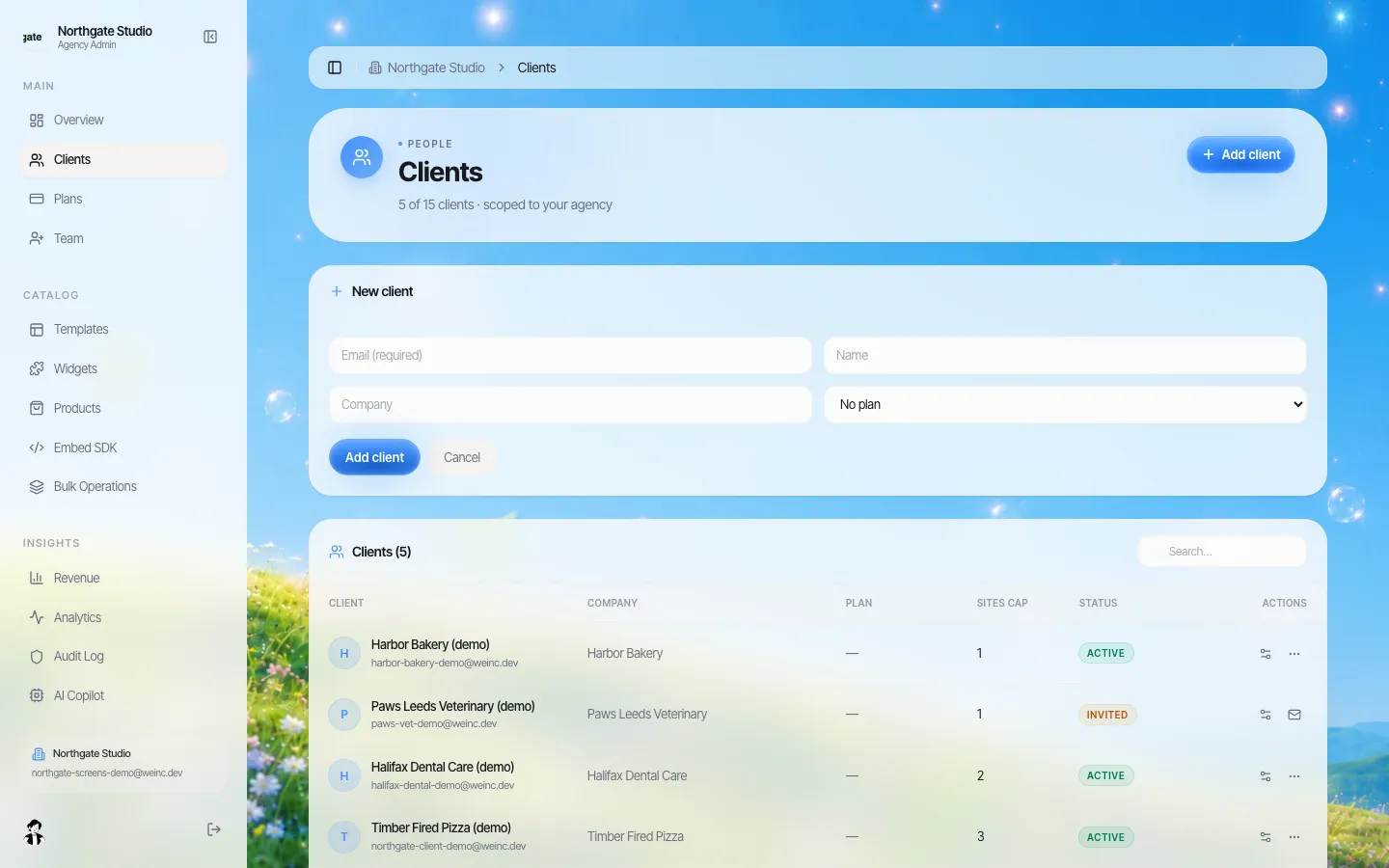
*Inviting one advisor. The invitation goes out in your network's name, not ours.*
Networks rarely onboard everyone at once. A cohort approach works better:
| Week | What happens |
|---|---|
| 1 | Invite 10 to 20 volunteer advisors with different niches. Collect what confused them. |
| 2-3 | Fix your onboarding notes and disclosure text. Write two example sites with real advisors. |
| 4 onward | Invite advisors in monthly cohorts, timed with your training calls. |
| Ongoing | Each month, look at who signed up but has not published, and offer help. |
Networks that use their own tools can follow this automatically. We.Inc sends webhook events when an advisor signs up, creates their first site, publishes, or has not published seven days after joining, and there is an API to list and create client accounts. Those events can feed the CRM or advisor-success tool you already use.
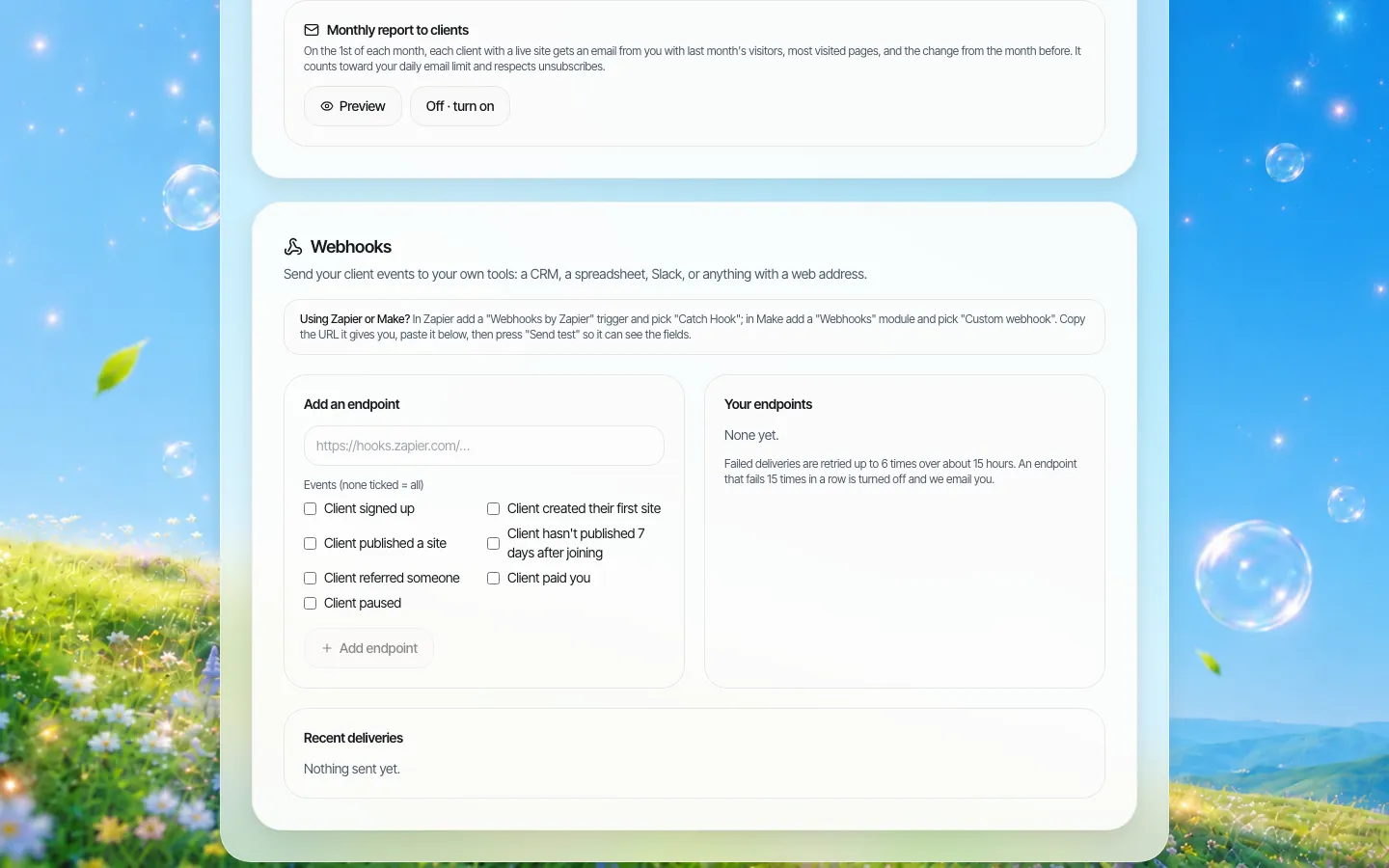
*Webhook settings. Events about advisors can go to your own systems or to Zapier or Make.*
Where We.Inc is not the right fit
Be clear about the edges. We.Inc is a website platform. It is not a booking tool, a supplier content feed, a CRM, a commission tracker or a GDS. If your advisors need live inventory and pricing feeds inside their websites, a travel-specific website product connected to supplier data will serve them better, and some consortia include one with membership. We.Inc fits networks that want advisors to have distinctive, personal sites under rules the network sets, with the booking tools kept separate.
Book a demo and bring three advisors: a new one, a high performer, and one who has resisted building a site. We will show how each would get started.
Sources
Last checked 2026-10-25.
- State of California, Office of the Attorney General, Seller of Travel: Business and Professions Code sections 17550 to 17550.59, including section 17550.20 on display of the registration number.
- State of California, Office of the Attorney General, Seller of Travel: frequently asked questions for registrants.
- Federal Trade Commission, FTC Rule on Unfair or Deceptive Fees to Take Effect on May 12, 2025, press release.
- Federal Trade Commission, Trade Regulation Rule on Unfair or Deceptive Fees (16 CFR Part 464), final rule text.
This section is general information, not legal advice.
Book a demo. Pricing is tailored to your volume and setup, and you get your exact price on the call. 0% transaction fee.
Frequently asked questions
Who should own a travel advisor's website, the advisor or the host agency?
A common fair split is that the advisor owns their personal domain and their own writing and photos, while the host owns any domain or path it provides and its logo and disclosures. Put the answer in the advisor agreement before the first site is built.
Do advisor websites need a seller-of-travel registration number?
In some states, yes. California, for example, requires a registered seller of travel to display its registration number in advertising for travel services. Ask your counsel which states apply to your network. This is general information, not legal advice.
Can the network check an advisor's site before it goes live?
Yes. Approval before publishing can be the default for new advisors and switched off per advisor once their first site has been checked. It is a single approval step.
Does We.Inc handle bookings or commissions?
No. We.Inc runs the advisors' websites. Bookings, supplier inventory, CRM and commissions stay in the tools you already use.
Can an advisor take their website when they leave?
The site code can be downloaded as a ZIP or exported to GitHub. Whether the advisor takes it, and which parts, should be set out in your advisor agreement.
Keep reading
- White label website builder: the We.Inc platform
- Client permissions: what each site owner can do
- Manage many client websites from one account
- Custom domains for every client site
- Code export and no lock-in
More in White Label
- Websites for every local, and for every member who runs a practice
- Websites for every department, lab and event, under one university brand
- A Vendasta alternative for agencies whose product is the website
- Your customers already run their business in your software. Should their website live there too?
- Can you white label Webflow? No. Here is the alternative.
- The white-label website builder for agencies
- A listing gets a wedding vendor found. A website gets them booked.
- A website program for the retailers you supply
We.Inc is an AI-powered website builder you can resell under your own brand. Launch a branded client dashboard, bill on Stripe Connect, and deliver AI-generated websites in minutes. White-label pricing is tailored to your volume and setup: book a 30-minute demo for a quote.
Product
- AI Website Builder: Describe a site in plain English; it's live in minutes
- White Label Platform: Your brand, your domain, your margin
- Enterprise: SSO, custom SLAs, and dedicated support
- Developer API: Embed site generation into your SaaS
Who It's For
- For Agencies: Resell under your brand
- For Freelancers: Your own branded builder
- For Hosting Providers: Add a builder to your stack
- For SaaS Platforms: Embed site creation via API
- For Startups
- For Financial Services
- For Healthcare
Features
- Drag & Drop Editor
- Built-in SEO Tools
- Custom Branding
- Client Dashboard
- Reseller Billing (Stripe Connect)
Resources
- Blog
- Help Center
- Free Business Tools
- Free UI Components
- Website Templates
- Template Collections
- Website Examples
- Guides
- Comparisons
- Alternatives
- Best Lists
- Reviews
- Pricing Guides
- Use Cases
- Glossary & Guides
- Integrations
- Developers
- Benchmark
- Windows App