
The website builder made for insurance agents.
The fastest way to get an insurance agent website live is to describe your agency to we.inc in plain English (lines of coverage, your state, your carrier appointments) and let the AI draft the pages. A site publishes on a we.inc address at no cost; paid plans start at $20 a month on Starter.
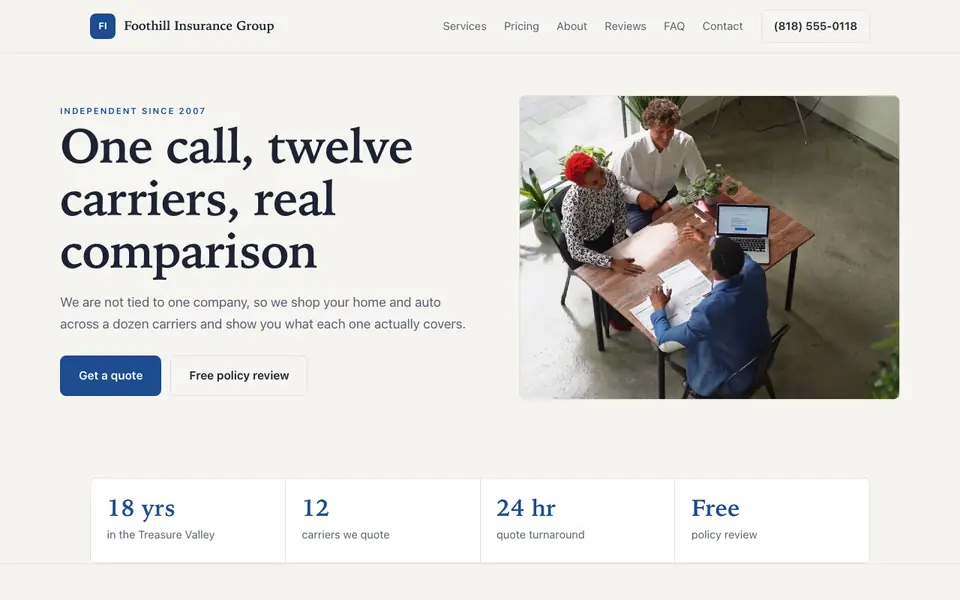
An insurance website for your agency with coverage pages, a quote request form, and your license details, written and built by AI from a short description.
Pages every insurance website needs
- Coverage / Lines of Business: Separate pages or clear sections for auto, home, life, business, and umbrella policies help visitors and Google understand exactly what you sell.
- Get a Quote: A form asking for name, contact info, coverage type, and current provider is the single highest-converting element on an agent site; route submissions to your email or CRM.
- Licensing & Carriers: List your state license number(s), the states you are licensed in, and the carriers you're appointed with. Consumers and some state bars check this before calling.
- About / Meet the Agent: Insurance is a trust purchase. A photo, your background, and how long you've served the area does more work here than on almost any other business type.
- Claims Help: A simple page explaining what to do after an accident or loss, with your after-hours contact, reduces panicked calls and shows you're prepared for the worst day, not just the sale.
- Reviews / Testimonials: Real client reviews (with permission) matter more for insurance than almost any other local service because buyers can't easily compare policy language themselves.
Try this prompt
A website for an independent insurance agency in Columbus called Heartland Coverage Group, selling auto, home, and small business policies, with a quote request form, a page listing our Ohio license number and carrier partners, and a claims help page.
Should my site have a separate page for each line of insurance?
Yes, one page per line you actually write: auto, home, life, commercial and so on. People search for the product, not for agents, so a page called "home insurance in your town" can be found where a general services page cannot. On each one, say which carriers you quote, what details you need to start, and what a renter or first-time buyer should ask before choosing cover.
How do I explain that I am independent rather than captive?
Say it in one plain line near the top: you compare policies from several companies instead of selling one brand. Then show it with a short list of the carriers you are appointed with. Shoppers often do not know the difference, so a two-sentence explainer on the about page helps. Check that your carrier agreements allow their names and logos to be used before you add them.
What should happen after someone sends a quote request?
They should know exactly when you will call. The form on your site sends the request to your email, so put a clear promise on the thank-you message, such as a reply within one business day, and keep it. Ask only for what you need to start the first conversation. Policy numbers, birth dates and licence details are better collected over the phone or through your carrier's own secure system.
Local search for an insurance agency
People shopping for cover usually search the product plus their town, such as "renters insurance Tulsa", and compare two or three agents before calling. These are the moves that put your agency in that short list.
One coverage page per product, with the town in the copy
Write about the risks local households and businesses actually face: flood zones, hail, older housing stock or a farm economy. That detail is what separates your home insurance page from a carrier's national one.
Check your carrier's rules before claiming a listing
Captive agents often have to follow the parent company's policy on Google listings and websites, and some provide an approved agent page already. Read your agreement first so you do not end up with a profile you have to take down.
Keep your name and address identical everywhere
Your agency name, address and phone should read the same on your site, your Google profile, your state licence lookup and directories. Mismatches between an old office and a new one are common after a move and quietly weaken rankings.
Publish the questions you answer on the phone
A short article on "does my policy cover a rental car" or "what changes when I add a teen driver" answers a real local search and gives you something useful to send clients. Keep advice general and point people to call for their own policy.
Website options for an independent insurance agent
Captive agents often get a carrier-provided page, while independent agents need their own site that explains the lines they write and makes asking for a quote simple. The usual choices are an insurance website vendor, the carrier page, or a self-managed site.
| Option | Good for | Watch out for |
|---|---|---|
| Insurance website vendors such as Agency Revolution | Agency templates, coverage content and email marketing aimed at retention. | Monthly fees, and coverage pages are often the same text many agencies use. |
| Carrier-provided agent pages | Free or low-effort and already approved by the carrier. | Limited to that carrier's products and branding, and you cannot take the page with you. |
| Wix or Squarespace | Full control and low cost. | Writing clear pages for each line of coverage, and a sensible quote form, is left to you. |
| we.inc | Describe the lines you write and the areas you serve to get coverage pages, an about page and a quote request form. | It does not rate or bind policies; quotes still come from your agency management and comparative rating tools. |
Have a licensed person review coverage descriptions before publishing, since your state may regulate how they are worded.
Inside the Foothill Insurance Group example agency site
Foothill Insurance Group is an independent agency our AI invented from a single sentence, not a real firm. Its pages show how an agency site answers the questions a shopper has before they will hand over a current policy.
A coverage list split into personal and commercial lines
Home, auto, business, umbrella and life each get their own entry with a short note on what gets compared. Shoppers scanning for one product find it at a glance, and a contractor looking for workers compensation sees straight away that the agency writes commercial cover.
Quote and policy review as two separate starting points
Some visitors want a fresh quote, others just want someone to look over what they already pay for. Offering a free annual review alongside the quote button catches the second group, who are often the easiest to win at renewal time.
Licensing and carrier detail kept honest
Agents must hold a producer licence in each state where they sell, and many states expect the licence number to be easy to find. Put it in the footer or about page, and only list carriers you are actually appointed with.
Foothill Insurance Group
This is Foothill Insurance Group, an insurance business we described to the AI in a sentence. See the Foothill Insurance Group example site.
Start from this design
Three designs that suit an insurance website.
- Independent Insurance Agency
- Dark & Gold Litigation Law Firm
- Text-Led Management Consulting
Insurance website design without the agency retainer. Describe the business in plain English and the AI writes and builds the pages around it: your services, your prices, your words.
Perfect for:
- Insurance brokers
- Life insurance
- Business insurance
License numbers are not optional
Most states require agents to disclose their license number somewhere a consumer can find it, and many carriers require it in marketing materials. Put it in the footer or on an About/Licensing page next to the states you're licensed in, not buried in fine print. This also builds trust with shoppers who are comparing agents.
Quote forms beat phone-only pages
Agents who only list a phone number lose the after-hours shopper who is comparing three sites at 9pm. A short quote form (name, ZIP, coverage type, current carrier) that emails you the lead captures that traffic without you doing anything extra.
Independent vs. captive agents need different copy
A captive agent (State Farm, Allstate) should lean on the parent brand's trust and focus the site on local service and availability. An independent agent should lead with the number of carriers you shop and the fact that you compare rates for the client, since that's the whole value proposition.
we.inc cannot process insurance applications or payments
The AI can build quote request forms, coverage explainer pages, and a claims-help page, but it cannot run bound policy issuance, premium payments, or an agency management system. Keep those in your existing AMS/CRM and link or embed where your carrier allows it.
What it costs
Beyond a domain (about $10 to $20 a year), most agents don't need extra tools for the website itself since quotes route to your existing agency management system by email. If you want the AI to write your coverage pages and keep editing them by chat, Starter at $20 a month covers most single-agent sites; multi-line agencies with several location or coverage pages typically fit better on Pro.
Building your site is free, no card needed. Paid plans from $20 a month. Compare plans
Frequently asked questions
How much does an insurance agent website cost on we.inc?
Building your site is free and needs no card. If you want AI to write the coverage pages and quote form copy for you and keep editing by chat, that starts on the Starter plan at $20 a month for 250 credits, plus roughly $10 to $20 a year for your own domain name.
Can I take insurance quote requests through the website?
Yes. The AI can build a quote request form that captures coverage type, ZIP code, and contact details and emails or routes it to you. We.inc does not run a bound-policy issuance system, so quotes and applications still get finalized in your agency management system.
Do I need to show my license number on the site?
Most states expect it and many carrier marketing guidelines require it. Add your license number and the states you're licensed in to your About page or footer; the AI can build that section for you.
Can I use my own domain name for my agency site?
Yes, on a paid plan: Starter and above include connecting your own domain, with SSL and hosting included. On We.Inc you can build your site free, with no card and no trial needed to start.
Will an insurance agent website actually help with local SEO?
A dedicated page per line of coverage (auto, home, life, business) with your city and state named naturally, plus a Google Business Profile that matches your site's name, address, and phone exactly, is what actually moves local rankings for agents. We.inc handles the on-page part; the profile and reviews are on you.
What makes good insurance web design?
Clear lines of coverage, each with its own quote button, your license numbers and states where shoppers can see them, and a plain answer to whether you are independent or captive. The example designs on this page are compared on exactly that journey.
Is there an insurance website template I can start from?
Yes. Building a site on We.Inc is free, with no card needed. Your own domain needs a paid plan (free to build, paid plans from $20 a month).
Can one site cover several agents or offices?
Yes. Ask the AI for an agents page with a card per agent and a page per office with its address, hours and phone. Each office page helps you show up for searches in that town.
Insurance web design: five agency designs, compared on the quote journey
Good insurance web design does three things: says which lines you write, shows you are licensed and independent (or captive), and makes asking for a quote easy. Below, four sample agency sites our AI built and one catalogue template, each read for how a shopper gets from the homepage to a quote.
How these were picked
Personal lines, life, home and commercial insurance samples from our library plus the Beacon Insurance template. Foothill Insurance Group is the lead demonstration; its carriers, reviews and figures are all made up. Checked 27 September 2026. Every design here is from the We.Inc library and is labelled as a sample or template. None is a customer site, and no entry claims results.
1. Foothill Insurance Group
Sample site built by our AI (made-up business). Open it
Task: A household comparing home and auto across carriers.
Design choice: Hero reads "One call, twelve carriers, real comparison" with "Get a quote" and "Free policy review" as the two buttons. Each line (home, auto, business, umbrella, life) is a card with its own "Free quote" link, and licensing (Idaho, Oregon, Washington) is listed under "Why independent".
Limitation: The quote links go to a contact form, not a rating engine. Keep real quoting in your agency system.
2. Tanner Kemp Life Insurance
Sample site built by our AI (made-up business). Open it
Task: A parent unsure whether they need term or whole life.
Design choice: Headline takes a position ("Most families need term, and we will tell you so") and the buttons are "Get quotes" and "Term or whole life". Products carry a from-price per month.
Limitation: Life only. A multi-line agency would need the home, auto and business cards added.
3. Cypress Row Home Insurance
Sample site built by our AI (made-up business). Open it
Task: A coastal homeowner checking whether wind and flood are covered.
Design choice: "Get a quote" sits next to "Check my coverage", and the services explain how homeowners, windstorm and flood policies fit together on one house.
Limitation: Written for one region's risks. Swap the storm copy for the hazards your market actually has.
4. Northgate Commercial Risk
Sample site built by our AI (made-up business). Open it
Task: A business owner whose contracts demand specific coverage.
Design choice: Opens on "Your contracts require coverage you may not have" with "Request a review", and every line is "Quoted per account" rather than priced.
Limitation: Commercial only, and its tone is too formal for a personal-lines storefront.
5. Independent Insurance Agency
Business template from the We.Inc library (demo site: Beacon Insurance). Open it
Task: An independent agency that wants a ready layout to start from.
Design choice: Beacon Insurance leads with "Auto · Home · Life · Commercial", a "12 carriers compared" line and one short block per line, then a quote request.
Limitation: Placeholder town, carrier count and copy. Replace every number with your own.
Task comparison
| Design | Home and auto quote | Life cover question | Business policy review |
|---|---|---|---|
| Foothill Insurance Group | Yes, card per line | Yes, one card | Yes, one card |
| Tanner Kemp Life Insurance | No | Yes, lead topic | No |
| Cypress Row Home Insurance | Home only | No | No |
| Northgate Commercial Risk | No | No | Yes, lead topic |
| Independent Insurance Agency | Yes | Yes, short block | Yes, short block |
Walkthrough: a homeowner asking for a bundled quote on the Foothill sample
- They land on "One call, twelve carriers, real comparison" and see "Get a quote" in the hero.
- "Coverage we write" shows home and auto as separate cards, each with a "Free quote" link and one line on what gets compared.
- "Why independent" answers the trust question: licensed in three states, twelve carrier appointments, claims advocacy included.
- The FAQ answers whether an independent agent costs more. Edit prompt to add what is missing: "Add our license numbers to the footer and a quote form that asks ZIP, coverage type and current carrier."
Copyable build brief
A website for [agency name], an [independent/captive] insurance agency in [city, state]. Lines we write: [auto, home, life, business]. One section per line with a quote button. A quote form asking name, ZIP, coverage type and current carrier. License numbers and states in the footer. A claims help page with our after-hours number. FAQ on independent vs captive and how bundling works.
What We.Inc does and does not do here
| Live rating and instant quotes | Not built in. The site collects quote requests; rating stays in your comparative rater or agency system. |
| Policy documents and client login | Not built in. Link your carrier or agency client portal. |
| Advertising compliance | We.Inc is not a compliance tool. Check license disclosures and carrier brand rules yourself. |
| Publishing for free | New We.Inc accounts can build a site free, with no card needed to start. No AI credits and no custom domain. |
| Having the AI write and change the site | Paid plans: Starter $20/mo, Pro $49/mo, Max $99/mo. You describe the business, then edit by clicking or by asking in chat. |
| Your own domain | Paid plans only. |
| Taking payments | Through your own Stripe account, so the money goes to you. We.Inc does not hold funds. |
| Forms | The AI builds contact and request forms. A synced booking calendar is not built in: link the scheduling tool you already use. |
What to adapt
- One card per line of coverage, each with its own quote button.
- License numbers and states where shoppers can find them.
- A plain answer to "independent or captive?"
What not to copy
- The sample carrier counts, reviews and years in business.
- Quoting prices your carriers have not approved.
Start from a suitable design
Start building this insurance agency website. Or check costs with the website cost calculator, test a current site with the website grader, and see pricing.
Related industries and website guides
- freelance website builder
- small business website design
- coaching website builder
- realtor website builder
- interior design website builder
- it service providers website builder
- insurance agents website examples
- Best website builders for insurance agents
Related website builders: Professional Services
- freelance website builder
- small business website design
- coaching website builder
- realtor website builder
- interior design website builder
- it service providers website builder
Before you start
- insurance agents website examples
- Best website builders for insurance agents
- how to make a website
- free website builder
- AI website builder
Related guides
Product
Who It's For
- For Agencies
- For Freelancers
- For Hosting Providers
- For SaaS Platforms
- For Startups
- For Financial Services
- For Healthcare
Features
Resources
- Blog
- Help Center
- Free Business Tools
- Free UI Components
- Website Templates
- Template Collections
- Website Examples
- Guides
- Comparisons
- Alternatives
- Best Lists
- Reviews
- Pricing Guides
- Use Cases
- Glossary & Guides
- Integrations
- Developers
- Benchmark
- Windows App